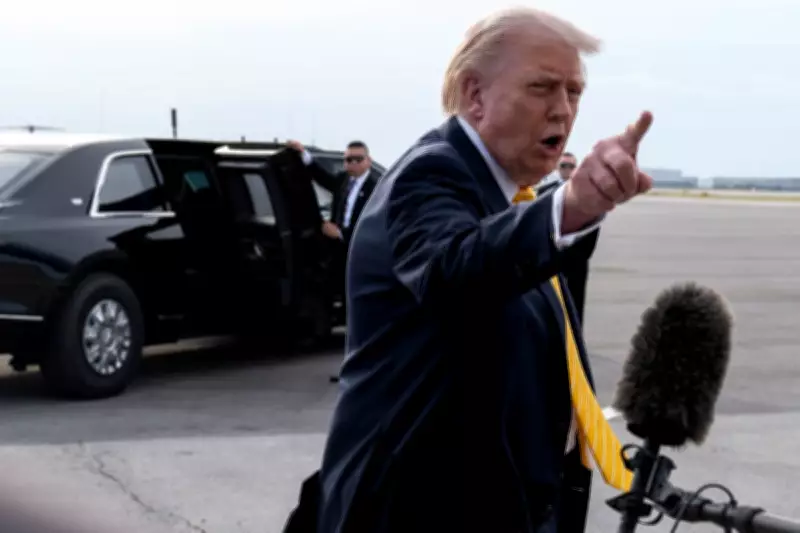
Donald Trump's latest threat to 'blow away' Iran underscores the limited options he faces as US president. His apocalyptic rhetoric, combined with his command of nuclear weapons, positions him alongside Vladimir Putin and Kim Jong Un as a global disruptor, warns world affairs editor Sam Kiley.
Trump's Threats: A Pattern of Bluster and Danger
Everything and nothing that Donald Trump says should be taken seriously. He has demonstrated both a willingness to follow through on threats and a tendency to back down. The hope is that when he threatens annihilation, he is merely throwing a tantrum rather than reaching for the nuclear button.
Any other world leader with access to doomsday weapons would provoke global horror. Trump has previously claimed he could 'totally destroy' North Korea, 'wipe out' Afghanistan, and warned that 'a whole civilization will die tonight' in Iran. His latest ultimatum: Iran would be 'blown off the face of the earth' if it targets US military assets in the region.

Condemnation and Comparisons
Trump's threats against Iran, more directly apocalyptic than any made by Tehran's leaders, have drawn condemnation from critics. However, his repeated flirtation with weapons of mass destruction places him in a category arguably more sinister than many dictators.
Recently, Trump has employed more inflammatory language than North Korea's Kim Jong Un or Russia's Vladimir Putin. Crucially, Trump governs a nation with a democratic constitution, but the extent to which its branches have been eroded will face a test in the November midterm elections.
Historical Context: Trump's Nuclear Threats
Trump's threats against North Korea date back to 2017, during his first term. His words have been personal, while Kim has avoided direct insults. Kim's officials have warned that Japan could be 'sunk into the sea' and that North Korea could 'destroy the US' in preemptive strikes.
Similarly, Putin has moved nuclear-capable forces closer to Ukraine and issued ambiguous warnings that he is 'not bluffing' about using 'all means at our disposal' to deter escalation. Russia possesses around 5,500 nuclear weapons, the US about 5,000, and North Korea only 40-50, still developing long-range missiles. By using such language, Trump aligns the US with rogue nations rather than mature nuclear powers like France and the UK.
The Iran Crisis: A War with Few Options
In Iran, the temptation to use massive destructive capabilities may grow as Trump realizes that the US-Israeli attack on Tehran's regime has achieved little beyond destabilizing the global economy. His latest threat to blow Iran 'off the face of the earth' comes as he struggles to reopen the Strait of Hormuz, closed by Iran after the attack. If any US vessels are fired upon, he has vowed to use the US arsenal devastatingly.
Iran, a nation that has exported terrorism, destabilized the Middle East, threatened Israel, and suppressed protests, now appears the more mature party in this conflict. 'We know full well that the continuation of the status quo is intolerable for America; while we have not even begun yet,' said Mohammed Bagher Ghalibaf, Iranian parliament speaker and chief negotiator.
Congressional Authorization and Ceasefire
Technically, Trump has less than a month before needing Congressional authorization for the war. His 'secretary of war' Pete Hegseth claims the 60-day countdown, starting April 1, has been reset by recent ceasefires that both sides have only partly observed. The US continues to blockade Iranian ports, and Iran attacks the United Arab Emirates, which has also conducted operations against Tehran. On Tuesday, Hegseth insisted the ceasefire remains in place.
Time on Iran's Side
Time favors Iran. US forces, including two Marine Expeditionary Units, paratroopers, and other ground invasion units, cannot remain at sea indefinitely. Global food supplies will suffer from reduced fertilizer shipments, as fossil fuel derivatives transit the Strait of Hormuz. Microchip production relies on helium from the same route, along with 20% of the world's oil.

These consequences stem directly from Trump's decision to wage war alongside Israel, led by Benjamin Netanyahu, who has been indicted for alleged crimes against humanity. This alliance, and the unilateral decision to go to war without consulting US allies, means Trump—not Iran—will be blamed for the fallout.
Enraged, the US president wants this problem to disappear. He seems increasingly tempted to blow it away.