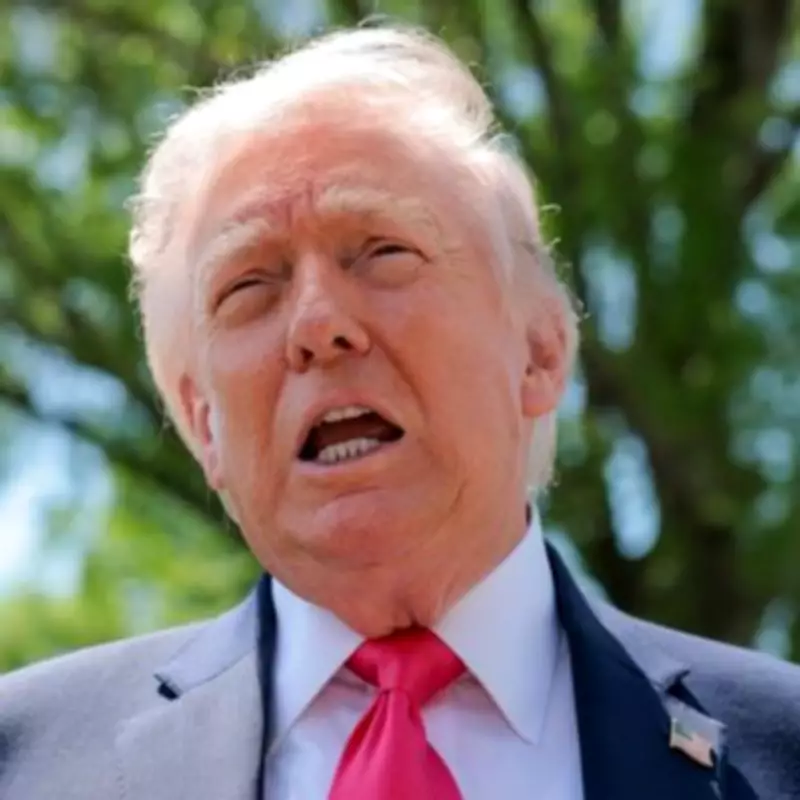
President Donald Trump has delivered a chilling warning to Iran, stating that a "nuclear holocaust" could occur unless Tehran reaches an agreement with the United States. This stark declaration came just hours after the President boasted about brokering a peace deal between Israel and Lebanon.
Trump's Dual Messaging on Peace and Peril
Speaking to journalists before boarding Marine One en route to Las Vegas, Trump claimed the US is "very close to making a deal with Iran" and outlined what he described as the significant benefits of such an arrangement. "If that happens, oil goes way down, prices go way down, inflation goes way down, and much more importantly, you won't have a nuclear holocaust," the President stated emphatically.
Ceasefire Agreement Between Israel and Lebanon
This warning followed Trump's announcement of a 10-day ceasefire between Israel and Lebanon, which came after weeks of reciprocal strikes and an Israeli bombing campaign that has claimed over 2,100 lives in Lebanon. Trump revealed the exact time the ceasefire would take effect, sharing a message on Truth Social where he took full credit for brokering the agreement.

"I just had excellent conversations with the Highly Respected President Joseph Aoun, of Lebanon, and Prime Minister Bibi Netanyahu, of Israel," Trump wrote. "These two Leaders have agreed that in order to achieve PEACE between their Countries, they will formally begin a 10 Day CEASEFIRE at 5 P.M. EST."
Washington's Role in Peace Negotiations
The President continued, "On Tuesday, the two Countries met for the first time in 34 years here in Washington, D.C., with our Great Secretary of State, Marco Rubio. I have directed Vice President JD Vance and Secretary of State Rubio, together with the Chairman of the Joint Chiefs of Staff, Dan Razin' Caine, to work with Israel and Lebanon to achieve a Lasting PEACE."
Trump concluded his message with characteristic bravado, adding, "It has been my Honor to solve 9 Wars across the World, and this will be my 10th, so let's, GET IT DONE! President DONALD J. TRUMP."
Strategic Implications for US-Iran Relations
A ceasefire agreement between Israel and Lebanon could have significant implications for any potential peace settlement between the US and Iran. Tehran made it clear during initial, unsuccessful peace negotiations between the US and Iran in Pakistan that a ceasefire in Lebanon was a fundamental requirement, without which Iran would refuse any American demands.
Iran's parliamentary speaker, Mohammad Bagher Ghalibaf, told his Lebanese counterpart, Nabih Berri, that Tehran is advocating for a permanent ceasefire "in all conflict zones." He added that a ceasefire in Lebanon is "just as important" as in Iran.
White House Invitations for Direct Talks
Trump issued invitations to the leaders of both Israel and Lebanon to participate in direct peace talks at the White House, sharing an additional message on his Truth Social platform. "In addition to the statement just issued, I will be inviting the Prime Minister of Israel, Bibi Netanyahu, and the President of Lebanon, Joseph Aoun, to the White House for the first meaningful talks between Israel and Lebanon since 1983, a very long time ago," he posted.
"Both sides want to see PEACE, and I believe that will happen, quickly! President DONALD J. TRUMP." Nevertheless, the last substantial negotiations between the two countries were in fact conducted in 1993, not 1983 as Trump claimed. It remains uncertain whether this was a typing mistake or an intentional reference to the period of Ronald Reagan's presidency.
Lebanese Resistance to Direct Engagement
Lebanese President Joseph Aoun rejected direct engagement with Israeli Prime Minister Benjamin Netanyahu on Thursday. The alleged comments were delivered during a phone conversation with US Secretary of State Marco Rubio, with Aoun asserting that Washington "understands Lebanon's position."
Aoun's office verified that a conversation with Rubio had occurred, yet made no reference to any prospective talks with Netanyahu. Netanyahu's office likewise stayed quiet on the issue. Lebanon and Israel held their first direct diplomatic talks in decades on Tuesday in Washington, following more than a month of hostilities between Israel and Hezbollah.

Ceasefire as Prerequisite for Negotiations
Lebanon has insisted that a ceasefire must be in place to stop the fighting between Israel and Hezbollah before any direct negotiations can get under way, while pledging to commit to disarming the group. Washington has yet to publicly announce its support for a ceasefire as a prerequisite, while the Israeli government has characterised the talks as peace negotiations centred on the disarmament of Hezbollah.
Ongoing Hostilities and Historical Context
Israel and Hezbollah continued to exchange fire across the border, with Hezbollah firing rockets and drones at towns in northern Israel. Israeli strikes on southern Lebanon intensified, particularly around the cities of Tyre, Nabatieh and the strategically significant town of Bint Jbeil, situated close to the Israeli border.
Israel and Lebanon have technically remained at war since Israel's establishment in 1948, with Lebanon remaining deeply split over any form of diplomatic engagement with Israel. Israeli forces have pushed further into southern Lebanon in an effort to establish what officials have described as a "security zone," which Netanyahu has stated will extend at least 5 to 6 miles into Lebanese territory.
The juxtaposition of Trump's nuclear warning to Iran with his peace-brokering claims highlights the complex geopolitical landscape of the Middle East, where ceasefire agreements and nuclear threats exist side by side in America's foreign policy approach.