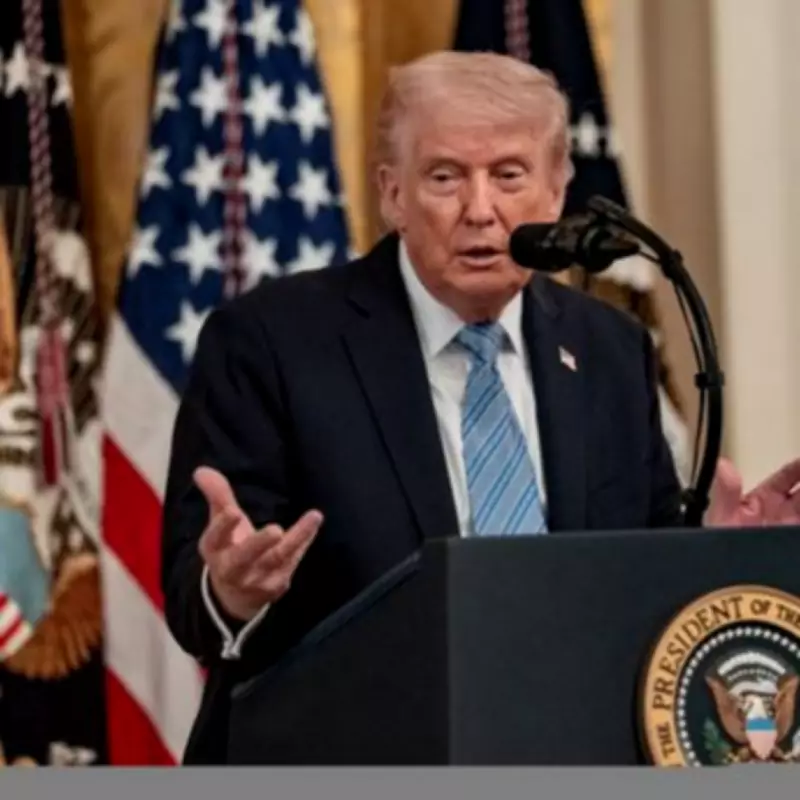
US President Donald Trump has intensified fears of a full-scale war returning to the Middle East, threatening that bombs will 'restart' if a peace deal with Iran is not reached soon. The warning came hours after Trump paused 'Project Freedom,' a mission aimed at freeing hundreds of ships stranded in the Strait of Hormuz by the Iranian blockade.
Trump's Warning
Trump stated, 'If they don't agree, the bombing starts, and it will be, sadly, at a much higher level and intensity than it was before.' The Navy section of Iran's Islamic Revolutionary Guard Corps responded by claiming 'safe and stable' passage through the strait will be ensured, adding that 'the aggressor's threats were neutralised.'
Background of the Conflict
Trump's warning came a day after Secretary of State Marco Rubio announced that the offensive stage of the Iran war was now 'over.' A one-page memorandum to end the war has been submitted by the US, including an end to uranium enrichment, lifting of US sanctions, distribution of frozen Iranian funds, and reopening of the Strait of Hormuz. Trump admitted it was 'perhaps a big assumption' that Iran would agree.

International Involvement
France's aircraft carrier strike group, led by the nuclear-powered Charles de Gaulle, is moving south of the Suez Canal into the Red Sea in preparation for a potential mission as part of a French-British plan for the Strait of Hormuz. This repositioning puts France's only carrier closer to the Persian Gulf chokepoint, where Iran has effectively halted commercial traffic since early March.
Recent Attacks
A cargo container ship operated by the CMA CGM Group was damaged in an attack while transiting the Strait of Hormuz on Tuesday, injuring multiple crew members. Iranian Foreign Minister Abbas Araghchi claimed Iran has attained 'an elevated international standing,' having proven its capabilities and strength. China's Foreign Ministry, after meeting with Araghchi, stated it values Iran's pledge not to pursue nuclear weapons while affirming its 'legitimate right to the peaceful use of nuclear energy.'
Regional Escalation
Israeli air attacks on southern and eastern Lebanon have killed more than a dozen people and wounded more than a dozen in recent days. At least four died and three others were wounded in an Israeli air strike on the town of Zellaya in eastern Lebanon. Israel also launched attacks on southern Lebanon using fighter jets and drones, with artillery shelling in the village of Mayfadoun resulting in two deaths. Five more people were killed and 15 wounded in an Israeli attack in Siksikiyah in southern Lebanon.
Displacement Orders
Israel issued forced displacement orders for 12 villages in southern Lebanon, warning residents to remain at least a mile from their homes. Most affected villages were north of the Litani River, an area not currently under Israeli occupation. Israel said it was responding to a violation of the ceasefire by Hezbollah. Fighting between Israel and Hezbollah renewed on March 2 after the Iran-backed group fired rockets at Israel, following the US and Israel's launch of a war against Iran.
Humanitarian Impact
Since then, Israeli attacks in Lebanon have killed about 2,700 people and displaced more than 1.2 million. Israeli forces have also destroyed entire villages in southern Lebanon, prompting comparisons with the devastation caused by Israel's war against Palestinians in Gaza.