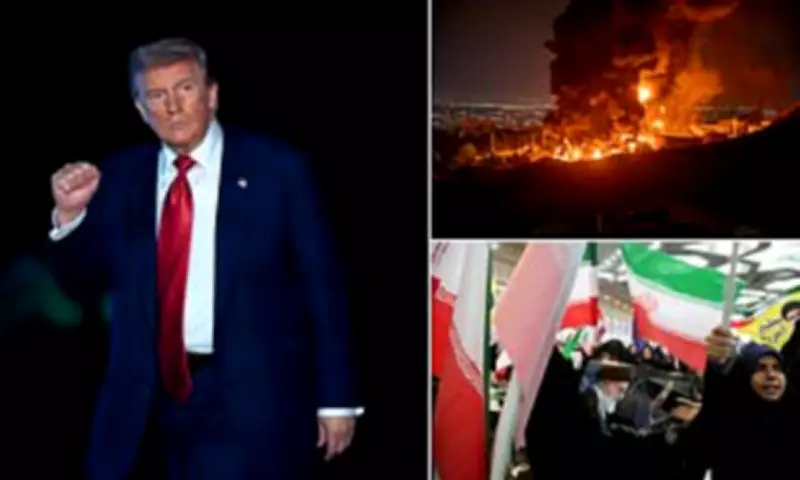
President Donald Trump reportedly used a phone call with Muslim leaders about ending the Iran war to push for a broader regional peace plan, according to a report released Sunday. The President asked several Middle Eastern countries on Saturday to enter peace agreements with Israel by signing onto the Abraham Accords, Axios reported.
Details of the Phone Call
The leaders of Saudi Arabia, the United Arab Emirates, Qatar, Turkey, Egypt, Pakistan, Bahrain, and Jordan were on the line with Trump when he made his request. The main goal would be to broker a peace agreement between Saudi Arabia and Israel, the outlet added. Trump told the Arab world leaders that his next phone call would be to Israeli Prime Minister Benjamin Netanyahu and expressed hope that Netanyahu would join them on a call in the near future.
When Trump's request was met with silence, the US President jokingly asked if they were still on the line, Axios reported. Trump informed the Gulf leaders that his envoys Jared Kushner and Steve Witkoff would follow up in the coming weeks.

Abraham Accords Background
The Abraham Accords, which sought to normalize several Arab states' relationships with Israel, were a key milestone of the first Trump administration. Nations that have signed on so far include Bahrain, Morocco, the UAE, and Sudan, as well as Israel. On Sunday morning, Trump expressed his desire for more Middle Eastern states to join, writing on Truth Social: 'I would like to thank, thus far, all of the countries of the Middle East for their support and cooperation, which will be further enhanced and strengthened by their joining the Nations of the historic Abraham Accords.' He added, 'Who knows, perhaps the Islamic Republic of Iran would like to join, as well!'
Reactions and Implications
South Carolina Senator Lindsey Graham, a close ally of Trump, called the potential deal 'one of the most consequential in the history of the Middle East.' He urged Arab countries to be 'bold for the future of a new Middle East' but cautioned that refusing Trump's proposal would have 'severe repercussions' and be seen as 'a major miscalculation.'
Trump announced Saturday afternoon that the Iranian peace agreement was 'largely negotiated' but still 'subject to finalization.' He noted that the Strait of Hormuz would be opened as part of the agreement. Mohammed bin Zayed, the president of the UAE, was among the Muslim leaders who expressed support for the deal, according to Axios.
Negotiation Details
Iran would reportedly agree to give up its stockpile of highly enriched uranium, with the exact nature of this process to be discussed over a 60-day period, according to the Associated Press. The deal would also involve the gradual reopening of the Strait of Hormuz and the end of the US blockade. Iran would be allowed to sell its oil through sanctions waivers.
Secretary of State Marco Rubio confirmed 'significant progress, although not final progress, has been made' in negotiations. He outlined a two-stage process: first, the full reopening of the strait; second, serious negotiations on Iran's pledge never to develop nuclear weapons, long-term restrictions on enrichment capabilities, and the disposition of highly enriched uranium.
Iranian Foreign Ministry spokesman Esmail Baghaei acknowledged 'narrowing differences' between Iran and the US but expressed caution following past attacks during nuclear negotiations. The Daily Mail has reached out to the White House for comment.