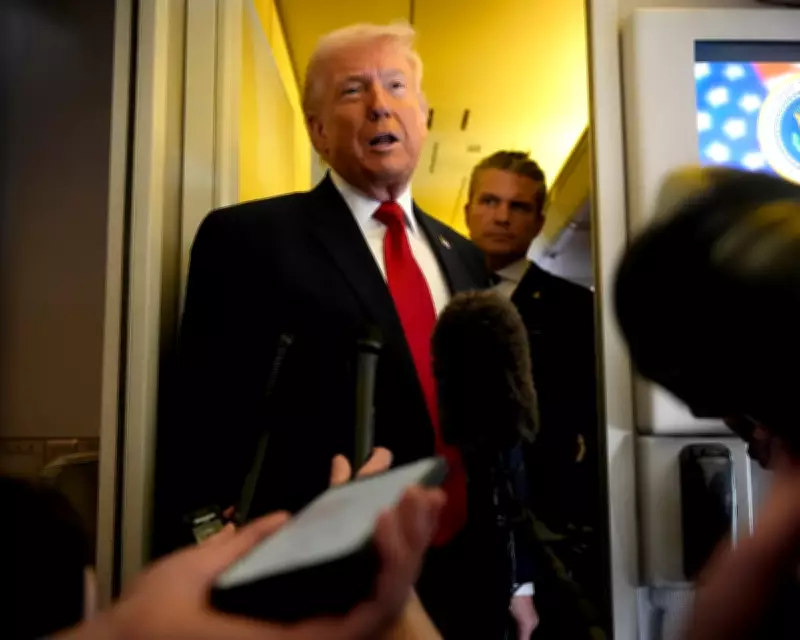
In a series of remarks made aboard Air Force One on Saturday, President Donald Trump left open the possibility of sending American ground troops into Iran under certain conditions, while simultaneously dismissing the idea of utilising Kurdish forces based in Iraq to mount an invasion of Tehran.
Trump's Ambiguous Stance on Ground Deployment
When questioned by reporters about the potential for deploying US troops to secure enriched uranium believed stored at Iranian nuclear sites—targets previously bombed by the United States in Operation Midnight Hammer last year—Trump responded with notable ambiguity. "We haven't talked about it," the president stated. "At some point, maybe we will. It would be a great thing. Right now, we're just decimating them. We haven't gone after it but something we could do later on. We wouldn't do it now."
Trump further elaborated, suggesting that if such a ground operation were ever undertaken, Iranian forces would be "so decimated that they wouldn't be able to fight at the ground level." However, he emphasised that any decision would require "a very good reason," describing the inquiry itself as not entirely appropriate.

Kurdish Involvement Firmly Ruled Out
In contrast to his non-committal position on American troops, the president was unequivocal in rejecting the possibility of Kurdish forces launching an invasion from Iraq. This stance comes despite reports from several news outlets indicating that Kurdish groups have been armed by the CIA, an idea that has gained traction in Washington circles.
"I don't want the Kurds going in," Trump asserted. "They're willing to go in, but I've told them I don't want them going in. The war's complicated enough without getting the Kurds involved." This declaration underscores the administration's intent to avoid further complicating an already volatile regional conflict.
Somber Ceremony at Dover Air Force Base
Trump's comments followed a solemn visit to Dover Air Force Base in Delaware, where he participated in the dignified transfer ceremony for six US service members killed during the initial stages of the war against Iran. Accompanied by JD Vance and Defense Secretary Pete Hegseth, the president observed under a hazy gray sky as flag-draped transfer cases were carried from a C17 Globemaster transport aircraft into waiting vehicles.
When asked if the somber moment gave him pause regarding the continuation of the conflict, Trump responded firmly, "No, we're winning the war by a lot. We decimated their whole evil empire. It will continue I'm sure for a little while but I'm very proud of the people." He later added that casualties are an inevitable "part of war."
Escalating Conflict and Shifting Timelines
The war has expanded significantly since Trump authorised the United States to join Israel in conducting airstrikes against Iran one week ago, including attacks that resulted in the death of Supreme Leader Ayatollah Ali Khamenei. Initially, Trump suggested the campaign might last approximately four weeks, but administration officials have since indicated it could extend for months.
On Saturday, Trump remained non-committal about the war's duration, stating, "I don't know. Whatever it takes," even as he later characterised the conflict as a "short excursion."
Controversy Over School Strike
Trump also addressed the highly contentious issue of a strike that destroyed a girls' elementary school in southern Iran, killing at least 175 people, many of whom were children. Despite ongoing Pentagon investigations and forensic analyses by the New York Times, CNN, and the Associated Press suggesting a high likelihood that the precision strike was conducted by the US—coinciding with attacks on a nearby Islamic Revolutionary Guard Corps naval base—Trump placed blame squarely on Iran.
"No, in my opinion, based on what I've seen, that was done by Iran," the president insisted. After Defense Secretary Hegseth declined to confirm this assertion, merely stating that the US was "certainly investigating," Trump reiterated his claim: "It was done by Iran. They're very inaccurate as you know with their munitions. They have no accuracy whatsoever. It was done by Iran."

These developments highlight the escalating tensions and complex dynamics of the US-Iran conflict, with Trump's remarks reflecting a blend of strategic ambiguity, firm boundaries regarding allied involvement, and unwavering confidence in the American military campaign.