Tehran Under Siege: Fear and Propaganda Grip Iran Amid US Calls for Uprising
In the early morning light near Azadi Square in central Tehran, a long queue has already formed outside a local bakery. Overhead, fighter jets roar relentlessly, and the distant thud of exploding bombs punctuates the air. Save for the occasional screaming ambulance, the streets of this typically bustling neighbourhood lie eerily empty, a silence that will persist throughout the day. A palpable sense of dread and paranoia hangs over the city like a thick, choking smog.
Brutal Suppression and Dire Warnings
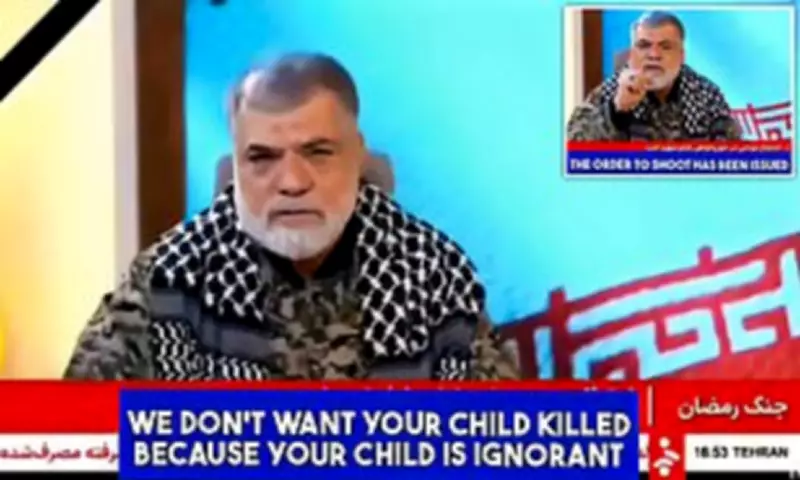
While darkness might embolden some protesters, those daring to chant anti-regime slogans face the grim risk of on-the-spot execution by the feared Basij militia. This paramilitary force, an arm of the Islamic Revolutionary Guard Corps (IRGC), roams the capital's streets, ruthlessly crushing any trace of dissent. On state television, a bearded IRGC commander issued a chilling threat directly to Iranian children, warning that 'anyone who speaks today in a way that echoes the enemy' risks being shot. He added, 'The order to shoot has been issued. We don't want your child killed because your child is ignorant.'
Barely a week has passed since former US President Donald Trump, from his Palm Beach mansion, exhorted the 'great, proud people of Iran' to rise up and usher in a new democratic dawn. Yet, so far, few are displaying much revolutionary zeal—and little wonder. Citizens buy their bread, scuttle straight home, and maintain contact with neighbours, family, and friends through encrypted messaging groups, a practice reminiscent of the Covid-19 lockdowns.

Trump's Call to Arms Meets Stark Reality
Launching Operation Epic Fury, Trump spoke passionately of the people's hour of freedom being at hand, promising American backing with overwhelming strength. 'Now is the time to seize control of your destiny, and to unleash the prosperous and glorious future that is close within your reach,' he declared. His war room was dimly lit, a shadow from his baseball cap obscuring his eyes, but his words were unequivocal. Reading from an autocue to avoid ambiguity, he urged, 'This is the moment for action. Do not let it pass.' On Thursday, he called for the regime's unconditional surrender, pledging to 'Make Iran Great Again.'
To many, his rhetoric might have conjured romantic images of Azadi Square filled with rejoicing crowds, demonstrators storming government buildings, and soldiers laying down arms. However, the reality in Tehran is starkly different. Not even the first green shoots of rebellion have emerged. The message from dissidents in the capital is clear: easier said than done, Mr President.
A Regime Cementing Its Grip
Defence analysts suggest that behind the scenes, American agencies like the CIA are attempting to foment unrest, given their long history of engaging with Iranian opposition elements. Yet, Tehran's dissidents appear disinclined to take up arms, while the 650,000-strong IRGC refuses to loosen its iron grip. Memories of the January uprising's brutal suppression, where an estimated 30,000 Iranians were killed, haunt even the bravest protesters.
Alongside the on-the-ground brutality, the regime is waging a concerted propaganda campaign. Tehran is framing the conflict as a binary choice between the Islamic Republic and national catastrophe. State media and the IRGC push a coordinated narrative to ordinary Iranians: without unity around the regime, the country could descend into a bloodbath akin to Iraq, with the war dragging on for years. Deliberately terrifying stories accompany these warnings—cities reduced to rubble, foreign troops on Iranian soil, and the nation's wealth looted by outsiders.
Experts Warn of Chaos and Fragmentation
This chaos theory is not without basis. Sir John Sawers, former head of MI6, warned on Saturday that a worst-case scenario of regime collapse could resemble Iraq in 2003, where 'central authority disappears, the country breaks up into different fragments, there'll be violent groups around, there'll be millions of refugees who seek to leave the country and it becomes a hotbed for terrorism.'

Everywhere, the clerical leadership is fostering paranoia. Mass text messages flood Iranian phones, one urging citizens to report 'any suspicious or security-related activity' to the IRGC Intelligence Organization. Another threatens that 'any movement that disrupts security will be considered direct cooperation with the enemy, and will be dealt with firmly.' On Tehran's streets, IRGC convoys of Basij foot soldiers parade, led by pickup trucks with loudspeakers booming: 'Iran is a superpower and we are winning the war.'
Internal Divisions and External Hopes
War has brought severe privations. Tehran residents speak of shortages in electricity, water, food, and medicine. On closed messaging groups, they swap information on where to find essentials. Schools have closed, and children study by candlelight at night, their labours interrupted by wailing air raid sirens. Hospital wards are filled with wounded IRGC members, while civilians often report being denied care.
Many believe that only if the Iranian military suddenly switches sides might signs of change appear. Mehran Kamrava, a professor of government at Georgetown University in Qatar, noted, 'What we saw in the Arab Spring in Tunisia and Egypt was a calculated decision by the military to abandon the civilian leadership because it was to its advantage to do so.' He added that if commanders within the Revolutionary Guards or army see corporate interest in abandoning the clerical leadership, we might see change, but so far, no such signs are evident.
Border Provinces and Ethnic Tensions
For a brief moment last weekend, rapid change seemed possible with news of Ayatollah Khamenei's death sparking euphoria in some quarters. However, many remain loyal to the regime or fear an Israeli or American-backed alternative. Attention has now shifted to Iran's border provinces, where hope persists that if the regime won't collapse from the centre, its edges might fracture.
Iran is a multi-ethnic nation with sizeable Azeri, Kurdish, Lur, Arab, Baluchi, and Turkmen populations. Iranian Kurdish opposition groups in exile in northern Iraq are reportedly planning to cross the border. Hana Yazdanpana of the Kurdistan Freedom Party stated, 'We have been preparing for this for the past 47 years, since the age of the Islamic Republic.' She explained that six opposition groups are coordinating politically and militarily but cautioned, 'The regime is very brutal, and the most advanced weapon we have is a Kalashnikov.'
Uncertain Future and Fragile Opposition
Dr Burcu Ozcelik, a senior research fellow at the Royal United Services Institute, observed, 'There is no organised opposition inside Iran, but there is a history of reformist movement in Iran.' She suggested that Iranian political figures could emerge, or the conventional army might take a greater role in a military coup scenario. Ultimately, she noted, 'It all depends on how long the Iranian regime can hold on to the monopoly of violence.'
As Tehran endures under the shadow of fear and propaganda, the path to revolution remains fraught with peril, with the regime's brutal tactics and internal divisions posing formidable barriers to any swift change.