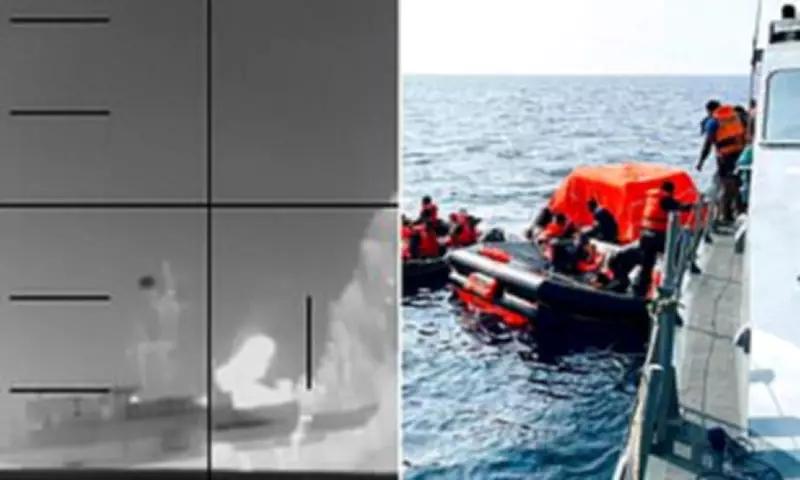
Sri Lanka Mounts Major Rescue Operation for Iranian Vessel Crew
In a dramatic development amid escalating naval hostilities, Sri Lanka has rescued more than 200 sailors from the Iranian vessel IRIS Bushehr after its engine failed. The rescue operation comes just one day after a separate Iranian warship, the IRIS Dena, was sunk by a torpedo launched from an American submarine off the coast of Sri Lanka.
Rescue and Recovery Efforts Underway
Sri Lankan President Anura Kumara Dissanayake confirmed that the country took control of the IRIS Bushehr after it requested assistance while anchored outside Sri Lankan territorial waters. Navy spokesman Commander Buddhika Sampath detailed the operation, stating that the sailors were being brought first to the port of Colombo. Following medical examinations and immigration procedures, they would be transferred to the naval base at Welisara, approximately twelve miles north of Colombo.
'The disembarkation is in progress,' Sampath said, adding that the ship itself would later be moved to an eastern port on the island. The IRIS Bushehr had been previously described in Iranian media reports as a navy logistics ship equipped with a helicopter pad.

Context of the Sinking of IRIS Dena
The rescue operation follows the sinking of the Iranian warship IRIS Dena by a US submarine on Wednesday. Footage released by the US Department of Defense showed a massive explosion beneath the ship's stern, with haunting images of it sinking. The Indian navy reported initiating search and rescue operations after receiving a distress signal from the Dena, deploying two aircraft and a sailing training vessel. However, by the time their response was launched, the Sri Lankan navy had already begun its own rescue efforts, ultimately saving 32 sailors and recovering 87 bodies.
This strike represents one of the rare instances since the Second World War where a submarine has sunk a surface warship, highlighting the expanding scope of the US-Israeli military campaign against Iran. The Dena had participated in naval exercises hosted by India, which included at least 74 countries, such as the US navy conducting reconnaissance and maritime patrol drills, before heading into international waters on its return journey.
Diplomatic Reactions and Statements
Iran's Foreign Minister Abbas Araghchi stated that the Dena had been carrying 'almost 130' crew, with the normal complement for a warship of that class being 140. He condemned the sinking as an 'atrocity at sea' and warned that the US would 'bitterly regret' the attack.
Sri Lankan President Dissanayake addressed journalists on Thursday night, emphasizing the unusual nature of the situation. 'We have to understand that this is not an ordinary situation. It's a request by a ship belonging to one party to enter into our port. We have to consider that according to the international treaties and conventions,' he said. Separately, on Friday, he posted on X: 'No civilian should die in wars. Our approach is that every single life is as precious as our own.'
Sri Lanka's Foreign Minister Vijitha Herath also expressed 'grave concern over the escalation of hostilities' in a conversation with Araghchi. Despite strong economic and political ties with Iran, including crude oil purchases worth $250 million, Sri Lanka maintains a neutral stance in the current conflict. Herath noted that relations had 'broadened significantly' under Ayatollah Ali Khamenei, who was killed in US-Israeli airstrikes on Saturday.
Expert Analysis and Broader Conflict Implications
Former Royal Navy chief Lord West, speaking to the Daily Mail, asserted that the sinking of the Dena has transformed a regional conflict into a 'global war.' He remarked, 'It makes the situation rather tricky, as some will say this was outside the Area of Operations. While it is a horrible event, it is acceptable as the US is at war with Iran. Nobody declares war these days but that's where we're at. This is now a global war.'

The conflict has drawn in multiple nations, with Iran launching missile and drone attacks into Kuwait, Qatar, Saudi Arabia, and Bahrain—all countries hosting US forces—on Friday. Qatar's Defence Ministry reported intercepting a drone attack targeting Al Udeid Air Base, while Saudi Arabia intercepted three ballistic missiles aimed at Prince Sultan Air Base. Bahrain experienced strikes on two hotels and a residential building, with no casualties reported.
In Lebanon, where fighting has intensified between Israel and Iran-allied Hezbollah militants, Israel conducted a series of airstrikes in Beirut's southern suburbs and other areas. The overall death toll includes at least 1,230 people in Iran, over 120 in Lebanon, around a dozen in Israel, and six US troops.
US Stance and Future Projections
US Secretary of War Pete Hegseth, at a press conference in Tampa, issued a stark warning: 'We have only just begun to fight and fight decisively. If you think you've seen something, just wait.' He added that Iran miscalculates US resolve, stating, 'Our munitions are full up and our will is ironclad. The amount of firepower over Iran and over Tehran is about to surge dramatically.'
Sri Lanka finds itself increasingly entangled in this expanding conflict, balancing humanitarian rescue operations with diplomatic neutrality as global tensions reach a critical juncture.