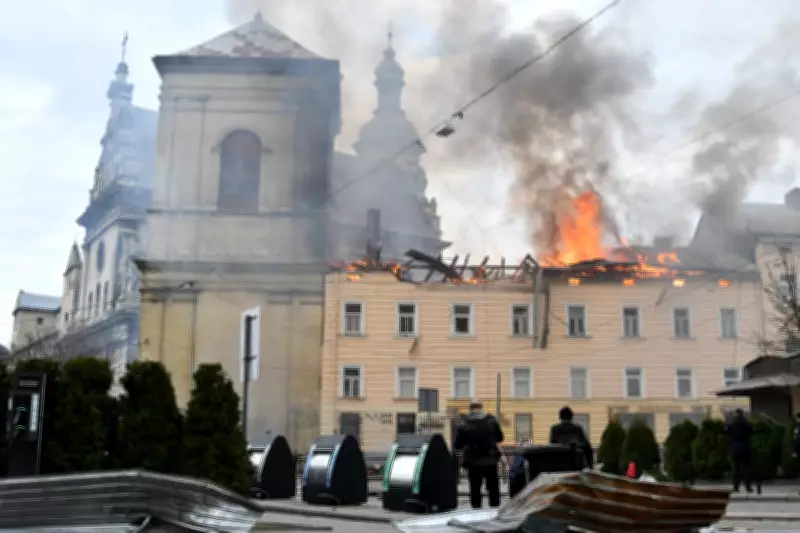
Three Dead and Historic Monastery Hit in Lviv as Russia Launches Rare Daylight Drone Attack on Ukraine
In a stark departure from its usual tactics, Russia launched a massive daylight drone assault on Ukraine, killing at least three people and wounding 30 others. The attack, which officials confirmed on Tuesday, also set a building in the centuries-old centre of Lviv ablaze, with a Unesco-listed monastery reported among the structures impacted.
Ukraine's air force stated that more than 400 drones were launched in the middle of the day, marking an abrupt shift from Russia's typical strategy of conducting similarly large aerial attacks under the cover of darkness during its more than four-year-old war. This daytime bombardment followed an overnight wave of Russian drone strikes that killed at least five people and injured 27 across Ukraine.
Zelensky Appeals for Urgent Air Defence Support
Ukrainian President Volodymyr Zelensky reported that the daytime attack caused damage in 11 regions, including a residential building in Lviv's city centre. He reiterated urgent calls for allies to supply Kyiv with more air defence munitions, which are dwindling as the United States and Europe have shifted their focus to the war in Iran in recent weeks.

"The geopolitical situation has become more complicated due to the war against Iran, and this, unfortunately, bolsters Russia's confidence," Zelensky said on Tuesday, adding that "the fundamental circumstances have not changed." He accused Russia of continuing the war and destabilising Europe, supporting the Iranian regime with intelligence data, and thereby prolonging conflicts while preparing for new ones in the coming years.
Escalating Ground Assaults and Preparations for Spring Offensive
Alongside the aerial attacks, Moscow has intensified its ground assaults along the 750-mile front line in eastern and southern Ukraine, with 619 attacks recorded over four days in mid-March. The country is bracing for renewed offensives as weather conditions improve after a winter of Russian strikes on energy infrastructure, which caused widespread power and heating cuts, exacerbating the harsh Ukrainian winter.
The commander-in-chief of Ukraine's armed forces, General Oleksander Syrskyi, stated that Russian troops had made multiple attempts in recent days to break through defensive lines. "Fierce fighting unfolded along the entire line of contact," he wrote on Telegram on Monday, warning that "the occupiers are attempting to bring up new units and are preparing to continue attacks." Syrskyi noted that the Russian military is relying on poor spring weather conditions, such as fog, to reduce the effectiveness of Ukrainian drone and artillery strikes.
Anticipated Mobilisation and Strategic Shifts
According to the Institute for the Study of War (ISW), a Washington-based think tank, a Ukrainian military official expects Russia to begin using mobilised military personnel on 1 April. Ukrainian Southern Defence Forces spokesperson Colonel Vladyslav Voloshyn told Interfax Ukraine that Russia plans to move all mobilised personnel currently in Crimea to Ukraine.
The ISW also reported that Russia is moving heavy equipment to the frontline in preparation for an intensification of fighting as the weather warms, signalling what it believes is the beginning of a spring-summer offensive. Michael Kofman, an analyst at the Carnegie Endowment in Washington DC, commented: "Usually there is a Russian wave of mechanised assaults around April, and they once again prove costly and ineffective."
The latest attacks come after weekend talks between Ukrainian and US delegations in Florida yielded no tangible results, underscoring the ongoing challenges in securing decisive international support. Ukraine continues to face a relentless assault, with officials reporting that Russia launched 948 drones over a 24-hour period—the largest such barrage of the war so far.