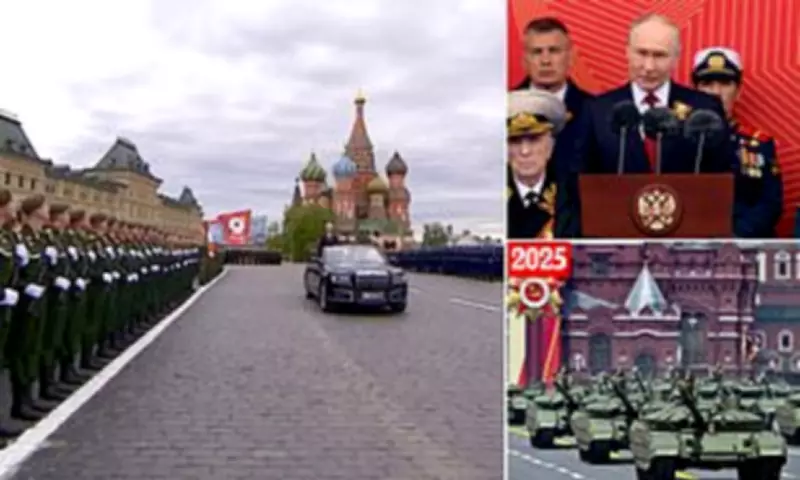
Russian President Vladimir Putin oversaw Russia's annual Victory Day parade on Red Square on Saturday amid extraordinary security fears and a mocking taunt from Ukrainian President Volodymyr Zelensky. The Kremlin staged the lavish military spectacle commemorating the defeat of Nazi Germany in World War II under the shadow of possible Ukrainian drone attacks, with officials forced to strip back the traditional display of military hardware.
Absence of Heavy Weapons
For the first time in nearly two decades, tanks, missile launchers, and other heavy weapons were absent from the parade, aside from a ceremonial flyover of combat jets. Russian officials blamed the sudden change in format on the 'current operational situation', while Kremlin spokesman Dmitry Peskov admitted authorities had introduced 'additional security measures' ahead of the event.
Putin's Use of Victory Day
Putin, who has ruled Russia for more than a quarter of a century, has long used Victory Day, the country's most important secular holiday, to project military strength and rally support for the war in Ukraine. However, this year's celebrations appeared overshadowed by fears that Kyiv could attempt to embarrass the Kremlin with a strike on Moscow during the high-profile event.

Zelensky fuelled the humiliation earlier this week when he claimed Russian authorities 'fear drones may buzz over Red Square' on May 9. He later appeared to troll the Kremlin further by issuing a mock 'decree' supposedly permitting Russia to hold the parade safely, declaring Red Square temporarily off-limits for Ukrainian strikes.
Mock Decree and Security Measures
The fake document, shared widely online, mimicked the style of an official Ukrainian presidential order and included the coordinates of Red Square, jokingly stating the area would be excluded from plans for the 'use of Ukrainian weapons' during the parade. Security was especially tight in Moscow despite a US-brokered three-day ceasefire intended to ease fears of disruption during the commemorations.
Russia declared a unilateral ceasefire for Friday and Saturday, while Ukraine had earlier proposed its own truce beginning on May 6, though both sides accused each other of continuing attacks. US President Donald Trump said on Friday that Russia and Ukraine had agreed to a ceasefire running from Saturday to Monday alongside a prisoner exchange, claiming the pause in fighting could mark the 'beginning of the end' of the war.
War of Words Continues
Despite the talk of a ceasefire, the war of words between Moscow and Kyiv continued ahead of the parade. Peskov dismissed the mock decree as a 'silly joke' as the Kremlin attempted to brush off the apparent taunt from Kyiv. 'We don't need anyone's permission to be proud of our Victory Day,' Peskov told reporters.
Russia's bigger and better-equipped military has been making slow but steady gains along the more than 600-mile front line. Ukraine has hit back with increasingly efficient long-range attacks, striking Russian energy facilities, manufacturing plants, and military depots. It has developed drones capable of reaching targets more than 600 miles deep into Russia, far beyond its capabilities before 2022.
Threats and Warnings
Russian authorities warned that if Ukraine attempts to disrupt Saturday's festivities, Russia will carry out a 'massive missile strike on the centre of Kyiv'. The Russian Defence Ministry warned the civilian population there and employees of foreign diplomatic missions of 'the need to leave the city promptly'. The EU said its diplomats would not leave the Ukrainian capital despite Russian threats.
Putin has used Victory Day celebrations to encourage national pride and underline Russia's position as a global power. The Soviet Union lost 27 million people in 1941-45 in what it calls the Great Patriotic War, an enormous sacrifice that left a deep scar in the national psyche and remains a rare point of consensus in the nation's divisive history under Communist rule.

Historical Context and Current Restrictions
Victory Day parades on Red Square have involved a broad array of heavy weapons - from armoured vehicles to nuclear-tipped intercontinental ballistic missiles - every year since 2008. Smaller parades are held elsewhere across the country, but this time many of them have also been pared down or even cancelled altogether for security reasons.
As the troops prepared to march across Red Square on Saturday, the authorities ordered restrictions on all mobile internet access and text messaging services in the Russian capital, citing the need to ensure public safety. The government has methodically tightened internet censorship and established increasingly stringent controls over online activities, causing rumblings and rare public expressions of discontent.