

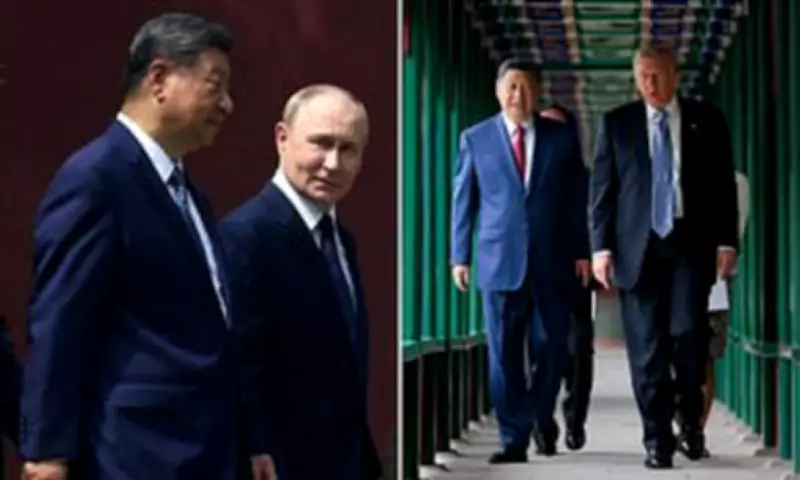
Russian President Vladimir Putin arrived in Beijing on Tuesday for talks with Chinese leader Xi Jinping, whom he has called a 'long-time good friend.' The visit comes just four days after U.S. President Donald Trump concluded his own state visit to China.
Strategic Partnership Deepens
The discussions, confirmed shortly after Trump's departure last Friday, aim to 'further strengthen' the strategic partnership between Russia and China and to 'exchange views on key international and regional issues.' Since Russia's invasion of Ukraine in 2022, ties have deepened significantly, with Putin visiting Beijing annually.
Moscow, diplomatically isolated on the global stage, is heavily dependent on Beijing economically. China is now the primary buyer of sanctioned Russian oil.

Warm Exchange of Letters
Setting a positive tone for the visit, the two leaders exchanged 'congratulatory letters' on Sunday to mark 30 years of their countries' strategic partnership. Xi stated that cooperation between Russia and China had 'continuously deepened and solidified,' according to Chinese state media.
In a video message released Tuesday, Putin described relations as reaching 'a truly unprecedented level' and noted that 'trade between Russia and China continues to grow.' He added, 'The close strategic relationship between Russia and China plays a major, stabilising role globally. Without allying against anyone, we seek peace and universal prosperity,' without mentioning any third country.
Contrast with Trump's Visit
The leaders are expected to sign a joint declaration after the talks, which stand in stark contrast to Trump's visit—the first by a sitting U.S. president in nearly a decade—aimed at stabilising turbulent relations. When Putin last visited Beijing in September 2025, Xi welcomed him as an 'old friend,' language not extended to Trump the previous week.
Putin, who has called Xi his 'dear friend,' is keen to demonstrate that their relations remain unaffected by Trump's visit. Despite Trump's efforts—including inviting top U.S. business leaders like Elon Musk, Tim Cook, and Jensen Huang—the U.S. president left China with little concrete outcome. China made no commitments on ending the war with Iran or on Taiwan, and Trump secured only vague promises of business deals.
Rush Doshi, director of the China Strategy Initiative at the Council on Foreign Relations, described Trump's visit as 'heavier on symbolism than on substance,' focusing on managing problems rather than solving them. Patricia Kim of the Brookings Institution noted that while Putin's visit may not receive the same pomp, 'the Xi-Putin relationship does not require that kind of performative reassurance,' as both sides view ties as 'structurally stronger and more stable' than China-U.S. relations.
Ukraine and Iran
Beijing has regularly called for talks to end the war in Ukraine, now over four years long, but has never condemned Russia's invasion, presenting itself as neutral. Trump and Xi discussed Ukraine last week, but no breakthrough was achieved. Kim suggested that Xi will likely brief Putin on his summit with Trump, but the lack of clear outcomes likely reassures Moscow that Xi did not strike any understanding detrimental to Russian interests.
According to the Financial Times, Xi told Trump that Putin might regret the invasion of Ukraine and asked whether Trump would combine U.S., Chinese, and Russian forces to combat the International Criminal Court. Putin hopes for deeper Chinese commitment, especially after Trump claimed Beijing agreed to buy U.S. oil to feed its 'insatiable' energy demand.
With Russia reliant on oil sales to China to sustain its war effort, 'Putin does not want to lose that support,' said Lyle Morris of the Asia Society. On the Middle East, Putin will likely seek Xi's perspective on China's next steps, as Trump signalled hopes for Beijing to play a leading role. However, on the U.S.-Israeli war with Iran, priorities may differ: China relies on freedom of major waterways and prefers a swift end to the Strait of Hormuz standoff, while Moscow benefits economically from relaxed sanctions on Russian energy supplies due to the conflict.

After meeting Xi in April, Russian Foreign Minister Sergei Lavrov said Russia could compensate for China's energy shortages as the war hits global supplies. Joseph Webster of the Atlantic Council noted that expanded energy ties may feature prominently, as Beijing seeks more Russian energy and Moscow finds shipping oil east more attractive following Ukraine's campaign targeting Russian energy infrastructure.





