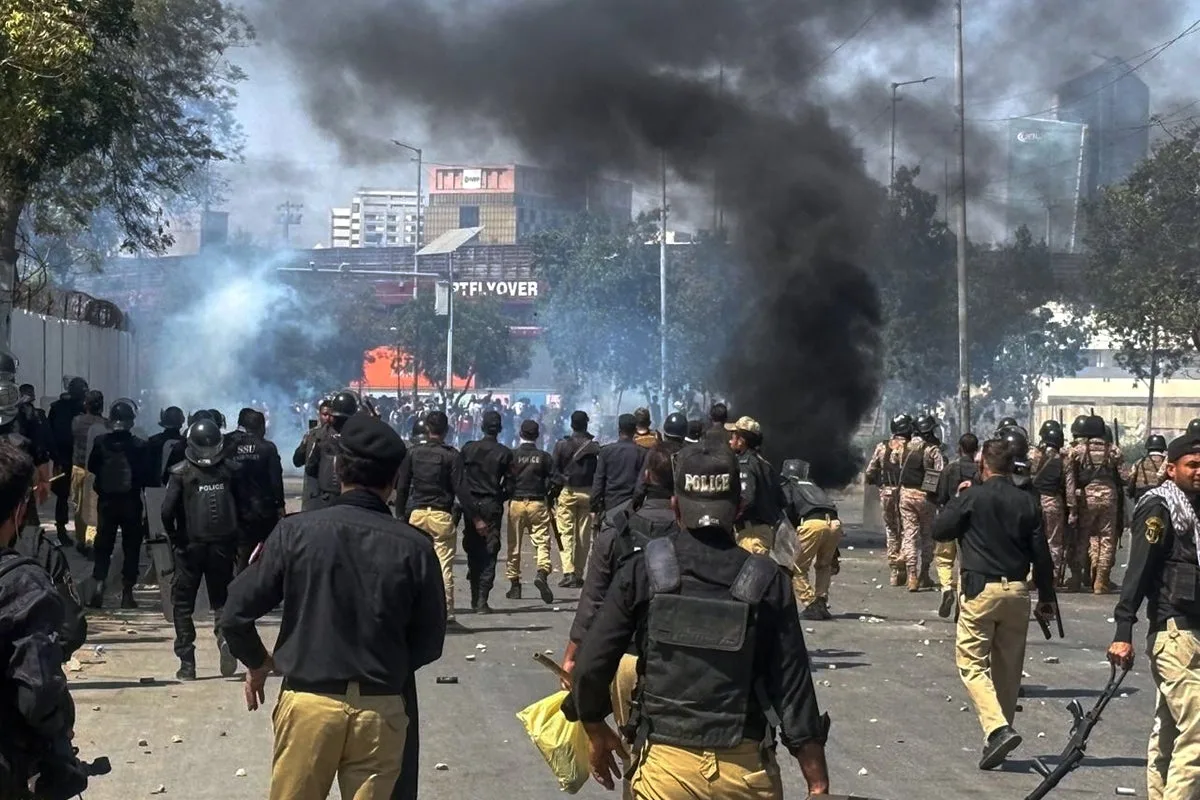
At least six people were killed in clashes with police after hundreds stormed the US consulate in Karachi on Sunday, as anger over the killing of Iran’s supreme leader Ayatollah Ali Khamenei spilled on to the streets in Pakistan. Police and paramilitary forces used batons and tear gas to disperse crowds who smashed windows at the diplomatic compound in the southern port city.
Summaiya Syed Tariq, a police surgeon at the city’s principal public hospital, said six bodies, along with several injured individuals, had been taken there. Police also confirmed that eight others were injured during the clashes. The unrest came hours after confirmation that Khamenei, 86, had been killed in joint US and Israeli air strikes on his Tehran office.
The attack triggered protests across Pakistan, Iraq and India-administered Kashmir. In Pakistan’s northern Gilgit-Baltistan region, protesters set fire to a United Nations office in Skardu. In Baghdad, pro-Iranian demonstrators assembled outside the Green Zone, where the US embassy is located. Iran retaliated with missiles and drones targeting Israel and US military installations across the Gulf.
US president Donald Trump described the moment as transformative, warning Tehran against escalation. Iran’s cabinet said the killing was a “great crime that will never go unanswered”. The Revolutionary Guard threatened its “most intense offensive operation”. Iran launched missiles at Israel and US installations in Bahrain, Kuwait and Qatar. Air defence systems were activated over Dubai, and shrapnel from a missile attack killed one person in the United Arab Emirates.
In India-administered Kashmir, thousands gathered in Srinagar’s Lal Chowk and the Old City, raising anti-US and anti-Israel slogans. Black flags and portraits of Khamenei were displayed. Demonstrations spread to Budgam, Baramulla and other districts. Muslim organisations in Lucknow announced protests and three days of mourning. Iran has formed a council to govern until a new supreme leader is chosen.