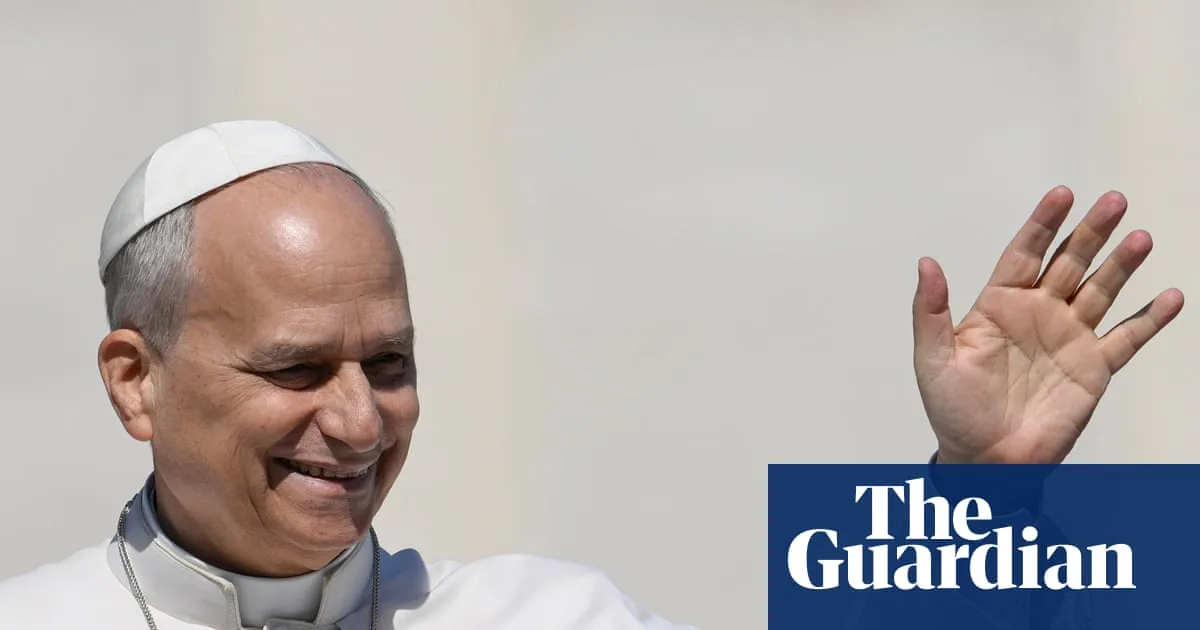
Pope Leo XIV's Historic Monaco Visit Highlights Small States' Global Role
Pope Leo XIV embarked on a rare one-day visit to the glitzy principality of Monaco on Saturday, marking the first papal trip to the Mediterranean enclave in nearly five centuries. The American-born pontiff's journey underscores how small states can exert significant influence on the international stage.
Symbolic Significance of the Monaco Visit
Vatican spokesperson Matteo Bruni emphasized that the visit provides Pope Leo with his inaugural opportunity to address all of Europe directly. "In the Bible, it is precisely the small ones who play a significant role," Bruni noted, highlighting Monaco's status as one of the few European nations where Catholicism remains the official state religion.
The principality's commitment to Catholic doctrine was recently demonstrated when Prince Albert declined a proposal to legalize abortion, citing the faith's importance in Monaco's society. This decision, while largely symbolic given France's constitutional abortion rights surrounding the 2.2-square-kilometer coastal state, aligns with other European Catholic royals who have upheld traditional teachings on an increasingly secular continent.
Bruni confirmed that "defense of life" would be a central theme of the visit, though he stressed that Pope Leo's vision encompasses protecting all life, including in wartime conflicts and humanitarian crises.
An Unexpected Diplomatic Destination
The visit's itinerary included a private audience with Prince Albert and Princess Charlene at the palace, a meeting with Monaco's Catholic community at the cathedral, and a Mass celebrated in the sports stadium. The trip materialized rapidly after Albert's January 17 visit to the Vatican, where he extended the invitation to Pope Leo.
Monaco, renowned as a tax-friendly playground for the wealthy and famous, with its Formula One Grand Prix and glamorous royal family, represents an unconventional choice for papal travel. Abbe Christian Venard, spokesperson for Monaco's diocese, acknowledged the curiosity surrounding the selection. "Is it really the place for a pope to go to a principality better known as a haven for billionaires?" he pondered, suggesting it reflects "some inner freedom from the pope."
Nevertheless, compelling reasons exist for the historic visit. No pope has set foot in Monaco since Pope Paul III in 1538—a gap of 488 years. The principality's population of 38,000 remains predominantly Catholic and remarkably multinational, with only one-fifth holding Monaco citizenship.
Diplomatic Convergence Between Small States
Though lasting just under nine hours—easily accessible by helicopter from the Vatican—the visit carries profound symbolic weight. It brings together the leaders of the world's two smallest sovereign states to address some of humanity's most pressing challenges.
With ongoing conflicts including Russia's war in Ukraine and the U.S.-Israeli engagement in Iran, Pope Leo is expected to reiterate his appeals for peace and dialogue. Bruni drew parallels between the principality's role and papal objectives, describing Monaco as "a laboratory for peace, social friendship, and the responsible use of influence and wealth."
Monaco has demonstrated this commitment through financial support for initiatives aiding Christians in the Middle East, including participation in the Aliph Foundation, which works to restore churches and cultural sites damaged by conflict. The government has also long supported church projects in Lebanon through l'Œuvre d'Orient, a French-based organization assisting religious workers across 23 countries.
Shared Environmental and Diplomatic Priorities
Prince Albert's well-documented environmental advocacy and Monaco's hosting of international conferences, particularly concerning Mediterranean ecological issues, align closely with Pope Leo's continuation of Pope Francis's ecological stewardship legacy. Environmental protection is anticipated to feature prominently in discussions.
François Mabille, director of the Geopolitical Observatory of Religion at the French Institute for International and Strategic Affairs, observed that Monaco's environmental forums and scientific conferences help counterbalance its glamorous reputation. "It is precisely on issues such as the environment where two small states with similar values can work together on the global stage," Mabille noted.
He further explained that Monaco's active foreign policy could enable the Vatican—which maintains diplomatic neutrality and holds only observer status at the United Nations—to extend its influence. "The Vatican's soft power can find a sort of continuity and convergence with another small state that, this time, votes and participates," Mabille concluded.
The historic encounter between Pope Leo XIV and Prince Albert thus represents not merely a ceremonial event, but a strategic alignment of two diminutive yet influential states committed to addressing global concerns through shared values and diplomatic cooperation.






