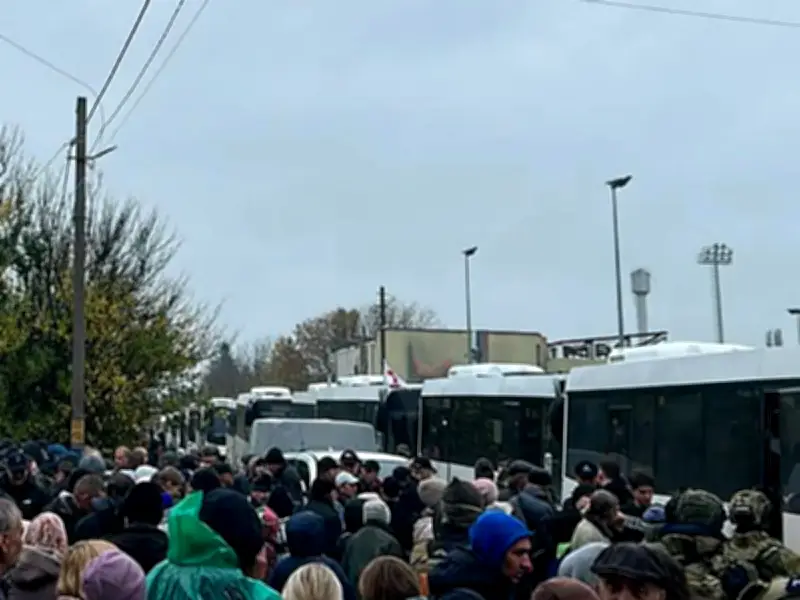
The evacuation of the Russian-occupied town of Oleshky has begun, with hundreds of stranded people being loaded onto 25 buses and ambulances. Around 1,000 people, including dozens of children, have been allowed to leave the town in Ukraine’s Kherson region.
Evacuees face agonizing choice
Terrified locals have told of an agonising choice of whether to stay to face a horrific winter or leave, despite fears they would be interrogated or sent to concentration camps. One scared man told Sky News: "Yes, I'm going, and other people are going too even though it's absolutely terrifying to head into the unknown. People are leaving because they realise this winter will be the hardest one throughout this bloody war."
It has been claimed around 2,000 people, including 50 children, have been trapped by minefields and Russian drone attacks since May. In the under-fire frontline city, food supplies had run out, there was no electricity or drinking water, with bodies of people reportedly lining the streets after Russian troops refused to allow them to be buried, locals claimed. It has been reported that some residents were so desperate they had been boiling grass to try and survive.
Ceasefire brokered with Vatican and US help
The temporary ceasefire, due to run out on Sunday at 11pm, was brokered with the help of the Pope and the US First Lady Melania Trump, to allow humanitarian aid delivery to Oleshky and to allow civilians to leave. Melania Trump said on X: "80 HOURS OF CEASEFIRE. Russian and Ukranian teams are on the ground in Oleshky, delivering aid and preparing the convoy for civilian evacuation. These coordinated operations are proceeding in full accordance with the agreements established between Ukraine and Russia."
The Ukrainian military had offered to extract people safely by boat across the Dnipro River front line, as the bridges were either mined or blown up. But Russian forces refused this route, demanding that fleeing civilians instead travel through their territory, to loop back into government-controlled Ukraine. Ukrainian officials said they feared Russians would use it as a 'propaganda show' and locals worried about interrogations.
Humanitarian aid and evacuation logistics
On Friday, Russian TV released images of an aid convoy delivering humanitarian supplies. Yana Lantratova, described as a Russian Human Rights Commissioner, said: "A large convoy has formed today which will deliver humanitarian aid to the town of Oleshky. It is based upon the people's needs and includes food, hygiene needs, medicine and fuel."
She was stood next to Ukrainian Ombudsman, Dymtro Lubininets, who said: "Everyone who wishes to receive aid will receive it, this includes assistance for those who wish to leave Oleshky." He said citizens who wish to go to Ukraine and those who wish to go to Russia will both be 'provided with assistance'. The Russian-installed head of occupied Kherson Oblast, Volodymyr Saldo, had earlier claimed residents will have a choice - either to stay in Russia or to travel to Ukrainian-controlled territory "to reunite with their families."
But Russia has been accused of doing everything they could to prevent this from happening. The Kyiv Independent claimed a source, speaking on condition of anonymity, said Russia had taken steps to ensure as few people as possible left for Ukraine. They said that patients at the city's only functioning hospital were being registered and told they faced 'filtration' if they left - a security screening and interrogation system used by Russian forces against Ukrainian civilians in occupied territories. It was claimed Russian forces had also refused to go house-to-house to inform sick people that the evacuation was happening, and those living in outlying villages had been told they could be shot if they approached the assembly point.
War crime allegations and filtration concerns
Oleksandr Tolokonnikov, the deputy head of the Kherson regional state administration, the exiled Ukrainian authority, said that Russia planned to turn the evacuation into a propaganda show. He told The Times: "The Russians will do everything possible to persuade people to stay in the occupied territories or in Russia and prevent them from going further. They want to use this situation for propaganda, to show the world that people are happy living under Russian occupation and that nobody wants to leave for Ukraine or Europe."
Human rights groups have said since Russia’s full-scale invasion of Ukraine on February 24, 2022, Ukrainian civilians, including those fleeing hostilities, have been forcibly taken by the Russians. They have been held in areas of Ukraine occupied by Russia or to the Russian Federation. This was described as "a serious violation of the laws of war amounting to a war crime and a potential crime against humanity." Human Rights Watch say Ukrainian citizens were subjected to a process referred to by Russia as "filtration," where they collect civilians’ biometric data, including fingerprints and front and side facial images. The civilians are interned as they are questioned about their political views, have to go through body searches, and their personal belongings and phones are searched. Many reported that they were housed in overcrowded and squalid conditions, for periods as short as several hours for up to almost a month.