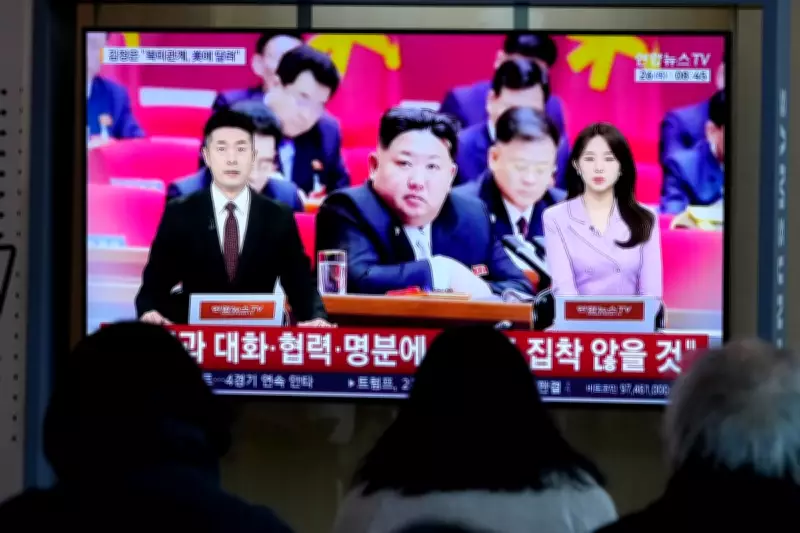
North Korea Issues Stark Warning to South While Signaling Potential US Engagement
North Korean leader Kim Jong Un has declared that his nuclear-armed nation possesses the capability to "completely destroy" South Korea if it perceives any threat to its security. The statement, delivered during the conclusion of a ruling party congress in Pyongyang, reiterates his steadfast refusal to engage with Seoul while simultaneously leaving the door open for potential dialogue with Washington.
Military Expansion and Nuclear Posturing
The official Korean Central News Agency reported that Kim Jong Un called for accelerated development of new weapons systems to bolster North Korea's military capabilities. These include intercontinental ballistic missiles that could be launched from underwater platforms and an expanded arsenal of tactical nuclear weapons specifically targeting South Korea, such as artillery systems and short-range missiles.
Kim asserted that the rapid advancement of North Korea's nuclear and missile programs has "permanently cemented" the country's status as a nuclear weapons state. He emphasized that any resumption of long-stalled dialogue with the United States would require Washington to discard what he perceives as "hostile" policies toward North Korea.

Strategic Positioning and Regional Dynamics
The Workers' Party congress, which began last Thursday, comes as Kim Jong Un seeks to establish a more forceful regional presence. This strategy leverages North Korea's expanding military nuclear program and growing alignment with Moscow, developments that have significantly deepened standoffs with both Washington and Seoul.
Analysts note that Kim's increasingly hard-line views toward South Korea have been developing since 2024, when he abandoned North Korea's long-standing goal of peaceful reunification and formally declared South Korea a permanent enemy. However, experts anticipated a more measured approach toward Washington to preserve possibilities for future dialogue, with the ultimate aim of securing sanctions relief and tacit recognition as a nuclear state.
Diplomatic Calculations and Foreign Policy
In his concluding report from the congress, Kim Jong Un stated that North Korea maintains the "toughest stance" against Washington but added there was "no reason we cannot get along" with Americans if they withdraw their supposedly hostile policy. North Korea frequently uses this terminology to describe U.S.-led pressure and sanctions targeting Kim's nuclear ambitions.
"Whether it's peaceful coexistence or permanent confrontation, we are ready for either, and the choice is not ours to make," Kim declared regarding U.S.-North Korea relations, emphasizing that prospects "depend entirely on the U.S. attitude."
Hardening Stance Toward South Korea
Kim Jong Un's vilification of South Korea reflects his assessment that Seoul, which previously facilitated his initial meetings with former U.S. President Donald Trump, no longer serves as a useful intermediary with Washington. Instead, he views South Korea as an obstacle to establishing a more assertive regional footing.
At the congress, Kim derided liberal South Korean President Lee Jae Myung's calls for engagement as deceptive, accusing successive governments in Seoul of seeking North Korea's collapse. He stated there is "absolutely nothing to discuss" with what he termed an enemy state and declared that North Korea would "permanently exclude" South Korea from the notion of a shared nation.
Weapons Development and Military Modernization
North Korea has made significant progress in recent years developing weapons from an extensive wish list Kim issued at the previous congress in 2021. These advancements include solid-fuel intercontinental ballistic missiles, tactical nuclear systems, and purported hypersonic weapons. The country launched its first military satellite in 2023 and has recently claimed progress in building a nuclear-propelled submarine.
During the latest congress, Kim set ambitious new goals to advance North Korea's nuclear forces over the next five years. He called for faster production of nuclear warheads and a broader range of delivery systems, emphasizing naval capabilities through underwater-launched ICBMs that could potentially be fitted on the nuclear-propelled submarine currently under construction.

Additional military priorities include developing artificial intelligence-equipped attack drones, strengthening electronic warfare capabilities to disable enemy command centers, deploying more advanced reconnaissance satellites, and creating unspecified weapons to target enemy satellites. Kim also announced plans to deploy more nuclear-capable artillery systems against South Korea in phased annual increments while accelerating efforts to "fortify" the inter-Korean border.