Met Opera Director Yuval Sharon Embarks on Wagner's 'Tristan und Isolde' - The Ultimate Staging Challenge
In a bold artistic move, Metropolitan Opera director Yuval Sharon has declared Richard Wagner's "Tristan und Isolde" to be the single most difficult work in the traditional opera repertoire to stage successfully. This declaration comes as Sharon prepares to make his Metropolitan Opera debut by directing a groundbreaking new production of Wagner's epic love story, which has already generated unprecedented excitement among opera enthusiasts.
The Impossible Challenge That Drew Sharon to the Met
Sharon, author of the 2024 publication "A New Philosophy of Opera," had previously written about the extraordinary challenges presented by "Tristan und Isolde" before being offered the directorial position at the Met. "It's something I wrote before I got the job, and it's part of why I took the job," Sharon explained. "Because I knew it was the hardest, and I love impossible challenges."
Metropolitan Opera general manager Peter Gelb expressed his long-standing admiration for Sharon's work, noting he has followed the director's career "since he was an enfant terrible" known for innovative productions in Los Angeles and Detroit. "I think it was inevitable ... that he would end up eventually at the Met," Gelb stated. "It was just a matter of finding the right project. It's finally landed in this production."

Unprecedented Audience Demand and Expanded Performances
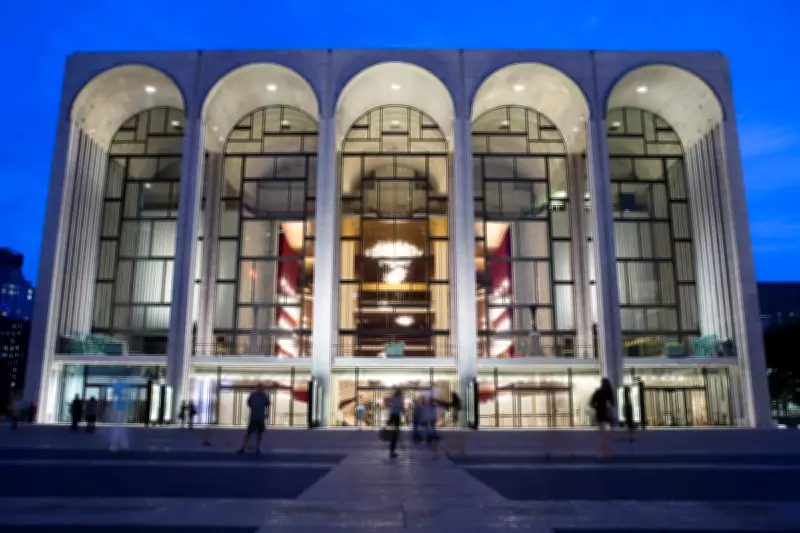
Anticipation for this production has reached extraordinary levels, particularly because Norwegian soprano Lise Davidsen has been cast in the demanding role of Isolde. The excitement proved so intense that all seven originally scheduled performances sold out the Met's 3,800-seat auditorium well before the March 9 opening night. In response to this overwhelming demand, the Met announced on Friday that it would add an eighth performance at the conclusion of the initial run.
Gelb's confidence in Sharon extends beyond this single production. The general manager has also entrusted Sharon with directing a new production of Wagner's monumental four-part "Ring" cycle, scheduled to launch in just two years.
Navigating Wagner's Philosophical Depths
According to Sharon, what makes "Tristan und Isolde" particularly daunting to stage is the profound philosophical foundation that Wagner built into this tale of passion, betrayal, and death. The composer, who wrote his own librettos, used the narrative as a framework for characters to explore what Sharon describes as "images of polarity: day and night, male and female, body and spirit, life and death."
"The opera is an encounter with the unknown and the inexpressible," Sharon elaborated. "It's both oceanic in scope and completely intimate in its perception." Gelb offered his own perspective: "It's a story that is short on plot and very big on the mythological and metaphysical aspects of the relationship between Tristan and Isolde. This isn't 'La Boheme.'"
Innovative Staging and Symbolic Design
Sharon's production begins with the two lead singers dressed in contemporary clothing, seated at a table positioned near the front of the stage. Set designer Es Devlin explained this approach: "We first see them as the singers who will be singing their roles. And they're a bridge between you and me and the work."
During the orchestral prelude, the singers gradually become immersed in the story of the doomed lovers. They eventually leave the table and reappear costumed as Tristan and Isolde within an oval-shaped opening in a wooden wall that spans the entire Metropolitan Opera proscenium. Sharon described them as "almost like shamanic figures who are about to take us into another world. Shamans go to a very risky place. They touch this other world but they stay in our world and they help communicate between them."
The Transformative Tunnel Design
By the third act, when Tristan has been mortally wounded, the oval opening deepens into a tunnel with a light visible at its end. For Sharon, this tunnel evokes descriptions of near-death experiences while simultaneously suggesting the process of a child entering the world from the womb - imagery that Tristan himself describes in the opera's text.

The tunnel design provides a practical benefit for the performers: the set functions as a kind of megaphone that helps project their voices throughout the auditorium. "It's a really practical consideration which comes back to this opera being barely performable," Devlin noted. "You are designing a musical instrument to support those voices."
As the principal singers disappear into the drama, two actors wearing costumes similar to theirs replace them at the table, with the two pairs switching places intermittently throughout the performance. Ordinary objects on the table also transform into "portals into another dimension," according to Sharon, including a water jug that becomes magnified through projections until it transforms into the Celtic Sea that Isolde crosses on her voyage to Cornwall.
The Largest Set in Metropolitan Opera History
If the staging concept represents an ambitious undertaking, the physical set itself may be even more remarkable. "This is physically the first production in the history of the Met that actually fills the proscenium not only from side to side but top to bottom," Gelb revealed.
John Sellars, assistant general manager for production, provided staggering statistics: when the set was delivered by Hudson Scenic Studios in Yonkers, New York, it required 42 large shipping containers. By comparison, the Metropolitan Opera's second largest production, Puccini's "Il Trittico," requires only 27 containers.
Vocal Challenges and Casting Excellence
For the singers tasked with navigating this enormous set while bringing Sharon's conceptual vision to dramatic life, extraordinary musical challenges await. The title roles in "Tristan und Isolde" rank among the most difficult in all of opera, demanding both the vocal power to penetrate Wagner's massive orchestra and the stamina to sustain four hours of intense singing.
The Metropolitan Opera's cast features soprano Lise Davidsen, fresh from a triumphant role debut in Barcelona, and tenor Michael Spyres, who is undertaking the complete opera for the first time. They are joined by mezzo-soprano Ekaterina Gubanova and bass-baritone Tomasz Konieczny as Brangäne and Kurwenal, the lovers' faithful servants, while bass-baritone Ryan Speedo Green portrays the cuckolded King Marke. For the additional performance on April 4, Stuart Skelton will sing Tristan and Stephen Milling will perform as King Marke. Yannick Nezet-Seguin, the Metropolitan Opera's music director, will conduct the entire run, with the March 21 matinee being televised live in HD to movie theaters worldwide.