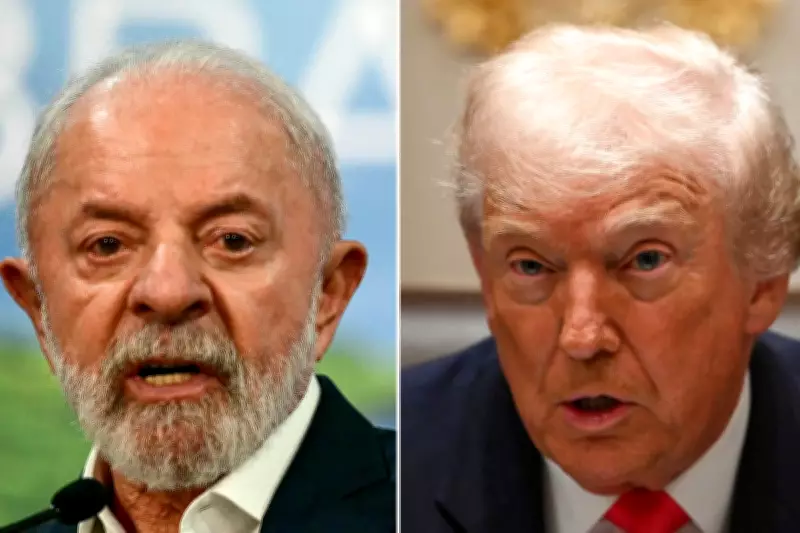
Brazilian President Luiz Inácio Lula da Silva is set to visit the White House on Thursday, aiming to rekindle what Donald Trump once described as their "excellent chemistry." The high-stakes meeting seeks to avert new tariffs on Brazilian goods and advance negotiations on critical minerals and combating organized crime, according to three individuals close to the Brazilian leader.
Despite the ambitious agenda, a Brazilian official involved in the preparations expressed caution. "We don't know if the visit will help," the official told Reuters, "But it's more likely to help than doing nothing."
Trade Tensions and Tariff Threats
The visit unfolds against a backdrop of recent trade tensions. Last year, Trump imposed steep 50% tariffs on Brazilian products, accusing the nation of a "witch-hunt" against Jair Bolsonaro, who was later convicted for attempting to overthrow democracy. While Trump subsequently withdrew most of these levies, including those on Brazilian beef and coffee, partly to ease rising US grocery prices, and the Supreme Court struck down broader tariffs, new concerns have emerged.

Brazilian exports still face a 10% tariff set to expire in July. However, in recent weeks, there have been signs of potential new tariffs stemming from a Section 301 investigation into alleged unfair trade practices.
Further friction points include Brazil's blocking of a US-backed renewal of the World Trade Organization e-commerce tariff moratorium and its high tariffs on certain goods, such as ethanol. The Office of the US Trade Representative also recently alleged that nearly half of Brazil's timber exports originate from illegal sources – a claim the Lula administration refutes, citing historically low deforestation rates.
Brazilian officials grew alarmed about a new wave of tariffs during a meeting with US officials two weeks ago. Sources present at the talks noted that officials asked few questions, fostering a perception that the investigation was designed to justify tariffs rather than resolve trade issues. "What they are doing is building a case, even if unfounded, to justify the later adoption of tariffs," one Brazilian official stated.
Critical Minerals as a Strategic Lever
Despite these trade disputes, a potential thaw began last September at the U.N. General Assembly, when Trump made his "chemistry" comment. This was partly a recognition of Brazil's vast reserves of critical minerals, according to Monica de Bolle, a Brazilian economist and senior fellow at the Peterson Institute of International Economics. The Trump administration's strategic interest in securing a rare-earth supply chain, vital to high-tech manufacturing, is expected to keep the meeting focused.
"On the part of the U.S., they are looking for some kind of deal – whatever that happens to be – on critical minerals and rare earths with Brazil," de Bolle explained. "The U.S. actually needs something from Lula."
However, a concrete critical minerals deal is not anticipated by the Lula administration, as officials have struggled to even agree on a basic memorandum of understanding. Brazil insists on domestic processing of minerals, while the US seeks a price floor mechanism to prevent China from leveraging its market influence to undercut Western producers. Discussions remain vague, lacking projections for investments, production, or timelines. This uncertainty is compounded by US investments, such as USA Rare Earth's $2.8 billion acquisition of Serra Verde's rare-earth mining operations, which are advancing without a clear regulatory framework, raising concerns in Brazil.
Nevertheless, both Trump and Lula have an incentive to demonstrate cooperation, suggesting that even a loose framework could be hailed as a success. "The bar is actually kind of low for both of them," de Bolle observed.
Organized Crime and Security Cooperation
Another significant point of contention revolves around White House efforts to designate Latin American gangs as terrorist groups. The Lula administration is actively trying to prevent such a move concerning local gangs like PCC and Comando Vermelho. Brazilian officials fear this designation could pave the way for US military intervention in Brazil or sanctions against banks unknowingly dealing with gang members.

Federal Police chief Andrei Rodrigues warned in March that such a decision could have "repercussions for the Brazilian economy, the productive sector, and the financial system." Instead, Lula plans to propose enhanced cooperation on organized crime, money laundering, and gun trafficking. An official working on the proposal admitted, "I don't think we will be able to sign anything because we sent it very recently."