Israel Intensifies Military Campaign with Dual Strikes in Lebanon and Iran
Israeli Prime Minister Benjamin Netanyahu has vowed to deliver "many surprises" in the next phase of the ongoing war, as Israel launched fresh assaults on southern Lebanon early Sunday and targeted a critical oil storage facility in Tehran. The escalation marks a significant broadening of the conflict, with the Israeli military asserting it will "not allow Iranian terrorist elements to establish themselves in Lebanese territory." These coordinated strikes follow a pattern of increasing regional violence that has already claimed hundreds of lives.
Tehran Oil Depot Blaze and Civilian Infrastructure Targeted
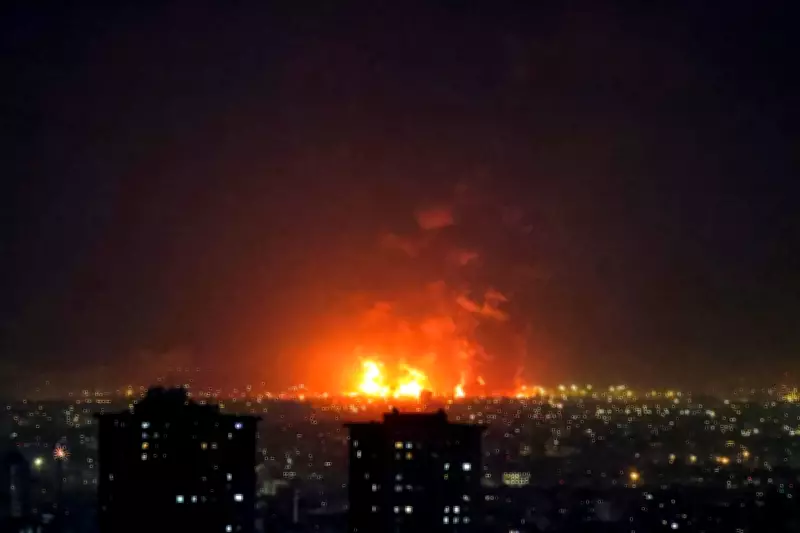
In a dramatic escalation, Israeli forces struck an oil storage depot in Tehran on Saturday, sending pillars of fire and heavy smoke billowing into the night sky. Associated Press footage captured the stark glow of the explosion, which state media attributed to "an attack from the U.S. and the Zionist regime." This facility supplies fuel to the capital and northern provinces, marking what appears to be the first time a civil industrial site has been directly targeted in the conflict. The attack underscores Israel's willingness to expand its military objectives beyond traditional military targets.
Lebanon Casualties Mount as Israeli Strikes Continue
The Lebanese Health Ministry reported that Israeli airstrikes killed eight people in southern Lebanon, with local media adding that an Israeli drone hit a hotel in Beirut, resulting in four deaths and ten injuries. These latest fatalities come on top of at least forty-seven others killed in Israeli strikes on Saturday. The Israeli military stated it was targeting senior figures within the Lebanese contingent of Iran's Revolutionary Guards' Quds Force, highlighting the proxy nature of the conflict.

Iranian Leadership Divided Amid Regional Apology
Iranian President Masoud Pezeshkian issued an apology Saturday for attacks on "neighboring countries," even as Iranian missiles and drones continued to target Gulf Arab states. His statement revealed a rift within Iran's leadership council, which has governed since Supreme Leader Ayatollah Ali Khamenei was killed in the war's opening airstrikes. Pezeshkian emphasized that "from now on, they should not attack neighboring countries or fire missiles at them, unless we are attacked by those countries," advocating for diplomatic solutions.
However, hard-line judiciary chief Gholam Hossein Mohseni-Ejei, another council member, insisted that war strategy would not change, warning that "intense attacks on these targets will continue." This internal conflict complicates diplomatic efforts, with Pezeshkian dismissing U.S. President Donald Trump's call for unconditional surrender as "a dream that they should take to their grave."
Regional Fallout and U.S. Involvement Deepens
The conflict has triggered widespread regional consequences. In Kuwait, authorities confirmed two border guards were killed by a swarm of missiles and drones. The United Arab Emirates reported debris from an aerial interception killed a driver, bringing the UAE death toll to four since the war began. Saudi Arabia intercepted drones headed toward its Shaybah oil field and shot down a ballistic missile targeting Prince Sultan Air Base, which hosts U.S. forces.
In a significant development, a missile landed on the helicopter landing pad at the U.S. Embassy compound in Baghdad, the first such strike in the heavily fortified Green Zone since the war began. Iraqi caretaker Prime Minister Mohammed Shia al-Sudani condemned it as a "terrorist act" by "rogue groups." Meanwhile, Trump ruled out involving Kurdish fighters, stating "the war is complicated enough without having ... the Kurds involved," despite Kurdish willingness to assist in toppling Iran's government.

Human Cost and Global Implications
The fighting has resulted in substantial casualties, with at least 1,230 people killed in Iran, more than 290 in Lebanon, and 11 in Israel, according to official figures. Six U.S. troops have also died. The conflict has rattled global markets and weakened Iran's leadership through hundreds of Israeli and American airstrikes. Trump described U.S. operations as an "excursion" and suggested issues like rising gas prices would improve once the conflict ends, but reiterated "We're not looking to settle."
As the war enters a new phase, the limited control of Iran's theocratic leaders over the Revolutionary Guard becomes increasingly apparent. The paramilitary force, which answers only to the late Khamenei, controls ballistic missiles targeting Israel and other countries and appears to be selecting its own targets independently. With conflicting statements from Iranian leadership and continued military escalation, the path to diplomacy remains fraught with uncertainty and danger for the entire region.