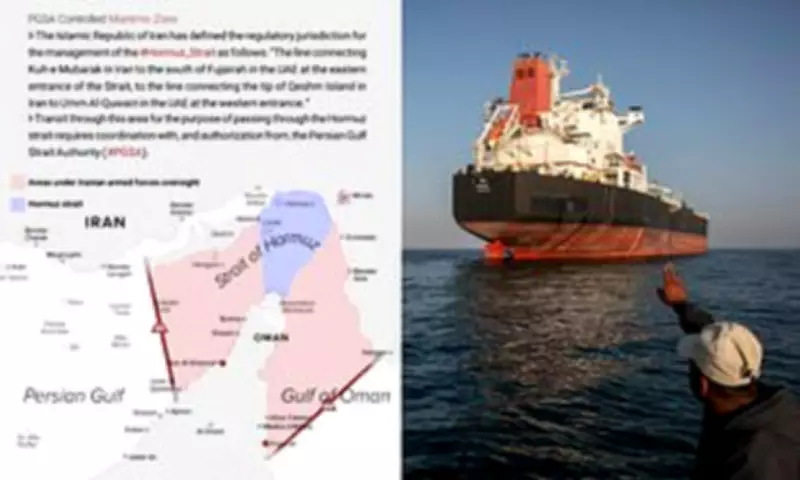
Iran has unveiled a new map of the Strait of Hormuz, which it says delineates the area of the vital waterway under its control. Since late February, following attacks by the United States and Israel, Iran has imposed a stringent blockade on the strait, through which one-fifth of the world's oil once flowed. This blockade has triggered a massive surge in global oil, gas, and energy prices.
Iran's Assertion of Control
Despite repeated international efforts to persuade Tehran to relent, the regime has maintained its iron grip on the Strait of Hormuz. The Persian Gulf Strait Authority (PGSA), an Iranian body established earlier this month to manage marine traffic in and out of Hormuz, announced that Iran is placing the region under the 'oversight' of its armed forces. The claimed area spans 8,800 square miles, extending into the territorial waters of Oman and the United Arab Emirates (UAE). The UAE has denounced Iran's claims as 'nothing but fragments of dreams.'
Iran's asserted lines of influence run from Kuh-e Mubarak to just south of Fujairah in the UAE on its eastern boundary, while the western line extends from the western tip of Iran's Qeshm Island to Umm Al Quwain, also in the UAE. The PGSA has declared that any 'transit through this area for the purpose of passing through the Hormuz strait requires coordination with, and authorisation from the PGSA.'

International Reactions
US Secretary of State Marco Rubio strongly condemned Iran's actions, accusing Tehran of attempting to establish a 'tolling system' in the Strait of Hormuz. He claimed that Iran was trying to persuade Oman to join the initiative. 'There is not a country in the world that should accept that,' Rubio stated, calling the idea 'not acceptable.' He warned that if such a system were implemented in the Strait of Hormuz, it could set a precedent for five other locations worldwide.
Despite Iran's latest announcement, Rubio acknowledged 'some slight progress' in the situation regarding Iran and the Strait of Hormuz. 'There's been some slight progress, I don't want to exaggerate it, but there's been a little bit of movement, and that's good,' he said. However, he reiterated that 'fundamentals remain the same,' emphasizing that 'Iran can never have nuclear weapons, it just cannot make them.'
A senior UAE official expressed skepticism about the likelihood of a resolution. Presidential adviser Anwar Gargash stated that the US and Iran have only a '50-50' chance of reaching an agreement to free up the Strait of Hormuz. He urged Tehran not to overplay its hand in the ongoing stop-start negotiations amid the fragile ceasefire in the Middle East war. 'Iranian officials have missed a lot of chances over the years because there's a tendency to overestimate their cards,' Gargash told the GLOBSEC Forum in Prague. 'I hope they don't do that this time.'
Regional Impact and Concerns
The oil-rich UAE, which hosts US military facilities, was targeted by approximately 3,300 drones and missiles during 40 days of war starting from February 28, according to Gargash. Only about four percent of these projectiles got through. He stressed that the Iran-blockaded Hormuz, which normally carries a fifth of global oil production, must return to normal operations. He cautioned against an inconclusive ceasefire, stating, 'Negotiations just to reach a ceasefire and sow the seeds for further conflict in the future is not what we're seeking. The Strait of Hormuz clearly has to go back to the status quo and this should be an international waterway.'
With US negotiators focusing on Iran's potential development of an atomic weapon, Gargash noted that the Iranian nuclear program has become the primary concern for the UAE. 'The Iranian nuclear program was our second or third worry, now it's our first worry,' he said. 'We see that Iran is capable of using any weapon that it has in its hands, which is what we learned.'