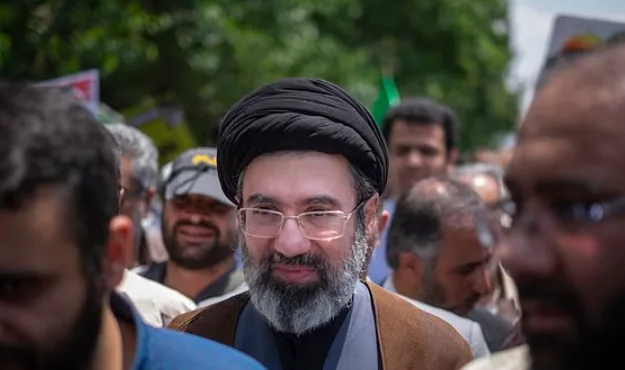
Iranian Leader's Son Holds Luxury London Apartments Overlooking Israeli Embassy
Mojtaba Khamenei, the son of Iran's recently deceased supreme leader Ali Khamenei and a potential successor to his father's position, owns two high-value luxury apartments in Kensington, West London, that directly overlook the Israeli embassy. This revelation has triggered significant security concerns among experts who warn of a potential surveillance operation.
Property Portfolio and Security Implications
The two apartments, situated on the sixth and seventh floors of a prestigious building, are estimated to be worth more than £50 million. They include ground-floor servants' quarters and are located less than 50 metres from the Israeli embassy building, placing them within close proximity to Kensington Palace, the official residence of the Prince and Princess of Wales.
Security specialists have expressed alarm at this arrangement, noting that the direct line of sight from these properties could facilitate monitoring and photography of embassy staff and visitors. The short distance also raises the possibility of audio capture from outdoor conversations and even laser-assisted monitoring of window vibrations to extract speech from inside the embassy. Additionally, the range could allow for hacking of embassy wireless networks to monitor internet traffic.
Roger Macmillan, a counter-terrorism specialist and former security director at Iran International, stated: "Iran owns the view into the back of the Israeli Embassy from less than 50 metres away. Two apartments, direct line of sight, held through Mojtaba Khamenei. That's not a property portfolio - it's a permanent surveillance platform. This is a serious security breach."
Investigation Findings and Broader Property Holdings
The ownership of these Kensington flats was uncovered through a year-long investigation by Bloomberg, which revealed that Khamenei has held the properties since 2014. The investigation further disclosed that Khamenei owns an additional 11 mansions in Hampstead, North London, acquired through a front man and a shell company registered in the Isle of Man. These Hampstead properties are located on Bishops Avenue, often referred to as Billionaire's Row.

Combined, the Kensington and Hampstead properties are valued at an estimated £200 million. Most of these properties are reportedly empty, with several in a derelict state. The funds for these acquisitions are believed to have originated from Iran's sanction-busting oil programme, according to the Bloomberg probe.
Legal and Sanctions Context
The properties are held through Ali Ansari, an Iranian oligarch described as a close family friend and trusted front man. Ansari purchased the Kensington flats in 2014 and 2016 for £16.7 million and £19 million, respectively, shortly after acquiring the Hampstead properties for Khamenei in 2013 for £73 million. The Hampstead acquisitions were made via Birch Ventures Limited, a shell company registered in the Isle of Man, with Ansari listed as the beneficial owner in Land Registry and company documents.
Since October of last year, all 13 properties have been subject to charges imposed by the Treasury, preventing their sale. These charges followed sanctions against Ansari, who is accused by the Treasury of being a corrupt banker financing the Islamic Revolutionary Guards Corps (IRGC).
Roger Gherson, a lawyer representing Ansari, commented: "Mr Ansari vehemently denies any financial relationship with Iran's Islamic Revolutionary Guard Corps or the son of the former supreme leader. It is his intention to challenge the UK Government's decision to impose sanctions."
Recent Arrests and Broader Concerns
This revelation coincides with the arrest of four Iranians in north London early on Friday, suspected of spying for Iran's intelligence services. The individuals, who are Iranian and dual British-Iranian nationals, are alleged to have been surveilling Jewish locations and individuals, potentially including synagogues and worshippers in London. Additionally, six others were arrested in Harrow, north-west London, on suspicion of aiding and abetting an offender, though sources indicate they are not linked to any plots.
A spokesman for Transparency International highlighted the broader implications: "We now know that Iran's political leaders have invested heavily in the UK over the last 10 years. Failure to build effective defences to tackle money laundering in the UK has national security implications, leaving our financial system vulnerable to leaders from hostile, kleptocratic states and cronies who finance their regimes."
The Israeli embassy has declined to comment on the matter. The situation underscores ongoing tensions and security challenges related to Iranian activities in the UK, particularly concerning diplomatic missions and community safety.