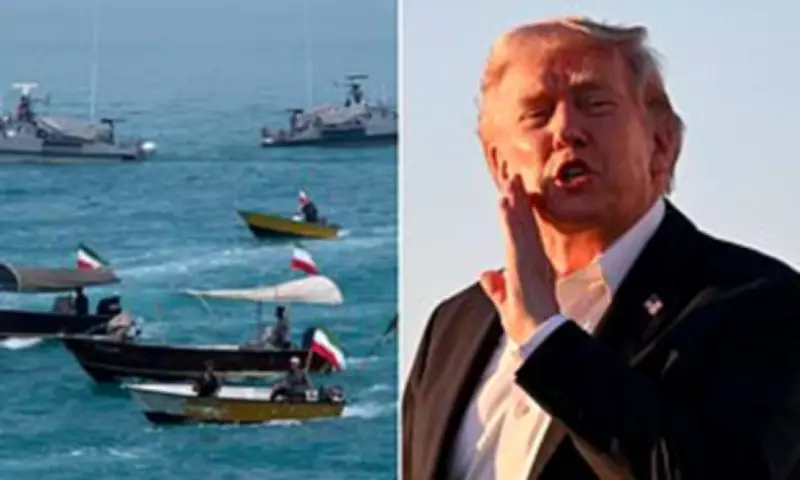
Iran's navy prevented 'American-Zionist' warships from entering the Strait of Hormuz on Monday, state TV reported, while the Fars news agency said two missiles had struck a US warship near Jask island after it ignored Iranian warnings. This follows Iran's warning to US forces earlier on Monday not to enter the strategic waterway after President Donald Trump stated the United States would 'guide out' ships stranded in the Gulf due to the US-Israeli war on Iran.
IRGC Warning and New Maritime Map
A spokesperson for Iran's Islamic Revolutionary Guard Corps (IRGC) declared that any vessel violating the Islamic Republic's maritime rules will be stopped by force, as stated in a statement carried by the Fars News agency. Iran's navy issued a new map of the area of the Strait of Hormuz under its control on Monday. The controlled area begins in the west with a line between the westernmost tip of Iran's Qeshm island and the United Arab Emirates' Umm al Quwain emirate. In the east, the area ends at a line between Iran's Mount Mobarak and the UAE's Emirate of Fujairah.
Trump's Humanitarian Gesture
Trump provided few details of the plan to assist ships and their crews that have been confined to the vital waterway and are running low on food and other supplies more than two months into the conflict. 'We have told these Countries that we will guide their Ships safely out of these restricted Waterways, so that they can freely and ably get on with their business,' Trump said in a post on his Truth Social site on Sunday. He added: 'This is a Humanitarian gesture on behalf of the United States, Middle Eastern Countries but, in particular, the Country of Iran. Many of these Ships are running low on food, and everything else necessary for largescale crews to stay on board in a healthy and sanitary manner. I think it would go a long way in showing Goodwill on behalf of all of those who have been fighting so strenuously over the last number of months.' Trump warned: 'If, in any way, this Humanitarian process is interfered with, that interference will, unfortunately, have to be dealt with forcefully.'

Iran's Response and Blockade
In response, Iran's unified command told commercial ships and oil tankers to refrain from any movement not coordinated with Iran's military. 'We have repeatedly said the security of the Strait of Hormuz is in our hands and that the safe passage of vessels needs to be coordinated with the armed forces,' Ali Abdollahi, head of the forces' unified command, said in the statement. 'We warn that any foreign armed forces, especially the aggressive US Army, will be attacked if they intend to approach and enter the Strait of Hormuz.' Iran has blocked nearly all shipping into and out of the Gulf apart from its own since the start of the war, cutting off around a fifth of the world's oil and gas shipments and sending oil prices soaring by 50 per cent or more.
US Central Command Support
US Central Command, which is blockading Iranian ports to pressure Tehran, said it would support the rescue effort with 15,000 military personnel and more than 100 land- and sea-based aircraft, plus warships and drones. 'Our support for this defensive mission is essential to regional security and the global economy as we also maintain the naval blockade,' Admiral Brad Cooper, the CENTCOM commander, said in a statement.
Iran's 14-Point Peace Proposal
Over the weekend, Iran sent a 14-point plan calling on the US to end the war within 30 days. The Middle Eastern nation's latest request aims to resolve the conflict instead of extending the ceasefire, according to Iran's state-linked media. Trump said he was reviewing the new Iranian proposal but expressed doubt it would lead to a deal. The proposal, a rebuttal to the US nine-point plan, also calls for the US to lift sanctions on Iran, end the naval blockade, withdraw forces from the region, and cease all hostilities, including Israel's operations in Lebanon, according to the semi-official Nour News agency. Washington wants Tehran to give up its stockpile of more than 400 kg (900 pounds) of highly enriched uranium, which the United States says could power a bomb. Iran says its nuclear program is peaceful but is willing to discuss some curbs in return for the lifting of sanctions. Iran sent its reply via a Pakistani intermediary, the news agency reported.

Iranian Spokesperson's Remarks
Asked on Monday about the US response to Tehran's latest offer, Iranian foreign ministry spokesperson Esmaeil Baghaei said he would not go into details but criticized Washington's stance. 'The US will not easily give up its habit of maximalism and unreasonable demands. We are still faced with a side that both changes its views regularly and raises issues that could complicate any diplomatic process,' he told reporters.
Rising Tensions and Incidents
Tensions continue to rise as vessels attempting to transit the Strait of Hormuz have reported being fired on, and Iran has seized others. Soon after Trump's comments on Sunday, the United Kingdom Maritime Trade Operations agency said a tanker had reported being hit by unknown projectiles in the strait. All its crew were reported safe in the incident, which occurred 78 nautical miles north of Fujairah, in the United Arab Emirates. In a rare piece of good news, Pakistan said on Monday the US had handed over 22 crew from an Iranian container vessel that American forces had seized last month in what Tehran called a violation of international law. Pakistan, which has been trying to broker a peace deal, described the US move as a 'confidence-building measure.'
International Coalition and Oil Prices
The Trump administration has been seeking help from other countries to form an international coalition to secure shipping in the strait. CENTCOM said the latest effort announced by Trump would combine 'diplomatic action with military coordination.' It was not immediately clear which countries the US operation would aid or how the operation would work. Meanwhile, crude oil prices edged higher on Monday, and analysts said they were likely to remain above $100 a barrel with no peace deal in sight and the Strait of Hormuz still largely blocked.