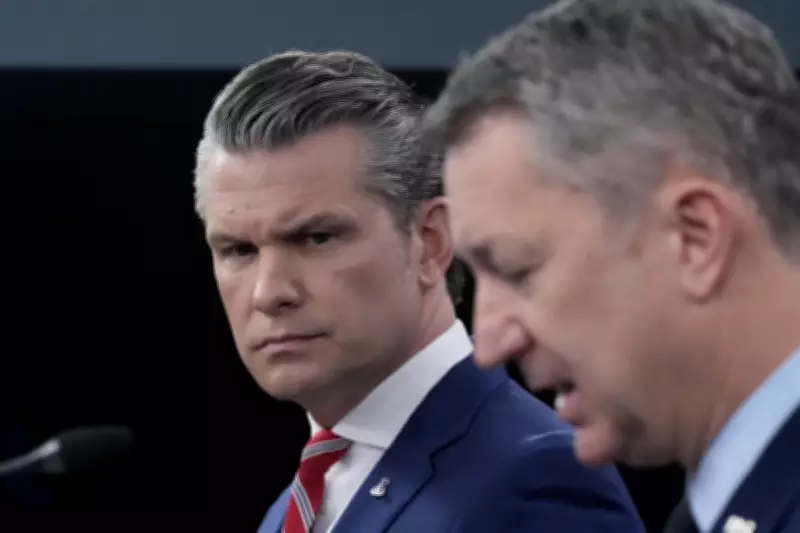
U.S. forces launched an effort to guide commercial ships through the Strait of Hormuz on Tuesday, with the first two vessels, both American-flagged merchant ships, sailing through without incident. Joint Chiefs Chairman General Dan Caine stated that the safety corridor in this critical waterway for oil and gas transport involves guided-missile destroyers, over 100 aircraft, and 15,000 service members. Defense Secretary Pete Hegseth emphasized that the forces prefer a peaceful approach to "guide" the more than 22,500 mariners stranded on over 1,550 vessels out of the Persian Gulf, but are prepared for any change in circumstances. "This is a temporary mission for us," Hegseth said. "We expect the world to step up." Iran has denounced the move as a violation of the ceasefire.
Uncertainty Surrounds Strait of Hormuz Situation
It remains unclear what will follow. The U.S. Central Command reported that Iran earlier launched multiple cruise missiles, drones, and small boats at civilian ships under U.S. military protection, and that U.S. helicopters sank six small boats involved in those attacks. It denied Iranian reports that American vessels had been struck. Secretary of State Marco Rubio will travel to Rome and Vatican City this week in an attempt to ease rising tensions between President Donald Trump and Pope Leo XIV. Trump has again lashed out at the pope, misrepresenting the pontiff's concerns about the Iran war and accusing him of "endangering a lot of Catholics."
Analyst Torbjorn Soltvedt, principal Middle East analyst at Verisk Maplecroft, said the situation remains highly uncertain because Iran still intends to attack ships that do not use the Iran-approved route near its coastline. "This initiative alone isn't something that looks like it's going to open the Strait of Hormuz," he noted. Shipping and insurance companies "still have to wait and see how this plays out." The northern route requires vetting by the Islamic Revolutionary Guard Corps and, in some cases, payment. The U.S.-guided "Project Freedom" route goes through Omani territorial waters to the south. Reopening the strait "can really only be done through either an agreement between the United States and Iran," or if the U.S. significantly diminishes Iran's ability to attack using drones, missiles, and small boats.

French President Says Iranian President Requested Talks
French President Emmanuel Macron said Tuesday, "I will be speaking with the Iranian president shortly at his request." He added, "France has maintained a consistent position from the start. We call for the cessation of all hostilities, the return to diplomatic negotiations, and respect for all countries in the region. The only possible option is the reopening of the Strait of Hormuz ... and the absence of any tolls or coercive measures." Macron warned that "any unilateral escalation against tankers, container ships, or third countries is a mistake that fuels war and leads to escalation."
Hegseth: Iran Still Had 'Will' to Develop Nukes
After the bombing of nuclear sites last summer, Hegseth said U.S. forces participated in new strikes this year alongside Israel because the Iranians' "will was still there to seek a nuclear bomb." He was asked about intelligence reports showing that, despite the initial bombing in Operation Midnight Hammer, the timeline for Iranian nuclear weapon development remained at 9 to 12 months. "The obliteration of those facilities set back their program," Hegseth said. "Hopefully Iran chooses a deal that they give up those ambitions, give up those capabilities."
Ceasefire Remains in Effect, Hegseth Confirms
The defense secretary confirmed that the ceasefire remains in effect despite some Iran strikes and the ongoing U.S. blockade. "No, the ceasefire is not over," Hegseth said, reaffirming Caine's earlier statements. General Dan Caine noted that more than 100 U.S. military aircraft are patrolling the skies "24 hours a day," and Tuesday marked a "quieter" period in the Strait. He added that 22,500 mariners on over 1,550 vessels in the Persian Gulf remain unable to transit. Caine commended the troops of the 82nd Airborne Division for using "next generation tactical networks" to "seamlessly synchronize" efforts.

Iran Attacks Below Threshold of Major Combat, Caine Says
Joint Chiefs Chairman Dan Caine told reporters at the Pentagon on Tuesday that Iran's recent acts of aggression are below the threshold of "major combat operations." Therefore, in the Trump administration's view, Tehran has not violated the tenuous ceasefire. "Since the ceasefire was announced, Iran has fired at commercial vessels nine times and seized two container ships, and they've attacked U.S. forces more than 10 times – all below the threshold of restarting major combat operations at this point," Caine said. The administration has cited the ceasefire in asserting that the president does not have to give a formal update to Congress on the war under the War Powers Resolution, which typically requires updates 60 days after beginning military action.
U.S. Forces Remain 'Locked and Loaded'
Pete Hegseth said in a Pentagon briefing Tuesday that U.S. military forces prefer the new effort to "guide" stranded ships through the Strait of Hormuz to be peaceful but are ready if needs change. "This is a temporary mission for us," Hegseth said, adding that the intent remains to hand control of the strait back to countries that need the waterway "a lot more than we do. … We expect the world to step up." Iran has denounced the move as a ceasefire violation.
Trump Renews Criticism of Pope Leo
Trump is renewing his criticism of Pope Leo XIV even as Rubio prepares to visit Vatican City to ease tensions between Washington and the Holy See. The president misrepresented the pontiff's concerns about the Iran war in an interview with conservative commentator Hugh Hewitt, saying Leo is aiding Tehran and making the world less safe. "The pope would rather talk about the fact that it's OK for Iran to have a nuclear weapon," Trump said. "And I don't think that's very good. I think he's endangering a lot of Catholics and a lot of people." Leo has not said Iran should obtain nuclear weapons. He has called for more peace talks, criticized war generally, and lambasted Trump's specific threats of mass civilian strikes. The pope has emphasized that he is reflecting biblical and church teachings, not speaking as a political rival to Trump.
Rubio to Visit Vatican Amid Tensions
Secretary of State Marco Rubio will travel to Rome and Vatican City this week in a bid to ease rising tensions between Trump and Pope Leo XIV over U.S. policies, particularly the Iran war. The State Department said Monday that Rubio, a Catholic who with this trip will have visited Italy or the Vatican at least three times as the Republican president's top diplomat, would be in Italy on Thursday and Friday. The Vatican announced that Rubio would meet with Leo, the first American pontiff, on Thursday. "Secretary Rubio will meet with Holy See leadership to discuss the situation in the Middle East and mutual interests in the Western Hemisphere," the department said. "Meetings with Italian counterparts will be focused on shared security interests and strategic alignment." The trip comes as Trump has criticized Leo for his stances on the Middle East and elsewhere and as the president has drawn pushback for posting a social media image likening himself to Jesus Christ.
Negotiations Make Little Progress
Iran's latest proposal for ending the war calls for the U.S. to lift sanctions, end the blockade, withdraw forces from the region, and cease all hostilities including Israel's operations in Lebanon, according to the semiofficial Nour News and Tasnim agencies, which have close ties to Iran's security apparatus. Iranian officials over the weekend said they were reviewing the U.S. response. Tehran has claimed its proposal does not include its nuclear program and enriched uranium, long a driving force in tensions with the U.S. and Israel. Iran wants other issues resolved within 30 days and aims to end the war rather than extend the ceasefire. Trump expressed doubt over the weekend that the proposal would lead to a deal.
Strait of Hormuz Closure Has Far-Reaching Consequences
The disruption of the waterway has squeezed countries in Europe and Asia that depend on Persian Gulf oil and gas, raising prices far beyond the region. The U.S., meanwhile, has enforced a naval blockade on Iranian ports since April 13, telling at least 49 commercial ships to turn back, according to its Central Command. It has also warned shipping companies that they could face sanctions if they pay Iran for transit of the strait. The blockade has deprived Tehran of the oil revenue it needs to shore up its ailing economy. U.S. officials have expressed hope the blockade will force Iran to make concessions in talks on its disputed nuclear program and other longstanding issues.
UAE Bore Brunt of Iran's Retaliation
The United Arab Emirates' Defense Ministry said its air defenses had engaged 15 missiles and four drones fired by Iran. Authorities in the eastern emirate of Fujairah said one drone sparked a fire at a key oil facility, wounding three Indian nationals. The British military reported two cargo vessels ablaze off the UAE. Indian Prime Minister Narendra Modi on Tuesday condemned the attacks, calling the targeting of civilians and infrastructure "unacceptable." On X, Modi said India stands in "firm solidarity" with the UAE, and stressed the need for safe and uninterrupted shipping through the Strait of Hormuz. Tehran did not confirm or deny the attacks, but Iran's Foreign Minister Abbas Araghchi early Tuesday said on X that both the U.S. and the UAE "should be wary of being dragged back into quagmire." Pakistan and Saudi Arabia condemned the strikes against the UAE. The Saudi condemnation came despite increasingly strained relations between it and the UAE.
Trump Vows to Reopen the Strait
U.S. President Donald Trump on Sunday warned that Iranian efforts to halt passage through the strait "will, unfortunately, have to be dealt with forcefully." He said the U.S. effort, "Project Freedom," was intended to aid tens of thousands of stranded seafarers on hundreds of ships stuck in the Persian Gulf since the war began. The U.S.-led Joint Maritime Information Center advised ships on Monday to cross the strait in Oman's waters, saying it had set up an "enhanced security area."
Iran Accuses US of Ceasefire Violation
Iran has called the new U.S. effort a violation of the fragile ceasefire that has held for more than three weeks. In a post on X on Tuesday, Qalibaf accused Washington of undermining shipping security in the Strait of Hormuz, and warned that a "new equation" there is taking shape. He signaled that Iran has yet to fully respond to the U.S. attempt to reopen the waterway, saying: "We know full well that the continuation of the status quo is intolerable for America; while we have not even begun yet." His statement did not mention negotiations with the U.S. that are now in the form of passing messages via Pakistan.