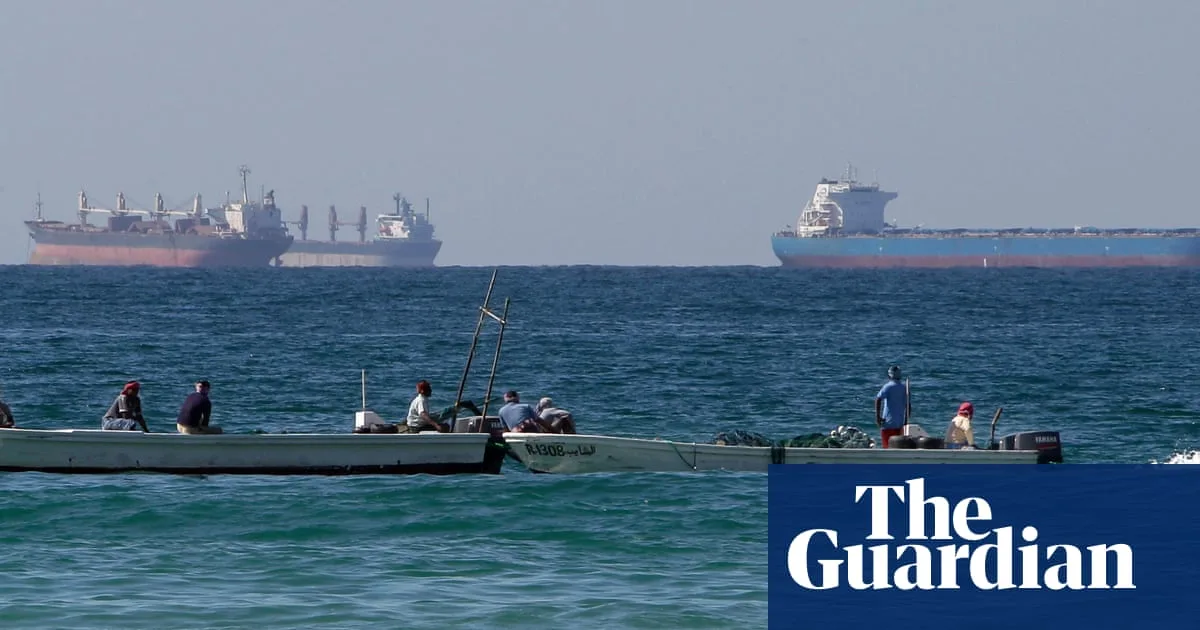
An eerie quiet hangs over Ras Al Khaimah’s industrial port. Usually a thriving maritime hub of the United Arab Emirates, now ships stand docked and silent. Not far out along the hazy horizon, a backlog of hundreds of tankers have lined up in recent days, halted along a waterway flooded with danger.
Any vessel heading past Ras Al Khaimah out to the Arabian Sea must traverse the world’s most treacherous strip of water for shipping today: the strait of Hormuz. Just over 20 nautical miles from Ras Al Khaimah, two oil tankers heading for the strait were attacked by Iranian missiles this week, one catching fire. On Saturday, Fujairah, the UAE’s main oil port on its east coast, was targeted by a drone attack, with thick black smoke seen billowing from its terminal.
It is one of the many consequences facing Gulf states as they are pulled deeper into a war that they did not start and had diplomatically tried to prevent. For decades, Bahrain, Kuwait, Saudi Arabia, the UAE, Qatar and Oman have allowed US military bases, infrastructure or access on their soil, and have been among the largest buyers of American weapons and technology. In return, the US has stood as the Gulf’s closest and most significant military partner and protector.
But now, Gulf states have growing concerns over the relationship, analysts say, after Donald Trump was seen to wilfully torpedo peaceful diplomatic negotiations in favour of starting a war in the Middle East. “The perceived Iran threat to the Gulf only became a reality when the US declared the war – Iran did not fire first,” says Khaled Almezaini, an associate professor of politics and international relations at Zayed University, in Abu Dhabi. “There is strong condemnation of the Iranians but at the same time there’s a message to the Americans and the Israelis that, well, we have to find a way to end this. This is not our war.”
In the weeks before the strikes, Gulf leaders hosted negotiations and made repeated overtures to the US president, emphasising the severe consequences for regional security if he attacked Iran. Yet Trump chose to carry out the strikes, it is widely believed, without consulting or warning Gulf allies. While the Gulf expected to be caught in the backlash, the scale of Iran’s campaign of revenge has left many shocked. Gulf states had assured Tehran that none of their bases would be used for attacks but that has not stopped Iran launching thousands of drones and missiles targeting airports, military bases, oil refineries, ports, hotels and office buildings.
Aviation in the region remains highly restricted, with airlines losing billions of dollars. Bahrain is facing an economic crisis, while the UAE’s reputation as a haven for tourism and western investment has taken a significant hit. States are successfully rebuffing most Iranian missiles and drones, but the interceptors and air defence systems are costing countries like the UAE upwards of $2bn (£1.5bn). Iran’s violent blockade of the strait of Hormuz – the only sea passage linking the Gulf with the open ocean and through which a fifth of global energy supplies are carried – has led to a drastic reduction in the oil and gas exports that bankroll Gulf economies. Experts estimate that between $700m and $1.2bn is being lost every day in oil exports.