
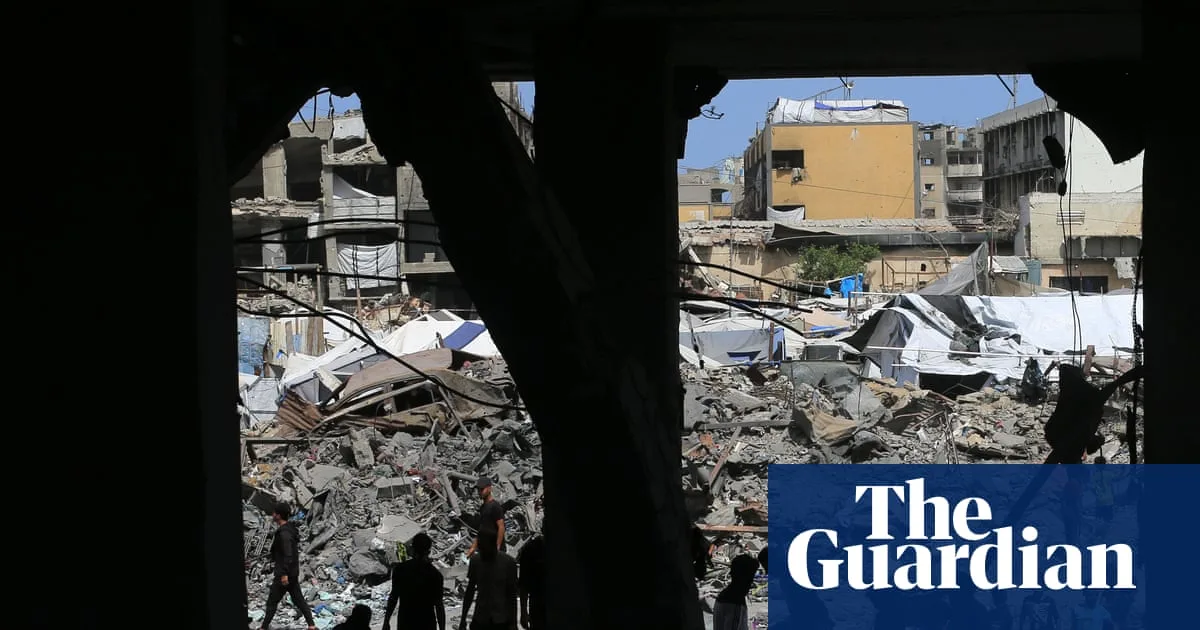
More than seven months after a ceasefire deal was brokered by Donald Trump, Gaza remains in a grim limbo, with no reconstruction under way and the Board of Peace struggling to secure funding. Palestinian technocrats chosen to run the strip are effectively sidelined in Egypt, awaiting security guarantees and diplomatic permission to enter Gaza.
In a 15 May submission to the UN Security Council, the Board of Peace said the "principal obstacle" to implementing Trump's plan was Hamas's refusal to hand over weapons and cede control. However, several people familiar with the body said funding shortfalls could jeopardise the effort. Nine countries pledged $7bn (£5bn) at the board's inaugural meeting, but only the United Arab Emirates and Morocco have sent funds. The group has received $23m for operations and an additional $100m for a future Palestinian police force, amounting to roughly $1.75 for every $100 pledged.
The UN has estimated the cost of rebuilding Gaza at upwards of $70bn over decades. Several countries that initially pledged money are now reluctant to pay, according to five people familiar with the organisation. "Countries are hesitant to pay their portions," said one diplomat, while another source noted that the Iran war has provided cover for delays. "Nobody with money and resources wants to work with the Board of Peace," said a third person familiar with the group's efforts.
Nickolay Mladenov, the Bulgarian diplomat serving as "high representative" for Gaza, admitted last week that Palestinians had been let down. "The door to the future of Gaza is still closed. It is not what the Palestinians were promised, and it is not what they deserve," he told journalists in Jerusalem. He added that the impasse also jeopardised Israel's long-term security. Mladenov's report to the UN Security Council urged donor states to contribute funds "without delay", noting that committed but undisbursed funds represent the difference between a framework on paper and one that delivers on the ground.
A senior Board of Peace official denied urgent funding challenges, insisting donors remained committed and that the UN appeal was made in the context of longstanding shortfalls in UN aid programmes. The official said Morocco, Bahrain and the UAE had all transferred money, though a person familiar with the board denied that Bahrain had sent any funds. Trump has pledged $10bn in US funding, but board officials have not formally requested it, and the money remains controlled by US State Department official Jeremy Lewin.
The board's expenses include salaries for 12 Palestinians appointed to the National Committee for the Administration of Gaza, who are being paid an average of $16,000 to $17,000 a month while waiting in Egypt. Fundraising for the board is being handled solely by Aryeh Lightstone, a key Middle East policy adviser in both Trump administrations, who has been shuttling between Tel Aviv, Abu Dhabi and Washington to rally support for the plan.




