
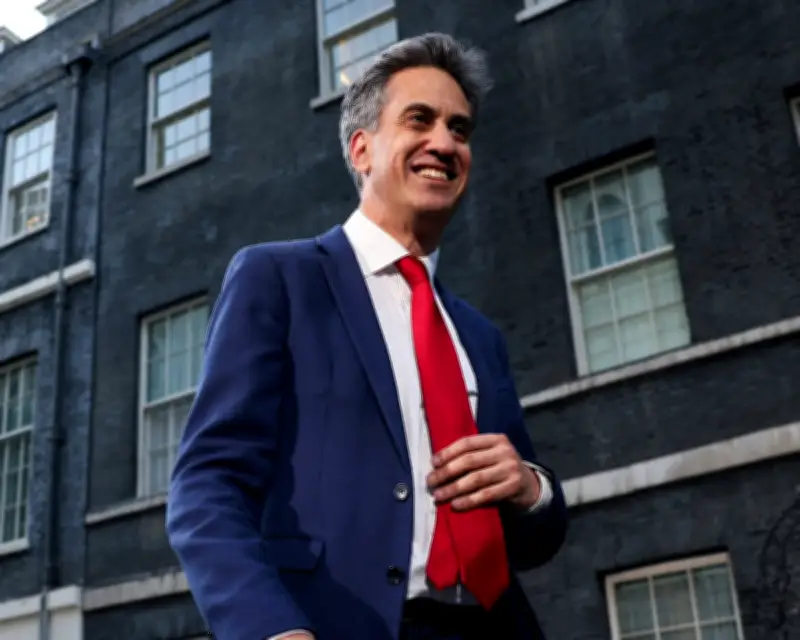
Ed Miliband was appointed foreign secretary in Andy Burnham’s first cabinet as prime minister last month, and allies say he is not nursing resentment after being deprived of the chance to be chancellor. “Ed has an immense appetite to get things done and is relishing being in this job,” one says. “Ed will be a policy-driven foreign secretary.”
Miliband is preparing a distinct agenda on relations with the EU over the next decade, Britain’s chairing of the G20 next year and the climate crisis. He is also determined to contribute to debates about shaping the international order of the future, which may take him into difficult territory given the volatility of the US alliance. On Palestine, his instincts are clear: in 2014, as Labour leader, he urged his MPs to vote to recognise Palestine, though action may take longer, partly because of Israeli elections and the sudden glimmer of progress over Hamas disarmament.
A difficult inheritance
Miliband becomes the tenth foreign secretary since William Hague stood aside in 2014. He arrives without a Foreign Office permanent secretary after the sacking of Olly Robbins, and with some staff on a rolling strike over the large job cuts that Robbins had announced.
Working with Hamish Falconer, the new Europe minister based in the Foreign Office, Miliband intends to be closely involved in talks on the UK’s relations with the EU, which he regards as the single biggest question facing the UK. His personal involvement gives the Foreign Office greater influence in the Europe debate than under Keir Starmer’s leadership, when the Cabinet Office was the sole proprietor of negotiations with the EU.
Miliband represents a Eurosceptic constituency and remains bound by Labour’s manifesto red lines not to enter the single market or customs union in this parliament. That does not prevent him from seeking to influence Andy Burnham’s longer-term thinking about where the UK’s relationship with the EU should be in 10 or 15 years. His aides argue Burnham has shown openness to ideas on social care, and the same openness may apply to issues such as European defence.
“Having a closer relationship with Europe is a key foreign policy priority to protect our national security and grow our economy,” an ally said. “Ed will be working in lockstep with No 10 and Hamish Falconer to make this happen. He sees Europe as at the heart of this agenda.”
Reviving the G20
Friends say Miliband wants to find a way to revive the ailing G20, a largely economic multilateral body that has been steadily declining in influence since 2008, when the UK played a major role coordinating the response to the financial crash during Gordon Brown’s premiership. In the latter days of his own time in No 10, Starmer appointed Brown as his special envoy on global finance and cooperation in advance of the G20. Brown will retain the role, working alongside Miliband, who was one of his advisers while chancellor. Lord Wood, a foreign policy adviser during the Brown premiership, has also been appointed to the Foreign Office as a minister in the Lords, and will bring experience and intellect to the role.
With the UK due to chair the postponed illicit finance summit in December ahead of taking over the G20, ideas such as a global wealth tax and greater transparency in overseas financial holdings are being promoted. The secrecy of Britain’s overseas territories has for a decade been a millstone in the UK’s call to combat corruption.
Kirsty McNeill, the new international development minister and a former executive director at Save the Children, has been asked to wrestle with the impact of massive aid cuts. She has previously said the UK will not regain credibility on aid unless it sets out a path for returning aid spending to 0.7% of GDP. Aid will fall to 0.3% next year, and Burnham’s £2 bus fare cap is being funded by a raid on the aid budget. The G20 at least provides a creative way for her to build alliances to tackle unjust debts and illicit financial flows.
A global wealth tax was proposed during the Brazilian presidency of the G20 in 2024 after a study commissioned from the French economist Gabriel Zucman. “There is overwhelming public support for this idea,” Zucman said at the report’s launch. “Ten years ago, nobody believed 130 countries would support a minimum tax on multinationals. It was thought of as utopian.” The report said billionaires were paying an average of 0.3% tax on their wealth, less than the rates paid by workers. Zucman said the average wealth of the top 0.0001% of individuals had grown by 7.1% a year on average between 1987 and 2024, increasing the share of global wealth held by billionaires from 3% to 14%.
Trump, Miami and the G20
Trump’s own G20 summit is due in Miami in December, by which time he could be diminished by a reverse in the midterm congressional elections. There has been a slow drop-off in world leaders attending the G20, partly owing to geopolitical rifts over Ukraine and questions over its value, but by next year the economic fallout from the war in Iran may require economic and political coordination.
Gaza and Labour pressure
Miliband is not expected to act quickly on Burnham’s admission that Labour needed to “do better” on Gaza. Burnham suggested action on trade with illegal Israeli settlements was on his agenda, but Foreign Office diplomats have questioned the enforceability of such a ban.
A debate is under way over whether European states would best help the political parties opposed to the Israeli prime minister in October elections by imposing fresh sanctions, underlining Benjamin Netanyahu’s diplomatic isolation, or whether he would use international disapproval to his domestic advantage. Pressure from Labour backbenches for a more robust policy that treats international law with the same seriousness in the Middle East as the UK does in Ukraine is intense. A letter from 80 parliamentarians coordinated by MP Kim Johnson called on Burnham to impose comprehensive sanctions on Israel and recognise the findings of the UN commission of inquiry that Israel is committing genocide. Burnham has said it is for the international courts to make such determinations.
The Trump balance
A consequential question will be how Miliband retains his progressive credibility while remaining on good terms with the US state department under Trump. Wood, a sceptic about past UK foreign military interventions, strongly opposed the US military attack on Iran. But the need to retain a modicum of US support for Ukraine has, ever since Trump’s election, been seen as an essential UK foreign policy priority, one that has required compromises and often involved working with the recently deceased Republican senator Lindsey Graham, a vocal supporter of Ukraine. That is unlikely to change in the short term.




