
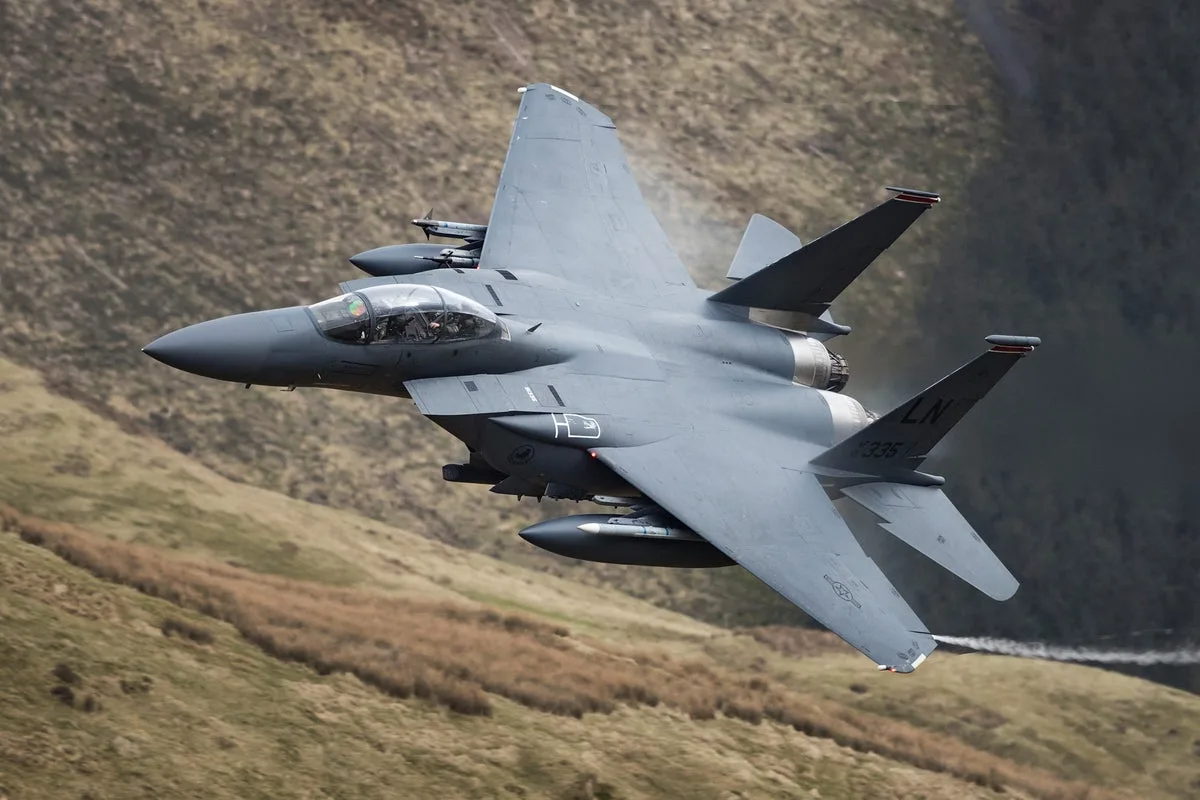
The CIA deployed a top-secret technology known as “Ghost Murmur” to locate and rescue a US airman who was shot down over Iran last weekend, according to reports. The officer, identified only by his callsign “Dude 44 Bravo” and described by President Donald Trump as a “highly-respected Colonel,” was the weapons system officer in an F-15E Strike Eagle that was brought down southwest of Isfahan on Friday.
While the pilot ejected safely and was rescued by military helicopters that same day, the second officer was injured and stranded 200 miles behind enemy lines for 36 hours. He activated a Boeing-made Combat Survivor Evader Locator beacon before hiding in a mountain crevice, but his exact location remained uncertain as he evaded capture with a bounty on his head.
The new Ghost Murmur technology, developed by Lockheed Martin’s Skunk Works division, uses long-range quantum magnetometry to trace the electromagnetic signals produced by a human heartbeat. The data is paired with AI software to isolate it from background noise and pinpoint its source. Speaking at a White House briefing, CIA Director John Ratcliffe said the agency used “exquisite technologies that no other intelligence service” possesses, comparing the effort to “hunting for a single grain of sand in the middle of a desert.”
A source told the New York Post that the technology works by detecting signals previously measurable only in a hospital setting with sensors pressed against the chest. Advances in quantum magnetometry, particularly using sensors built around microscopic defects in synthetic diamonds, have made it possible to detect these signals at much greater distances. The source described it as “hearing a voice in a stadium, except the stadium is a thousand square miles of desert.”
The source noted that the remote Iranian wilderness provided an “ideal first operational use” with minimal electromagnetic interference, meaning “almost no competing human signatures.” However, they cautioned that the capability is not omniscient and works best in low-clutter environments, requiring significant processing time. The technology has been tested on Black Hawk helicopters and may be considered for future use with F-35 fighter jets.




