
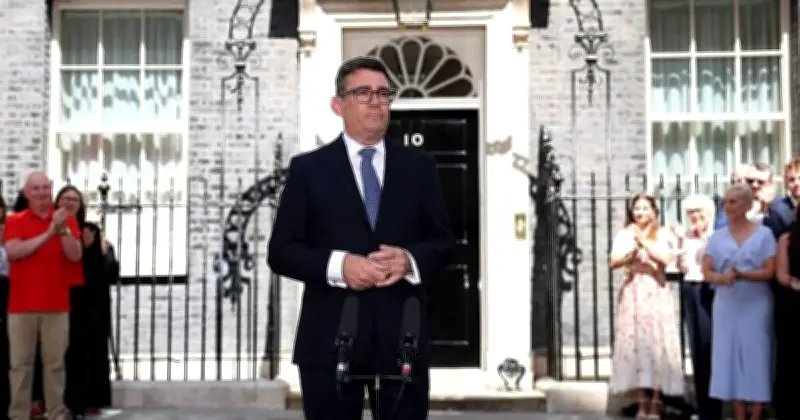
Volodymyr Zelensky will become the first world leader to meet Andy Burnham, as the pair hold a crucial meeting in the UK on Monday. The Ukrainian President is expected to join the Prime Minister at a British naval base, where the PM will share essential expertise to assist in producing cutting-edge electronic jammers designed to block Russian defence systems.
Stone Cloak technology
This will enable Ukraine to mass produce devices, known as Stone Cloak, preventing its drones from being tracked and targeted. Mr Burnham described the technology as "the best of homegrown British innovation".
He said: "Britain stands with Ukraine, shoulder to shoulder, and our support remains unwavering. Russia should be in no doubt of our resolve, and we will not back down until we achieve long-lasting and just peace for Ukraine." Stone Cloak is the best of homegrown British innovation and proven on the frontline, and it will be vital to protecting our security in both our countries.
No10 confirmed the UK is sharing the intellectual property for Stone Cloak, which will be integrated into the next generation of UK deep-strike capabilities. The British military will utilise the jammers to enhance Project Brakestop - the UK's new low-cost cruise missile. Thousands of the tablet-sized devices have already been donated to Ukraine to support drone operations. Downing Street stated the move sets back Putin's illegal invasion of Ukraine.
Training and support
During Mr Zelensky's visit, he and Mr Burnham will meet more than 200 Ukrainian military personnel and sailors who have been undergoing training in the UK over the past three weeks. The UK has previously committed £3billion a year to Ukraine to assist in its fight against Russia for as long as necessary - providing a total of £25bn in support since 2022.
Standing up to Trump
This comes as Mr Burnham revealed he was willing to stand firm against Donald Trump, should it serve Britain's national interest. In a BBC interview, due to be broadcast in full on Monday, he said: "Well, I've had one phone call. I always treat people as I find them, and it was a good exchange. It was, as I said before, a warm exchange. So I am that kind of politician, I always judge people as I find them. I've lived my whole life by that. And I found him to be really warm on Monday. But obviously we will continue to build the relationship as we go forward."
When pressed by journalist Laura Kuenssberg on whether he would be willing to challenge the President if necessary, Mr Burnham replied: "Of course... all leaders have to do that. You have to defend your own national interest before anything else. That's what you're required to do if you're to do this job properly. I will always put Britain's interests first."
Defence Secretary on Iran and US relations
His predecessor, Keir Starmer, had endured a fraught relationship with the US President after refusing to permit US forces to utilise British bases to launch aggressive strikes on Iran. On Sunday, newly appointed Defence Secretary Wes Streeting revealed he had held talks with his US counterpart Pete Hegseth, making it plain that this stance would remain unchanged. However, he confirmed that both nations were collaborating on efforts to reopen the Strait of Hormuz.
The vital shipping route, which carries 20% of the world's natural gas and oil supplies, has been effectively shut by Iran following US and Israeli attacks on February 28. Mr Streeting told Sky News: "I was clear that we've not supported offensive action in Iran and we won't support offensive action in Iran, but there are plenty of things that we can and should do together when it comes to securing the Strait of Hormuz, in making sure that Iran doesn't develop nuclear weapons, in terms of investing in our capability and Nato's capability."
He acknowledged the closure was inflicting significant economic damage, admitting: "But it's hard to undertake that work, of clearing the strait and securing commercial shipping while hostilities continue. And that's why every effort is being made, particularly by allies in the region, to try and bring about the conditions where we can achieve that."
Describing relations with the Trump administration he said: "The first thing you do is you don't suck up. And I don't think, my impression is, President Trump, his administration, that's not what they're looking for, actually. He's a straight talker." When asked whether he trusts the US President, the Defence Secretary replied: "Well, I don't know him, but I do trust the United States." He noted that the bond between the two countries is unparalleled anywhere in the world.
Chancellor's 'buy British' pledge
At the weekend, John Healey, the new Chancellor, pledged a "buy British" blitz within the UK government. He told The Sun: "You will see this as a determined drive that you have not seen before from a British government. Buying British not 'if possible', but by design. So every procurement pound supports British jobs, British apprenticeships and British skills."
He highlighted that during his tenure as Defence Secretary, over 86% of the 1,200 major defence contracts awarded were handed to British firms. The government has yet to establish a timetable for reaching 3% of the UK's gross domestic product (GDP) on national defence. Mr Healey told The Sun this was "not a matter for this first week".




