
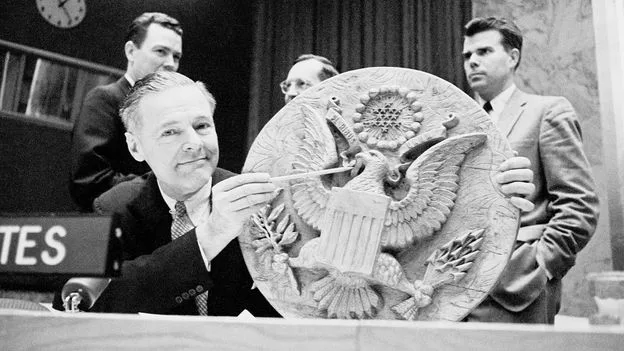
In 1945, during the final weeks of World War Two, a troop of Russian boy scouts presented the US Ambassador in Moscow, W Averell Harriman, with a hand-carved Great Seal of the United States. The gift, intended to symbolise cooperation between the two nations, was proudly displayed at Spaso House, the ambassador's official residence. Unbeknownst to Harriman and his security team, the seal contained a covert listening device later known as 'The Thing'. It remained undetected for seven years, eavesdropping on diplomatic conversations.
The Thing was a remarkable piece of engineering. John Little, a 79-year-old counter-surveillance specialist who built a replica, describes it as having tubes like organ pipes and a membrane 'like the skin of a drum, that will vibrate to the human voice'. Despite its sophistication, it was compacted into a tiny object resembling a hat pin, with no electronics or battery, making it invisible to counter-surveillance screening.
The device was activated remotely by a transceiver in a nearby building, which sent a high-frequency signal that reflected vibrations from the bug's antenna. It was only discovered in 1951 when a British military radio operator in Moscow accidentally tuned into its wavelength and heard conversations from a distant room. The following year, US technicians spent three days searching Spaso House before realising the Great Seal was the source.
Vadim Goncharov, a Russian technician who operated The Thing, noted that it provided 'specific and very important information' that gave the USSR advantages during the Cold War. The device's success was not only due to its technical ingenuity but also because it exploited cultural trust in beautiful objects. Russian intelligence weaponised the assumption that artworks are passive symbols of status or taste.
The Thing is not an isolated case. Throughout history, art has been manipulated for espionage and military strategy. Leonardo da Vinci designed tanks and siege weapons, Peter Paul Rubens spied during the Thirty Years War, and artists in both world wars devised camouflage. Even British art historian Anthony Blunt, Surveyor of the Royal Art Collection, was a Soviet spy. The inventor of The Thing, Lev Sergeyevich Termen (Léon Theremin), also created the world's first electronic instrument, the Theremin.




