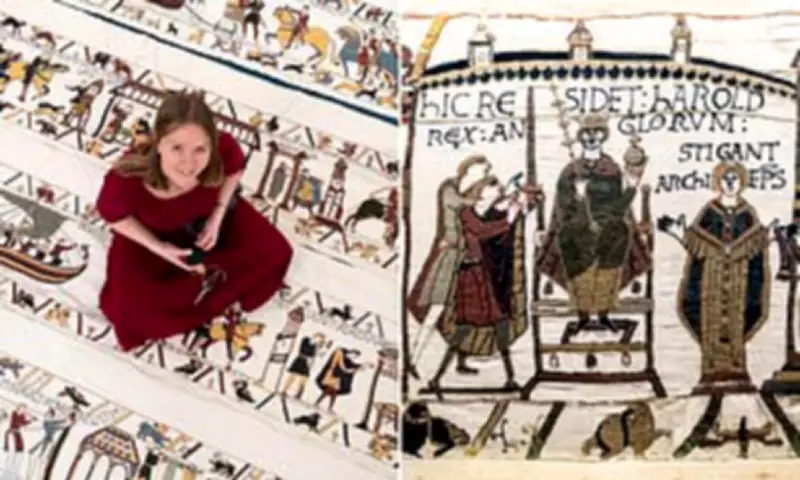
It has been hailed as the 'blockbuster show of a generation'—the first time in nearly 1,000 years that the Bayeux Tapestry returns to England. However, the British Museum's £33 entrance fee for a mere 40-minute viewing slot when the exhibition opens in September has sparked debate. If you feel that is a stitch-up, take heart: you can still view the classic tale of William the Conqueror and the Battle of Hastings at half the price—or even for free.
The tapestry, believed to have been commissioned by William's half-brother, Bishop Odo of Bayeux, has inspired numerous copies. For example, a Danish version in Jutland, completed in 2015 by a Viking women's group, costs around £16 to visit. A new English version is also underway, sewn by a fan of true-crime documentaries, with her progress tracked by 13,000 enthusiastic followers on Facebook.
Then there is the 19th-century life-size replica in Reading Museum, a magnificent copy with its own fantastic backstory connecting arts and crafts pioneer William Morris, Queen Victoria, and the late Rolling Stones drummer Charlie Watts. You can visit it free of charge.

'The original was a medieval masterpiece, but this tapestry is a masterpiece of the arts and crafts movement,' says Brendan Carr, communities engagement curator at Reading Museum. 'That makes it an artefact in its own right, not just secondary to Bayeux.'
It should be acknowledged from the outset that the Reading version is missing a few bawdy details from the original. Famously featuring 626 human figures, 190 horses, 33 buildings and 37 ships, the Bayeux Tapestry also includes 93 penises, both equine and human—of which none can be discerned in the Victorian replica.
The driving force behind the 230 ft Reading tapestry (more properly described, like the original, as an embroidery) was a formidable woman named Elizabeth Wardle. She lived in the Staffordshire market town of Leek with her husband, Thomas, a successful silk and textile manufacturer. The Wardles' colourful circle included Victorian celebrities such as William Morris and artist Dante Gabriel Rossetti, founder of the Pre-Raphaelites.
Much of Elizabeth's married life was taken up giving birth to and caring for 14 children before she suffered what is thought to have been a breakdown. Family legend has it that she only returned to health after Thomas brought embroidery home for her to do. Taking it up with enthusiasm, Elizabeth went on to establish the Leek Embroidery Society, which also helped promote her husband's textile business.
Elizabeth counted Sir Philip Cunliffe-Owen, who ran the South Kensington Museum (now the V&A), among her many friends, and it was Cunliffe-Owen who first showed her photographs of the Bayeux Tapestry in 1885. The idea of embroidering a replica 'so England [could] have a copy of its own' became an obsession. So, she mustered more than 35 women, assigned them different sections, and set them to work.
'These weren't noblewomen like those who stitched the first tapestry,' says Jan Messent, a renowned embroiderer and author of The Bayeux Tapestry Embroiderers' Story. Messent says that the Leek needlewomen were 'from the prosperous middle classes—the wives of merchants, businessmen and shopkeepers. And in contrast to the original, they all sewed their names on it, so we know who embroidered what.'
With the finished work due to go on display just one year later in 1886, the women had a tight and stressful deadline. Elizabeth's son later told the Reading Standard that 'every minute of the day revolved around the making of the tapestry'. Yet it would turn out that the more serious problem was the source material.
The women based their work on images supplied by Joseph Cundall, who had been commissioned by the British government to capture the original tapestry in photographs. Only three copies of Cundall's work have survived—one of which was owned by the late Rolling Stone Charlie Watts. When he died, the Bayeux Museum bought it for £16,000.

Cundall's photographic plates were hand-coloured by the South Kensington Museum before they were lent to the women of Leek to trace and copy. But the colourisation had blurred the different types of stitches being used. As Professor Gale Owen-Crocker, author of The Design of the Bayeux Tapestry, says: 'The pictures in this replica are an accurate representation, but the stitching isn't always. To adapt Morecambe and Wise's famous phrase, they use the right stitches but not necessarily in the right order.'
Then there is the controversial question of nudity in the Reading tapestry. Or, rather, the lack of it. Not that the Leek ladies can be blamed for the censorship: Responsibility for that lies with the South Kensington curators who, when they hand-coloured the photographic plates, removed anything explicit. 'The stallions in the original became geldings and the men were covered up,' explains Brendan Carr. 'There's a particularly well-endowed gargoyle [in the original] who looks like he's wearing a nappy because of his size. So, it isn't a case of prudish Victorian ladies—it was the male curators thinking they were protecting them.'
The tapestry was finally unveiled on June 14, 1886, and quickly proved a sensation. More than 1,200 people paid a shilling to view it (about £8.50 today). It went on tour around the country and was exhibited in New York and Germany before it came back to Britain for Victoria's Golden Jubilee in 1887.
Yet taking the tapestry on tour involved a great deal of work—and expense. So, when in 1895 alderman Arthur Hill (half-brother of Octavia Hill, founder of the National Trust) offered £300 on behalf of the town of Reading, the Leek ladies eagerly accepted—aside, that is, from Elizabeth, who was horrified by the deal.
'By this time, the fame of the tapestry had even reached Queen Victoria who summoned Arthur Hill and the tapestry to Windsor Castle,' says Carr. The monarch's rather sniffy diary entry noted only that she had viewed 'a very curious copy of the celebrated Bayeux Tapestry'. But she seems to have been alone in her downbeat view when it comes to all things Bayeux.
'The tapestry is fundamental to our heritage,' says Owen-Crocker. 'The Norman conquest changed the ownership of land, the Church, the language we speak. It is enormously important.' Perhaps that is what has fuelled the many reproductions.
The Danish version in Borglum Abbey, Jutland, took nine women in the 'Vikinggroup'—teachers, nurses, bank tellers and cleaners—14 years to complete and is true to the original (nudity and all). Meanwhile, Jan Messent was commissioned by an embroidery company to create an ending for the original Bayeux work as the final eight feet had been lost. 'Or it's the possibility the final scene was purposely hacked off as someone's personal trophy, perhaps during the French Revolution,' she says.
Her work, which is also displayed in the Reading exhibition, shows a triumphant conqueror being crowned and ends with the words 'omnes gaudent' ('everybody rejoices'). 'Which is true to the spirit of Bishop Odo,' although that might not, she suggests, include the Saxons.
If you're a fan of the Normans and their Conquest, you could even buy your own Bayeux tapestry. Embroiderer Mia Hansson from East Anglia has been working on a version since July 2016, documenting her progress for 13,600 Facebook followers, who comment enthusiastically on her posts. It will eventually go on sale.
Hansson, who also cares for her disabled son, says she likes to watch true crime documentaries while she sews. 'I have no interest in history at all, but I have loved embroidery since I was five, when my nan taught me,' she says. 'I have a calm life, so I like to watch something gory when I stitch.' And there's certainly plenty of that in the Bayeux Tapestry. The only catch? With 30 ft still to go, she will have spent 10,000 working hours and forked out £1,200 on wool and fabric by the time it's complete. It will be put up for auction with a reserve of £1 million—which puts a £33 British Museum entrance fee in perspective.