
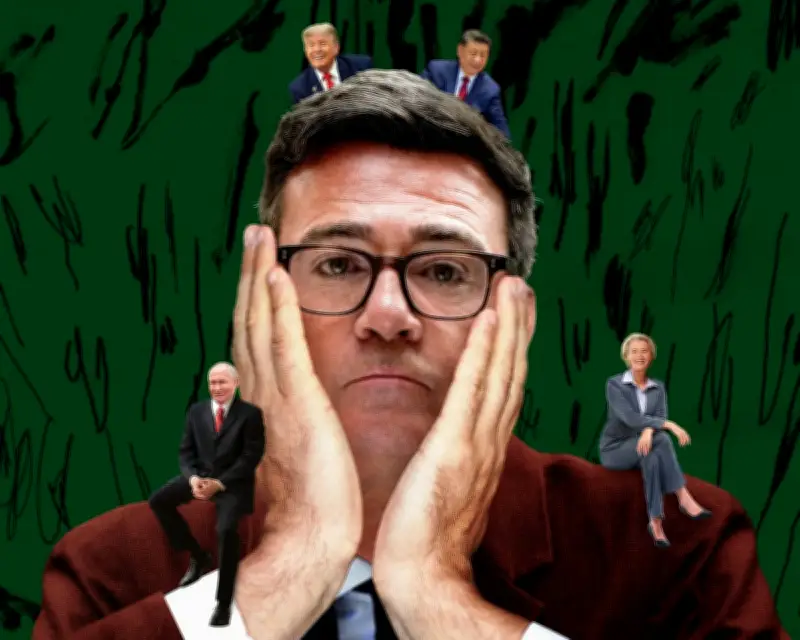
Andy Burnham is about to have a crash course in hardcore geopolitics, according to Guardian columnist Rafael Behr. The likely next prime minister would rather be in Warrington than Washington, but foreign policy will dominate his agenda more than he thinks.
If Burnham is lucky, he will get some time to adjust to the pace of life as prime minister before dealing with his first international crisis. It won’t be long, Behr warns.
Trump's Strategic Blunder in the Middle East
Donald Trump is an engine of constant turmoil. Aftershocks from his recent military adventure in the Middle East will be felt for years. None of the declared war aims were achieved. The Iranian regime was not toppled. The terms agreed for a ceasefire promise Tehran more generous sanctions relief with fewer conditions than were imposed under the nuclear containment deal that Barack Obama signed in 2015. It is a worse arrangement than the one Trump discarded in his first term as “one of the worst deals ever”. Stocks of US munitions and credibility have been drained.
It is a strategic blunder and a humiliation for Trump. Since he is incapable of owning a mistake, the injury to his pride will be nursed with vengeful spite. A wounded authoritarian leader compensates for the exposure of weakness with ever more aggressive performances of strength.
Russian Provocations and the Defence Investment Plan
A similar process is operating in the Kremlin. Vladimir Putin refuses to accept that his attempted conquest of Ukraine has failed. In his mind, the war is an existential battle to preserve Russian national honour against western hostility. Lack of progress on the frontline will lead to increased belligerence elsewhere. Kyiv’s allies can expect more Russian provocations – sabotage, drone incursions, cyber-attacks – and less US support to deal with them.
This is why the defence investment plan (Dip), published on Tuesday, matters so much and why the delay in its completion has been so embarrassing to Keir Starmer. Managing a dangerous global situation was supposed to be his strong suit. He preferred diplomacy to politics. He was more respected on the international summitry circuit than in the parliamentary Labour party. Tireless service to the country was, he believed, a better measure of achievement in office than sliding poll ratings. That view was his insulation against the clamour for new leadership. It was hard to sustain when the defence secretary resigned, citing frustration with the prime minister’s refusal to release resources vital to national security.
Military chiefs always want more money for weapons. Chancellors query whether existing budgets have been properly managed. The MoD’s record on that score is dismal. Mediating in those disputes, forcing the compromise, choosing between imperfect options, is a core competence in a prime minister. Starmer didn’t want to do it – not in defence and not in countless other cases where ministers had rival demands that could only be settled by intervention from No 10.
Burnham's Foreign Policy Gap
Burnham will be glad that the Dip row is done before it becomes his problem (although similar problems will land on his desk soon enough). He also won’t mind Starmer taking a valedictory turn on the international stage at the Nato summit in Ankara next week. That would be a tough first gig for a newbie prime minister with little experience of foreign affairs and no record of interest in them. Colleagues who have known Burnham for years, sharing cabinet and shadow cabinet tables with him, profess complete ignorance of his instincts on international questions.
Close allies say he is pro-European and suspicious of big US technology companies, but those are not lodestars in a geopolitical constellation. There is no developed concept of Britain’s place in the world equivalent to the role that Manchester’s economic success plays in Burnham’s analysis of the domestic sphere.
The gap will need filling. That requires last-minute cramming on foreign policy and smart delegation. Burnham is reported to be eager to retain Jonathan Powell, Starmer’s respected national security adviser. There is also speculation about a role for David Miliband, the former foreign secretary, now president of the International Rescue Committee. Outsourcing geopolitics and globe-trotting to a seasoned practitioner is a move with obvious appeal to a prime minister who would rather be in Warrington than Washington.
Starmer's Legacy and Burnham's Challenge
That may be a naive ambition. Starmer didn’t come to office with a yen for travel. International engagements ate his schedule because the world was on fire. But he also embraced that side of the job as a refuge when it turned out he had no feel for the Westminster game and no domestic priorities to call his own. Starmer deserves credit for keeping Britain out of the Iran war, for stalwart defence of Ukraine and for helping forestall total US betrayal of Kyiv. But on close inspection, the record hardly tells a story of strategic foresight. There was no long-term thinking behind the decision to raid the international aid budget for a quick patch to military expenditure on the eve of a visit to the White House, trading decades of accrued soft power for a few hours of goodwill from Trump. Peter Mandelson, it transpired, was not such a shrewd ambassadorial appointment.
For the first 18 months of his time in Downing Street, Starmer denied that a policy of equal alignment with Washington and Brussels was unsustainable. He tilted to Europe only when Trump demanded possession of Greenland. Starmer showed some of the same weakness overseas that, in acute form, finished his career at home. He couldn’t narrate his actions (or inactions) as part of a bigger story. He made choices only when they were forced on him, so they never looked like part of a plan. When he did finally settle on painful budget decisions, he wasn’t able to convince the losers that their sacrifice was in service of any collective project. He couldn’t inspire his MPs to make the argument for him because they also found his motives impenetrable.
Burnham's Political Strengths
Burnham is already better on that score. His performance in the Makerfield byelection and his speech on Monday, setting out an agenda for national renewal by redistribution of power, has given Labour MPs hope that their next leader is an upgrade when it comes to political basics. He knows what he is about. He sounds as though he means it. These are preconditions for reengaging with a disillusioned electorate. But Burnham’s story so far stops at the sea, with no view of the world beyond. That isn’t unusual for a new prime minister, but the next chapter will have to be written quickly and under enormous pressure. Only a few weeks remain before he enters Downing Street. His first international crisis will be along soon after.
Rafael Behr is a Guardian columnist.




