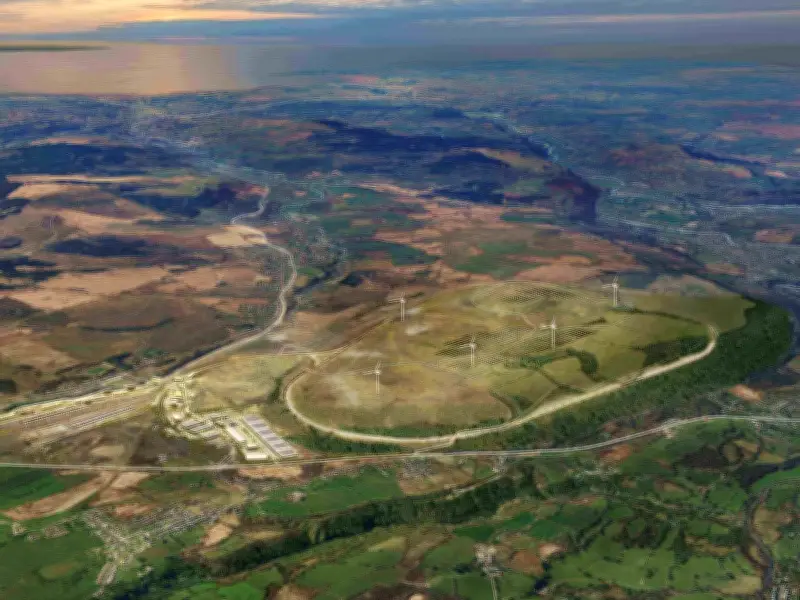
The developer of a proposed rail centre which has already received £70m in taxpayer money is now asking for further public funding guarantees. The CEO of the Welsh Government-owned company behind plans for a Global Centre of Rail Excellence on the border of Neath Port Talbot and Powys told a Senedd committee that it needed a further "intervention to help with the capital cost".
Data centre plan to fund rail scheme
He also said that the company wanted to sell off a large area of land for a giant data centre to help fund the scheme and was asking the Welsh Government to put the business rate revenue from that scheme towards guaranteeing private investment. The Global Centre of Rail Excellence (GCRE) is a proposed rail testing facility located at Nant Helen and Onllwyn on the border of Neath Port Talbot and Powys, being planned by GCRE Ltd, a company established and wholly-owned by the Welsh Government.
First announced in 2018 under Labour, it has been given £50 million of Welsh Government funding and £20m from the UK Government. The centre was meant to be fully operational by 2025 but has not secured the funding needed. The next suggested opening date is 2030.
Costs rise from £100m to £380m
The Senedd's economy committee was told on November 4 that £380m was needed for the train facility to be built. It was initially quoted as needing £100m, but Simon Jones, CEO of GCRE, said that quote was before any design work was done on the scheme. Mr Jones said that £380m includes "some contingency sums".
The GCRE is touted as a rail testing facility for new rolling stock. As costs have gone up, those behind the scheme have decided to look to a data centre to provide money to fund it. It is now at the point that the railway element of the scheme cannot continue without the data centre, the committee was told. The data centre would be "a means to an end".
Land sale and business rates
He said there was interest in the site for a data centre because it was "huge" and had strong energy and fibre connectivity but admitted the developer would be "taking a risk" as no planning process has begun on the data centre. He said they have been speaking to a developer who will spend "billions" on this site. He said it will not only raise funding from being sold to them, but also generate business rates.
The CEO was asked how much land would be sold off, how much it would raise and how much it would offset. Mr Jones said much of the detail couldn't be disclosed as the deal was still out to tender but said the sale of the land wouldn't be "a million miles" away from the amount government has already invested, some £70m. He said it would also result in one of, if not the biggest, business rate streams in Wales.
Reform UK MS Tom Montgomery responded to that statement saying: "My understanding is there is going to be a large, if not the largest data centre built in Scotland in the UK and the estimated business rates for that, and I'm happy to be put right again was £8m, so if you're getting tens of millions, how big is this data centre, because it would have to be knocking on the door of the biggest in the world to build it." Mr Jones replied saying: "I can't divulge that at the moment." He said: "Until we've gone through a detailed process on that, we can't nail a number down."
Jobs and investment challenges
The project would, those behind it say, create 1,400 jobs in its first decade. The GCRE say more than 200 companies, one fifth outside the UK, have endorsed the rail innovation project, however none have yet materialised into investment.
The new Plaid Cymru-led Welsh Government, led by Rhun ap Iorwerth, is looking at the scheme and has received specialist advice. Mr Jones said there have been two issues so far, one that "no-one will invest without knowing what this will cost" and secondly, it is a new business model.
"These two risks cannot be managed by the private sector, we've been saying to the government for the last three years there needs to be some kind of intervention to help with the capital cost, fixing the price of this thing, but also giving comfort that the revenues this thing will generate will be in line with the business plan," he said. "Elsewhere, the government provides guarantees to allow people to invest, that's essentially what we're saying needs to happen here," he said.
Strategy shift and funding breakdown
As a result, there has been a change in strategy, looking at whether private investment in data centre elements of the project can help to finance the construction of the rail element. Mr Jones says the business plan shows the railway will "wash its face commercially" but he added "investors don't have confidence it will do that because there's no reference model for that, so they need the comfort of a fall back, a safety net which the business rates could provide".
Mr Jones said his proposal to government is that the railway element can be built without any further government funding "if we can make use of the non-domestic rates to be able to provide a guarantee to the investor they will be able to get their money back if they put their money into the railway". "What we're looking at is making use of the receipt from land sale to pay for operation of GCRE," he said.
Mr Jones said: "This thing is going to take another two or three years of research work once we get the green light and then it will be three years to build it, so six years until it's operational." "If you're a customer who wants to place your order you've got to be comfortable to wait six years until your testing slot is available and also be confident that the thing is actually going to be there in six years time. Given we've been at this for a while it's hard for people to be confident," he said.
"We're in a position where our clients cannot sign up with us until they have confidence that the railway will be built. We have a chicken and egg situation. External funders for the railway are saying we need to have committed orders, and customers are saying we can't give you committed orders until we have external funding in place." "That cycle has to be broken otherwise we're not going to be able to move this forward," he said.
Asked how the £70m has been spent, Mr Jones said the breakdown was £12m on design and enabling works, £9m on staff, £6m on site operations, £11m on railway design, £10m on railway assets, £6m on buying land, and £3m on energy connections. Advisory fees on raising the money are £4m and £1m on a top-up to the Escrow fund. He denied they had gambled taxpayer money.
Mr Jones said it would be up to government ministers to decide whether to go towards the rail scheme, and jobs that can be generated, or the financial gains from data centres. In a later session of the same committee, Welsh Government economy minister Adam Price also faced questions on the topic.
Minister's response
Mr Price said the best value for taxpayers had to be found, not only in a financial sense but "public value". He said there are other implications about developing the economy more widely in that part of Wales. "You have to be very sure of the business proposition if you're going to invest whether as private or public investor. The process we're going through now is to crystallise these questions as quickly as we can because we don't want this to go on indefinitely. I think everyone is agreed we need to make a decision very soon," he said.
Mr Price said the "original premise has not turned out as hoped for". "This new dimension does change the context very significantly," he said. Asked about potential co-investment with the UK Government, Mr Price said: "If we end up in a position where we think an energy with a data centre unlocking the prospect of a major employment site, that's one proposition and we can have discussions about UK Government partners," he said. "If it is with a major rail component then there's different parts of the UK Government we can engage with."