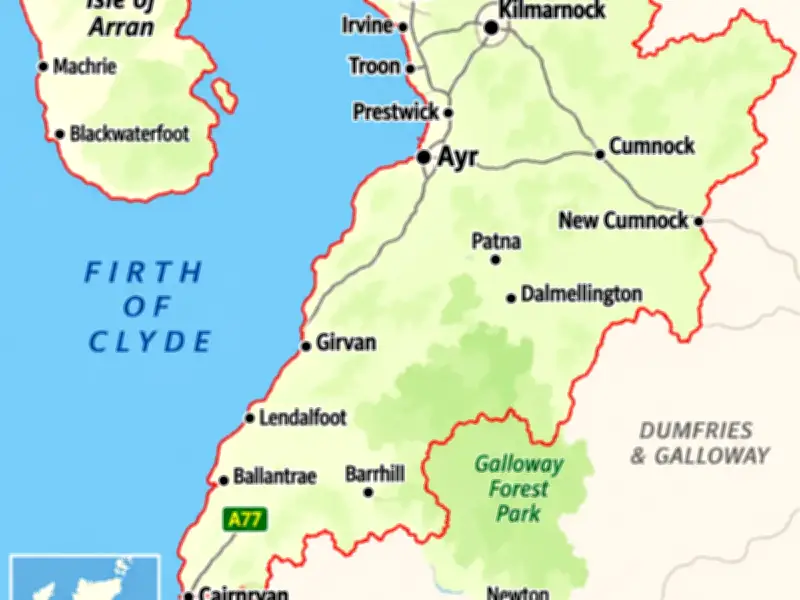
Councillors from East and South Ayrshire have agreed to engage with Scottish Government proposals that could see the region's three councils replaced by a single regional authority, despite widespread concerns about the impact on local democracy, costs and jobs.
The plans, which would replace Scotland's 32 councils with between six and ten regional authorities supported by 120 to 160 smaller community authorities, have prompted warnings from politicians who say they need more answers before backing any change.
Mixed reactions in East Ayrshire
At East Ayrshire Council, leader Douglas Reid told councillors: "I think we've got to fight strongly for Ayrshire." Labour group leader Barry Douglas warned that simply merging councils would not deliver the improvements communities needed, saying: "It cannot be merely changing boundaries with nothing else."
Conservative group leader Neill Watts remained unconvinced about the prospect of a single Ayrshire authority, despite acknowledging the need for the councils to participate in discussions. Responding to suggestions that his position had softened, Cllr Watts said: "No, I don't think necessarily I've converted." He added: "I'm still not really keen on putting the three Ayrshires together, but certainly from the conversations that have been had, we know that from the Scottish Government's point of view, they want something to happen."
Cllr Watts said it was therefore important that Ayrshire's interests were represented as discussions progressed. Cllr David Richardson suggested reviving the concept of an Ayrshire County Council, arguing that reducing duplication between authorities could release money for frontline services.
Cllr Douglas welcomed Cllr Watts' willingness to engage with the proposals, despite their political differences. He said: "I welcome Councillor Watts' comments in that. Let's go forward positively to get the best for the folk that we represent."
South Ayrshire pushback
At South Ayrshire Council, there was greater pushback on the plans from the Labour group. Councillor Philip Saxton questioned whether ministers had explained what residents would gain from the proposals, asking: "How will this benefit the local people we represent?"
Cllr Saxton also raised questions about which authorities would be grouped together, how decisions would be divided between regional and community bodies, and whether the reforms would lead to redundancies. Councillor Duncan Townson said ministers had failed to provide answers during briefings, stating: "They won't answer when this will take place, they will not answer how much it's going to cost and they will not answer how many jobs are at risk." He added: "That to me suggests that they have not done the basic groundwork."
Concerns over services and finances
The concerns about local accountability were also reflected in the East Ayrshire debate over the future of education and social care. Cllr Barry Douglas warned against transferring adult social care responsibilities to the NHS, arguing that councils understood the complex needs of their communities. He said: "I think we, as a local authority, know best when it comes to the needs of our communities and we have some real complex needs there. But I don't think the answer is to take that into the NHS."
The Convention of Scottish Local Authorities (COSLA) has argued that reform should strengthen local democracy, with decisions taken locally wherever possible. Its president, Councillor Shona Morrison, said: "The Scottish Government's proposals and approach to engagement need a rethink."
Financial concerns were another major issue in both council chambers. East Ayrshire leader Douglas Reid warned that officers were already working to prepare the council's budget while maintaining existing services, saying: "We don't have the manpower, the resources to look at this review." In South Ayrshire, Cllr Saxton questioned the potential expense of restructuring, referring to estimates of £2 billion in implementation costs and possible annual savings of £500 million.
COSLA vice-president Steven Heddle said: "Structures matter, but they are not the end in themselves. The test of any reform must be simple: will it improve people's lives?"
Next steps
Despite the disagreements, both councils are continuing discussions with ministers. East Ayrshire Council's chief executive, Joe McLachlan, indicated that a special council meeting could be held towards the end of November, while South Ayrshire chief executive, Stephen Penman, also expects to bring a further report before councillors.
The Scottish Government has described its proposals as a starting point for discussions rather than a final decision. No agreement has yet been reached on the creation of an Ayrshire regional authority or the division of responsibilities between regional and community bodies.