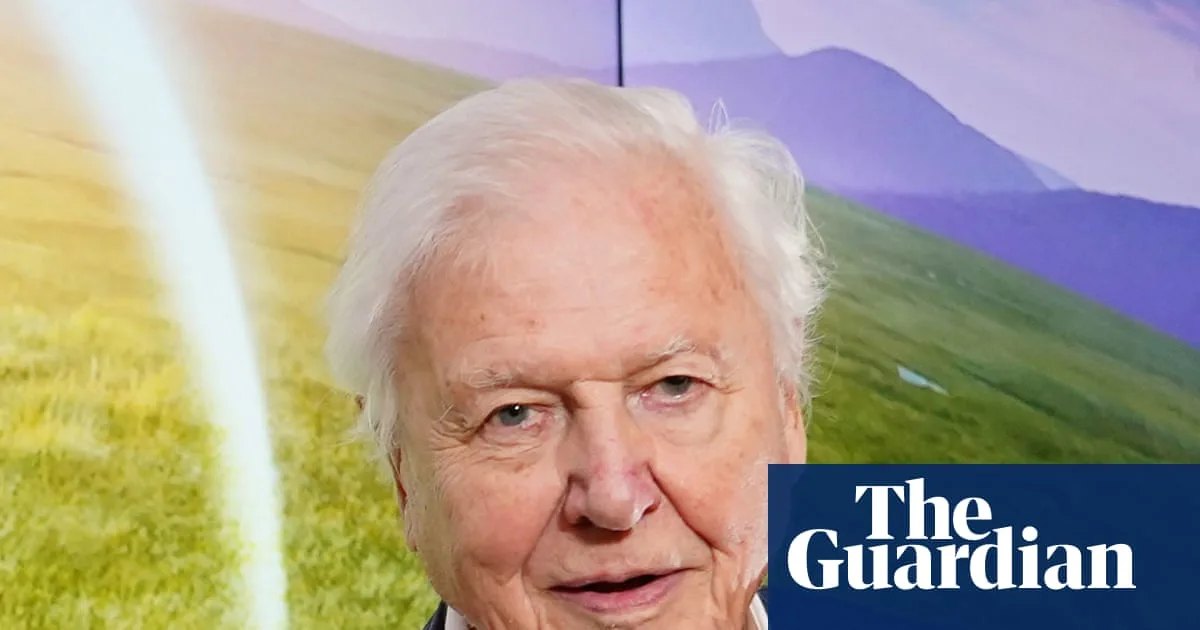
From his earliest days, David Frederick Attenborough knew that his future lay in natural history. He has frequently expressed profound gratitude for a long and rewarding career that has taken him across the globe. Over six decades ago, when asked by BBC News if he would prefer any other profession, he was unequivocal. 'As far as I'm concerned, no,' he stated. 'It is absolutely clear, as far as I can make out, that I am the luckiest person I have ever met. To be able to go where you want in the world, whenever you want, and do what you like—which is looking for animals and people and making films about them—what could be more marvellous?'
Born on 8th May 1926 in Isleworth, London, David was the middle of three brothers. He grew up in Leicester in a home that actively encouraged his curiosity for the natural world. His parents allowed him to keep tropical fish, salamanders, grass snakes, and hedgehogs. His father, Frederick Attenborough, was the principal of University College, Leicester, while his mother, Mary, nurtured the family's intellectual and cultural interests.
David's elder brother Richard, who died in 2014 at age 90, was a celebrated actor and director. His younger brother John, an executive at Alfa Romeo and later a financial advisor, died at 84 in 2012. During the war, the family also took in two German Jewish sisters, Irene and Helga Bejach, who were orphaned. They lived with the Attenboroughs for seven years before moving to the United States. David has described this kindness as 'a credit to my parents' and considers the girls his 'sisters, really.' Helga's letters and diaries were later released to Leicester University, and in 2020, Sir David hosted a reunion for descendants of both families, where it emerged that one of Helga's grandsons became an environmentalist inspired by him.
One of David's earliest wildlife encounters involved a money-making scheme. In 1963, he recalled learning at age 11 that the zoology department at his father's university needed newts. 'The head of the department was doing experiments on their diet—she required 30 newts per week,' he explained. 'I got wind of this and asked how much was being paid per newt. It was something astonishing like sixpence. So I undertook to supply her, which I did. What she didn't know was that I found them five yards outside her laboratory, in a pond. I used to go at night when she had gone home, fish them out, and take them to the laboratory in the morning.'
David attended Wyggeston Grammar School for Boys in Leicester and won a scholarship to Clare College, Cambridge in 1945 to study geology and zoology. After briefly editing science textbooks for children, his first attempt to join the BBC as a radio producer failed in 1950, the same year he married Jane Ebsworth Oriel. They later had two children, Robert and Susan. At just 24, his CV caught the attention of Mary Adams, who was setting up the BBC's new television service. David, who did not own a TV and had watched only one programme, accepted a three-month training course and became a producer in 1952. His early projects included the quiz Animal, Vegetable, Mineral? and the three-part Animal Patterns, featuring creatures from London Zoo.
Through this programme, he met Jack Lester, curator of the zoo's reptile house, and they decided to make a more ambitious series about an animal-collecting expedition. The result was Zoo Quest, first broadcast in 1954, which combined live studio presentation with location footage for the first time. 'From childhood I have been fascinated by the natural world,' he once explained. When they set off for Africa, Jack was to present while David produced and directed, but fate intervened. 'Jack became very ill immediately afterwards. But my boss said, well Attenborough, you are the only other person who was there. You will go and do it. I had to appear because there was nobody else to do that job. So, quite unintentionally, I appeared on television.'
Zoo Quest brought chimpanzees, pythons, and birds of paradise into living rooms for the first time and proved that natural history could attract huge audiences. It ran annually until 1963, when Sir David moved into BBC management. He excelled in this role but always longed to return to filmmaking. 'I longed to return to filming wildlife,' he recently said with characteristic simplicity.
As Controller of BBC2, David oversaw the first colour broadcasts in Europe, beating German broadcasters by three weeks. 'That was a huge step and required new transmitters, new cameras, new everything,' he recalled. 'I had the responsibility of trying to persuade the public that colour television was marvellous—the sets were quite expensive. I knew in my heart that the really great series was going to be one on natural history. All the loveliest creatures and fascinating behaviours you would never think of, we could cover that. Nothing could compare with the wonders of colour television.'
He commissioned the critically acclaimed series Civilisation by Kenneth Clark and The Ascent of Man by Jacob Bronowski. These ambitious landmark documentaries sparked the idea for Life on Earth, the biggest series on evolution and the natural world. His mission to make BBC2 stand out led to a portfolio of programmes defining the channel's identity, including Call My Bluff, The Money Programme, The Old Grey Whistle Test, and snooker series Pot Black. As Director of Programmes, he also commissioned Monty Python's Flying Circus, which became a global phenomenon.
Despite his success, David yearned to return to natural history full-time. 'I wanted to do a series which would tell the development of the history of life on evolution—starting from the simplest animals and going right through until you ended up with monkeys, apes, and humanity,' he explained. Realising he could not undertake Life on Earth while running both BBC channels, he faced a choice. When expected to apply for Director General, he was horrified. His brother Richard recalled: 'He said, me, behind a desk? I can't do that, can I? I said you would be a bloody fool if you accepted it, you should go on doing what you are marvellous at.' David later said, 'I would not have been any good. I do not have political skills. I may know about birds of paradise but I certainly do not know about prime ministers.'
In 1973, he resigned from the BBC and became a freelance broadcaster. His first series with the Natural History Unit was Eastwards with Attenborough, shot largely in Indonesia. He also made The Tribal Eye, immersing himself in remote cultures, sometimes wearing only a loincloth in the Solomon Islands. Life on Earth was commissioned in 1976, a 13-part series requiring three years of travel to 40 countries across a million miles to film over 600 species. Organised by post, the trips faced challenges including a coup in the Comoros, being shot at in Rwanda, and threats from Saddam Hussein's army in Iraq. 'There was one series that changed everything, Life on Earth,' he said. 'That was a turning point in my life.' Watched by 500 million people, it confirmed his reputation as the most successful wildlife filmmaker.
One challenge involved filming the rare coelacanth fish. After a coup in the Comoros, David charmed officials to regain permissions, but only a dead specimen was found in a bar. Underwater cameraman Peter Scoones stayed and captured a dying but living coelacanth, a filming first. Another challenge was filming the Grand Canyon on donkeys; David discovered he was allergic to donkey dust, so close-ups were abandoned. The team also captured the first footage of lions making a kill in Tanzania. In Rwanda, David filmed with mountain gorillas, a moment he calls 'one of the most privileged moments of my life.' Cameraman Martin Saunders saved their footage from rebels by switching labels on film cans.
Life on Earth was a triumph. 'We were very gratified,' David says. 'It did attract a very big audience—and they clearly felt that this was something out of the ordinary.' Producer Rodger Jackman described working with him as 'absolutely and utterly life changing.' However, David acknowledges the impact on his family. 'It was increasingly hard, particularly when you have a family. Four months was as long as I ever went away.' He missed milestones, and family jokes about his absence were common. He was knighted in 1985, taking his wife Jane and daughter Susan to the ceremony; his son Robert had emigrated to Australia.
David was married to Jane for 47 years before she died of a brain haemorrhage in 1997. He was filming in New Zealand but rushed back; she was in a coma but squeezed his fingers. 'The focus of my life, my anchor, had gone,' he wrote. 'Now I was lost.' He found consolation in the natural world. His daughter Susan now looks after him at their home in Richmond-upon-Thames. 'She runs the house. That is a blessing and a godsend,' he says.
After Life on Earth, David narrated every episode of Wildlife on One (253 episodes) and over 50 episodes of Natural World. He spent 20 years on the 'life' series, culminating in Life in Cold Blood in 2008. He narrated Blue Planet (2001), Planet Earth (2006), and Blue Planet II (2017), which highlighted plastic pollution. Other series include Green Planet, Frozen Planet, and Our Planet for Netflix. In his 90s, he has reduced foreign travel but continues narrating, including Kingdom and Parenthood in recent years. Asked in 1979 how he would follow Life on Earth, he laughed that he was 'not planning to retire.' 47 years later, he remains true to his word.






