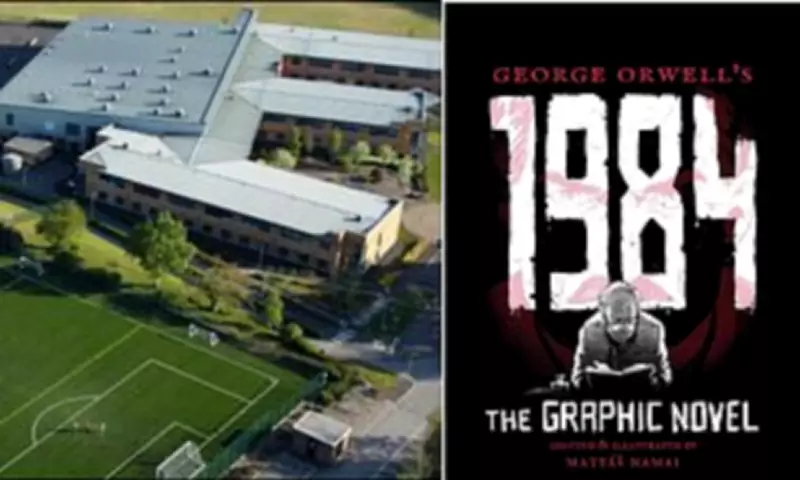
School Library Purge Sparks National Censorship Debate
A secondary school in Salford has ignited a fierce national controversy over educational censorship after removing more than 130 books from its library shelves. The Lowry Academy took the drastic action, citing concerns about the 'nature of their content,' which has drawn sharp criticism from teaching unions and educators who warn this should 'ring alarm bells' for academic freedom across the United Kingdom.
Classic Literature and Modern Titles Targeted
The school's librarian was instructed to discard a wide range of titles, including George Orwell's seminal dystopian novel 1984, Stephenie Meyer's wildly popular vampire romance Twilight, and Alice Oseman's acclaimed LGBT graphic novel series Heartstopper. This sweeping removal has positioned the academy at the centre of a growing national discourse about the boundaries of appropriate educational material and the role of censorship in schools.
School officials have defended their actions, stating that the books were initially sorted into 'age-appropriate' categories during a library audit. They claim that only a 'very small number of books' were permanently removed after being 'deemed inappropriate even for older children.' However, this explanation has done little to quell the mounting outrage from educational professionals.

Union Mobilises Against 'Chilling Effect'
The National Education Union responded decisively to the controversy, passing an urgent motion on Tuesday to 'fight censorship and defend librarians' across the country. Although the librarian involved in the Lowry Academy case is not an NEU member, the union has taken up the cause to protect its own members from facing similar professional dilemmas.
Kristabelle Williams, an NEU member from Lewisham who proposed the motion, emphasised the broader implications: 'We cannot ignore the issues that this case has brought up. We can take action as a union now to try to make sure it doesn't happen again.' She argued that union support would give librarians the 'confidence to not self-censor and resist the chilling effect that this case will cultivate.'
Broader Pattern of Educational Censorship Emerges
The Lowry Academy incident appears to be part of a wider trend affecting schools nationwide. Laura Butterworth, an NEU member from Tameside in Greater Manchester, revealed disturbing accounts from librarians in her district: 'I've heard many accounts from librarians in my district, of them having to take art books off the shelves because they have historic paintings and sculptures of nudes, which is insane.'
Butterworth passionately defended literary freedom, stating: 'Literature is an art form, and we need to make sure we are not eroding it and we're not censoring it.' Her comments highlight how the controversy extends beyond specific books to fundamental questions about artistic and educational expression in school settings.
Union Leaders Condemn 'Direct Attack on Educational Values'
Bernice Reynolds, another NEU member, framed the issue in stark terms: 'This is a direct attack on our educational values. Shrinking access to stories has never empowered a child.' The union's formal motion declared unequivocally: 'No school librarian should fear losing their job for carrying out their professional role - they should be supported by their school and defended by their union.'
The NEU has committed to developing practical resources for librarians, including toolkits for regional union representatives on how to respond effectively to book removal requests. This proactive approach aims to equip educational professionals with strategies to resist censorship pressures.
School Trust Defends Audit Process
Responding to the allegations, a spokesman for the United Learning Trust, which operates The Lowry Academy, offered a contrasting perspective: 'It is not the case that books have been 'banned' by the school. Following concerns that a number of books within the library were neither age nor content appropriate, an audit was conducted.'

The trust maintains that following this audit, 'books have been placed into age-appropriate categories and returned to the shelves. A very small number of books were deemed inappropriate even for older children due to their content and have been removed.' This characterisation frames the action as responsible curation rather than ideological censorship.
National Implications for Educational Freedom
NEU General Secretary Daniel Kebede issued a stern warning about the broader implications: 'Any move to censor books in school libraries, based on misinformation and fearmongering, should ring alarm bells for all of us. The NEU is clear that this is not a path we are prepared to follow in the UK. Children's access to a wide range of literature is a fundamental good that the NEU is proud to defend.'
This controversy at The Lowry Academy has thus evolved from a localised library management issue into a national debate about educational values, professional autonomy for librarians, and the essential role of diverse literature in children's intellectual development. As schools across Britain grapple with similar challenges, this case may prove pivotal in defining the boundaries between responsible curation and harmful censorship in educational institutions.