Victorian parlours, whiff-whaff and a Soviet spy: ping-pong is coming home. A century on from the first tournament in London, the World Team Table Tennis Championships are back, bringing with them a fascinating history.
The way Wang Chuqin plays, ping-pong is a physical impossibility. By the time you reach the end of the first two words of that sentence, Chuqin, the men's world number one, has seen the ball, calculated its speed, direction, and height, judged whether it is travelling with topspin, backspin, left or right sidespin, or a combination of the four, decided how to return, forehand, backhand, attack, block, push, spin, and where to aim, shifted his weight, positioned his feet, rotated his hips, brought his racket into position, and hit the ball. By the time you reach that first full stop, he has done it all 12 times over.
Thursday marked World Table Tennis Day, though many were unaware. The England Federation placed a trail of golden tables around London to mark the occasion and generate publicity for the World Team Table Tennis Championships, being held in the city for the first time since 1954. During a sunny lunch hour outside Temple Bar, beneath the walls of St Paul's, city workers played during their break, producing the familiar pick-pock, pick-pock sound. Amid the city's noise, there is the distinct rat-a-tat-tat of a runaway ball skipping away from the table into a far corner while players scurry after it.

It is the easiest and most familiar of games, yet also one of the hardest to master. "That's the beauty of it, it can be anything you want," says Chris Brown, head of development at Table Tennis England. "If you want to pick it up and have a chat while you play you can do that." It is one of the few sports where an eight-year-old and an 88-year-old can compete on an even footing. Recent research shows it has therapeutic benefits for the elderly, especially those with Parkinson's disease, and there is even an annual world championship for people affected by the condition.
Table Tennis England recently opened a free playing hub at the Exchange shopping centre in Ilford. The manager says it is the only thing that has ever increased footfall to the top floor. The English love it as a game. More than 600 people used the table at St Paul's in its first week. Sport England data shows around 2.5 million English adults played at least once last year. There are over 100 public tables in London alone, along with ping-pong themed bars and clubs in Bermondsey and King's Cross where players compete under pseudonyms. At the Bounce club, a short walk from the public table at St Paul's, the manager says they attract 600 people each evening to use their 17 tables, one of which was used in the 2012 Olympic final.
However, the sport is less embraced competitively in England. No English player ranks in the top 50 on either side of the world rankings, and only one, men's number one Tom Jarvis, is in the top 100. "It's quite a small community at the top," says England's female number one, Tin-Tin Ho. Like many on the English team, she came to the game through family. Her father was so obsessed that he chose her name to share initials with the game. Her elder brother is called Ping. "He was going to call me Pong," she says, "until my mum persuaded him he was taking it a bit too far." Ho has won the women's national title eight times in the last decade. "And I still find people don't really respect the sport or understand how many hours I have to spend in the gym to be fit enough to compete."
She now plays in the Spanish league. The sport draws larger audiences in mainland Europe, with Germany, Sweden, and France all having players in the world's top 10. Felix Lebrun's run to the bronze medal match at the Paris Olympics made him a star of the 2024 Games. By some measures, the International Table Tennis Federation is the largest sports organisation in the world, with 227 members compared to FIFA's 211. These world championships, held at the Copper Box Arena in Stratford and the OVO Arena in Wembley, will feature matches between North Korea and the Democratic Republic of the Congo, Mongolia and Mexico, Tahiti and Moldova. It is both one of the smaller sports events in London this month and one of the largest globally this year, with 64 countries competing, 380 players, and a global audience in the hundreds of millions, mostly in China.

Chuqin's social media following became so overwhelming that his official fan group on Weibo disbanded in protest against "fandom culture" after he complained about being mobbed by fans with cameras. "Table tennis players in China are similar to football players here," says Paul Drinkhall, who has won over 50 national titles but is currently ranked 390th in the world. "It's pretty much their national sport, the thing most kids grow up wanting to do." Brown says the Chinese media have been in the UK for months, "spending hours and hours doing links and clips for TV and internet shows." The British government will use the event for ping-pong diplomacy. When Keir Starmer took a trade delegation to China in January, Sally Lockyer, CEO of Table Tennis England, accompanied him.
The tournament is also a homecoming. The ITTF brought it back to mark the 100th anniversary of its founding and the first tournament in London in 1926. Initially planned as a European tournament, two Indian players arrived and asked to compete at the last minute, prompting organisers to upgrade it. The event was held at the Congregational Memorial Hall, demolished in 1968. Three plaques outside the office block now mark the Great Ejection of 1662, the founding of the Labour Party in 1900, but not table tennis. "Table tennis?" says the man behind the lobby desk. "Not here."
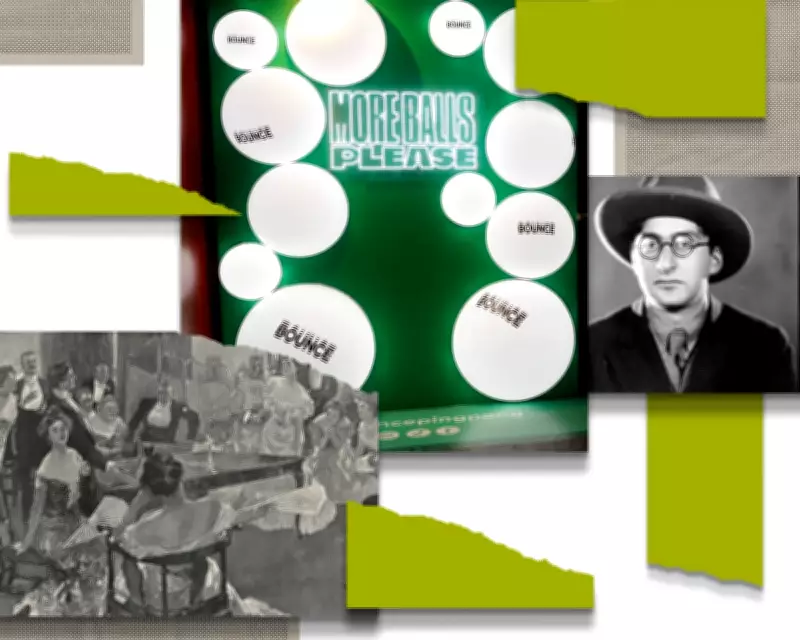
But it was once the home of the sport. The early days are obscure. Some suggest it was brought back to England by army officers serving in India during the Victorian era, along with kedgeree, chutney, and puttees. It remained a parlour game until Ivor Montagu took it up in the 1920s. Montagu is credited with making ping-pong what it is today, and World Table Tennis Day is held in his honour. Montagu was an Old Etonian and inveterate clubman, founder of the Cheese Eaters League, member of the Association of Cine Technicians, the Zoological Society, the World Council of Peace, Southampton United, the Woolwich-Plumstead branch of the Anti-War Congress, Marylebone Cricket Club, and the Friends of the Soviet Union. He was a film-maker and producer, author of monographs on the short-tailed field vole, a committed Communist, and founder of the English Table Tennis Federation. He learned the game on a Queen Anne table in his family's manor house and stuck with it for life.
Montagu claimed to have coined the name "table tennis" when faced with a copyright claim by Jaques, who held the copyright on "ping-pong." The Bounce club, coincidentally, is based in Jaques' old headquarters, where the manager insists no one may use the phrase "table tennis" within its walls. Both names fared better than Slazenger's version, "whiff-whaff." Montagu personally guaranteed the first World Championships, which lost 150 pounds, organised the inaugural International Federation conference, and persuaded his mother to donate the Swaythling Cup, still awarded to the men's tournament winner.
The English establishment viewed all this with suspicion. The head of MI6's counter-intelligence unit believed Montagu's extensive foreign correspondence with ping-pong enthusiasts about bat and ball technology was a ruse to share industrial secrets, stating, "we find it hard to believe that a gentleman can spend weeks upon weeks testing tennis balls." In 1954, Montagu was deported from a table tennis tournament in France as "politically undesirable." Years later, it was revealed he had been running a Soviet spy ring under the codename "Intelligentsia." However, they were wrong about the ping-pong; that part was entirely genuine.