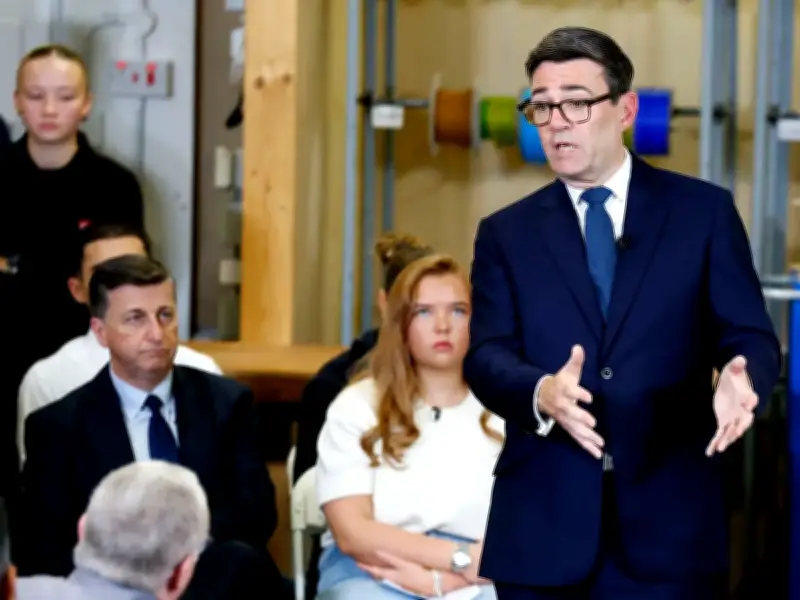
Prime Minister Andy Burnham has set out his vision for Devolution 2.0, aiming to empower communities across Scotland by moving power away from Holyrood and towards local regions. In a speech in Motherwell, he said he wants to work more closely with the SNP Government.
Scotland's "strange place" of centralisation
Writing for the Record, Secretary of State for Scotland Douglas Alexander argued that the centralisation of powers at Holyrood has left the country in a "strange place". He said that while power reached Holyrood, too much of it has stayed there, with police and fire services run as single national bodies, council tax set from the top, and council budgets squeezed year after year.
Alexander highlighted stark inequalities, noting that a man in East Renfrewshire can expect to live seven years longer than a man in Glasgow, despite being only ten miles apart. He said young people are leaving towns across the west because they cannot see a future at home, with high streets suffering and buildings burnt out.
A new model for regional power
Alexander argued that these problems will not be fixed by schemes dreamed up at the centre and handed down uniformly. He pointed to Greater Manchester as an example of what can be achieved when local leaders are trusted, noting that Andy Burnham used his powers to take back control of buses, cap fares and match training to available jobs. Since 2015, its economy has grown more than twice as fast as the UK average.
The UK Government has made an offer to the Scottish Government to work together on a devolution initiative on employability, which could mean decisions on helping people into work would be taken at a local level. Alexander said the question is whether John Swinney will take up the offer.
Funding and defence colleges
Alexander noted that the Scottish Government recently agreed to match the UK Government's £10 million to create two Defence Technical Excellence Colleges, one in the east and one in the west. This would train young Scots for skilled jobs in a defence sector that already supports more than 12,000 jobs. He said it took seven months to reach that agreement, but asked what could be achieved if that were the rule rather than the exception.
He also confirmed that £52 million has already gone to Scotland's regional leaders as the first part of a £140 million Local Growth Fund, with decisions made locally. On the North Sea, Burnham has been clear that his approach is pragmatic, not ideological, with decisions coming shortly. Burnham has also set out his intention to make a deal on food and farming at the upcoming UK-EU summit.
In the coming weeks, Burnham will sit down with John Swinney and other first ministers at the National Economic Council. Alexander expressed hope that Scotland's First Minister comes ready to say yes, saying people are sick of point-scoring between parliaments. He said what people want is a bus that turns up on time, a good apprenticeship, a high street with the lights back on, and pride in place. "That's what Devolution 2.0 is about. Let's get it done, together," he wrote.