
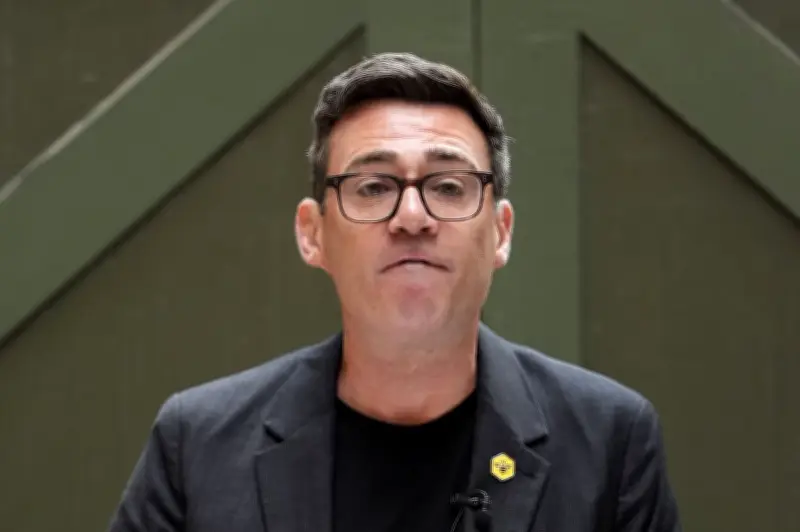
Andy Burnham has promised to give the UK a “new direction” with the largest transfer of power out of Whitehall in modern times, declaring that Westminster is “broken” and the country is “stuck in a rut”.
Burnham’s Vision for a ‘Circuit-Breaker’
In his first major speech since Sir Keir Starmer announced he would be leaving Downing Street, the would-be prime minister pledged to end “politics as usual” and pull people together in the “broadest possible coalition” to revive hope across the nation. Speaking at the People’s History Museum in Manchester, Burnham said he would give Britain the “circuit-breaker it needs” through sweeping devolution and economic reform.
“What hope can we have that it will be different this time? That is the question I would be asking if I was a voter right now,” Burnham said. “It is the one I want to answer as clearly as I can today, and in doing so give the new direction the country is looking for after 10 years of political turbulence since Brexit and 20 years of falling living standards since the 2008 financial crash.”
Westminster ‘Broken’ After Decades of Decline
The Makerfield MP, who gave up his role as mayor of Greater Manchester to return to Parliament in a by-election earlier this month, was blunt in his assessment of the current political system. “Westminster has not been working for people and it has not been working for a very long time. In fact, it is broken,” he said. “And as a result, the country isn’t where it should be. It is stuck in a rut, and clearly we can’t go on like this.”
Burnham’s speech focused on devolving power from Whitehall to local communities, promising a fundamental shift in how the UK is governed. He argued that decades of centralisation have left the country unable to address its most pressing challenges, from economic stagnation to regional inequality.
A New Coalition for Change
Burnham called for a “broadest possible coalition” to drive change, reaching beyond traditional party lines to include businesses, trade unions, and civil society. “We need to bring people together, not divide them,” he said. “That means building a movement that can break the grip of Westminster and give power back to the people.”
The speech marks a significant moment in Burnham’s campaign for the leadership, positioning him as a candidate focused on radical decentralisation and democratic renewal. With Starmer’s departure imminent, Burnham is seeking to capitalise on widespread disillusionment with the political establishment.
According to Burnham, the UK has suffered from “10 years of political turbulence since Brexit and 20 years of falling living standards since the 2008 financial crash”, a record he says demands urgent action. His proposals include transferring control over key policy areas such as transport, housing, and skills to regional mayors and local authorities.
Reaction and Next Steps
Political analysts noted that Burnham’s emphasis on devolution could resonate with voters in the north of England and other areas that have felt neglected by Westminster. However, critics argue that his plans lack detail on how such a vast transfer of power would work in practice.
Burnham’s campaign is expected to release more policy papers in the coming weeks, focusing on economic reform, public services, and constitutional change. For now, his message is clear: the country needs a new direction, and he is ready to provide it.




