
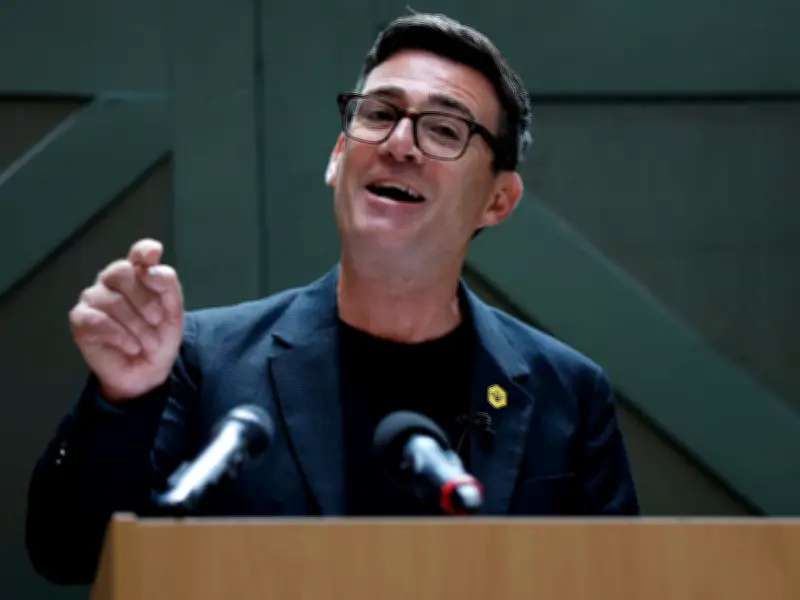
Andy Burnham has outlined a vision for the North East centred on a massive devolution of power from Westminster, promising to raise living standards through reforms in utilities, reindustrialisation, and regeneration. In a speech at the People's History Museum in Manchester on June 29, 2026, the Labour leader declared that Westminster is 'broken' and called for a 'circuit breaker' in British politics.
The Broken System
Burnham argued that after 10 years of political turbulence since Brexit and 20 years of falling living standards since the financial crash, the current political system has failed. 'Everyone can feel the country is not where it should be,' he said. 'People feel it in their bills, their rent, their high streets, their transport, and at the end of every month when there is less and less left over.' In the North East, he emphasised, this feeling is felt in Sunderland, Hartlepool, Gateshead, Blyth, and South Shields.
A New Approach: Place First, Not Party First
Burnham pledged to build a more collaborative politics, taking power out of the centre and putting it into the hands of local people. He cited his experience as Mayor of Greater Manchester since 2017, where he adopted a 'place first, not party first' approach focused on problem-solving and long-term thinking. 'Growth cannot be ordered from the top down. It can only be nurtured from the bottom up,' he said. For the North East, this means backing manufacturing, ports, energy, and public services, and giving local leaders the power to revive high streets and connect communities.
Number 10 North: A Nerve Centre for Devolution
Central to Burnham's plan is a 'Number 10 North' that would act as a conduit for redistributing power and resources across the UK. He promised that the days of Whitehall blocking devolution are over, and that the whole of Whitehall would be required to support local areas. This would be a 10-year mission to raise living standards, focusing on three tasks: reform of essential utilities, reindustrialisation, and regeneration of places.
Essential Utilities: Public Control and Lower Costs
Burnham proposed that all parts of the UK should be able to take greater public control of essential services such as water, housing, energy, and transport, learning from the model that transformed bus networks in Greater Manchester. Ten-year plans would aim to bring down costs for individuals, families, and businesses. For the North East, this means tackling energy, housing, and transport costs, ensuring people are not overpaying for basics while wages stagnate.
Reindustrialisation: Backing Clean Industry and Manufacturing
Every region would be supported in setting clear industrial ambitions. Burnham identified opportunities in the North East for electric vehicles, offshore wind, clean industry, and advanced manufacturing. He pledged to ensure that jobs, skills, and apprenticeships from these sectors are rooted in local communities. Public procurement would no longer chase cut-price deals abroad but instead support British-based suppliers. He also promised to end the school system's focus on university, creating parity between academic and technical education so young people in Sunderland, Gateshead, Middlesbrough, Hartlepool, and County Durham have clear paths to skilled work close to home.
Regeneration: Council House Building and Stronger Towns
Burnham highlighted that Britain has lost almost one and a half million council homes since the 1980s, leading to a housing trap. He promised the biggest council house building programme since the post-war era, using vacant public land and adopting a Housing First philosophy. For the North East, this means more affordable homes in Newcastle, South Tyneside, Stockton, Darlington, and Northumberland, along with stronger towns and high streets backed by business rates reform to support pubs and local businesses.
Burnham concluded: 'Good growth in every postcode. Hope in every heart. Imagine no more. Let's make it happen.'




