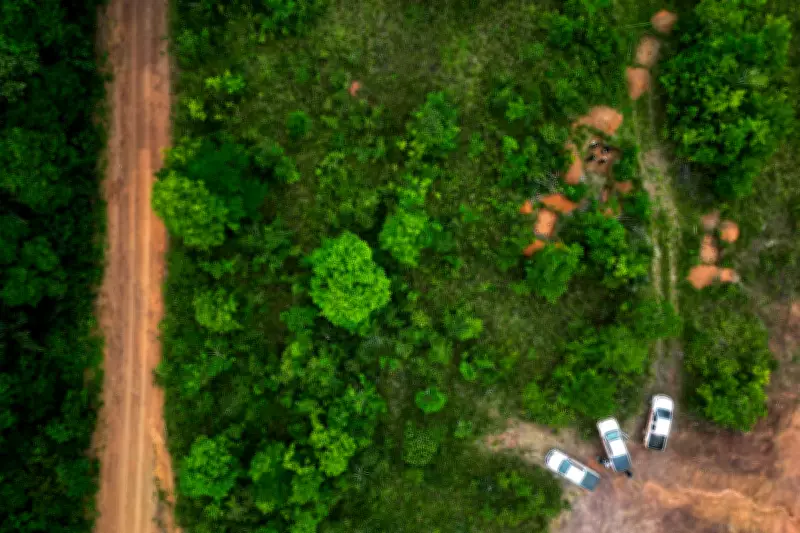
Road construction in the Amazon, often associated with deforestation, is simultaneously uncovering a rich tapestry of ancient history. Archaeological surveys along the BR-156 highway in Brazil’s northern state of Amapá have revealed significant discoveries predating European colonisation.
Unearthing the Past
At nine excavation sites, researchers have unearthed pottery vases, possibly used as funerary urns, alongside small artefacts crafted to resemble human faces. Lúcio Flávio Costa Leite, director of the Archaeological Research Center at Amapá’s Institute for Scientific and Technological Research, explained the dual nature of such infrastructure projects. “What we know about the region’s past is also tied to the openings created by these projects, which gives our relationship with them a somewhat ambivalent character,” he said. He emphasised that this new knowledge demands closer attention and “permanent protection measures.”
These discoveries reinforce a growing understanding that the Amazon was far from a “human desert” before colonisation. Instead, it was a landscape shaped by sophisticated, interconnected societies. The artefacts along BR-156, for instance, include pottery displaying multiple styles and techniques, reflecting cultural influences stretching from Brazil’s Pará state to the Caribbean.

A team from the National Department of Transport Infrastructure meticulously cleaned and analysed the finds. Archaeologist Manoel Fabiano da Silva Santos described the excavated soil layers as a historical timeline. Upper strata yielded items such as Portuguese porcelain and nails, indicating European occupation, while deeper layers contained “pottery and ceramics associated with earlier Indigenous presence, marking the site’s transition before and after the arrival of colonizers.”
The ‘Stonehenge of the Amazon’
One of the most impressive sites in Amapá is located in the city of Calçoene, where a 1,000-year-old stone monument stands. It consists of 127 carved monoliths arranged in a circle about 30 metres (98 feet) in diameter, set in open grassland amid the rainforest and bordered by a slow river. Dubbed the Archaeological Park of the Solstice, it has been called the “Stonehenge of the Amazon” for its resemblance to the British monument.
Researchers found that the stones were positioned so that during the winter solstice in the Northern Hemisphere they mark the exact point where the sun rises, said archaeologist Mariana Petry Cabral, a professor at the Federal University of Minas Gerais, who was part of the team that began digging at the site some two decades ago. “It’s hard to say exactly what all the stones mean, but what we do know is that they are not from the site itself. They were brought from other nearby locations,” she said. Subsequent research and excavations revealed the site also served as a burial ground. Radiocarbon dating showed it was occupied for hundreds of years, beginning around 1,100 years ago.
Discovered by scientists in 2005, the site can be visited with prior approval from Amapá’s Institute for Scientific and Technological Research. It is currently undergoing the process to become a national park, which will allow more visitors. Such archaeological sites are protected by Brazilian law, which prohibits alterations, adding a layer of protection for the surrounding rainforest.
Broader Implications
Modern archaeological and historical ecology research shows that Indigenous peoples not only lived in the Amazon for centuries but also actively shaped it. They managed and cultivated the landscape through long-term, sustainable practices, said Eduardo Neves, an archaeologist and professor at the University of São Paulo. Neves has studied the Amazon rainforest for more than 30 years and, since 2023, has led the Amazon Revealed project, which uses satellite scans to identify archaeological sites hidden beneath the forest canopy.

Scans have revealed roads linking archaeological sites and buried patterns in the rainforest that point to repeated occupation and deliberate landscape modification. Together, these features suggest large settlements, Neves said. Archaeologists had long suspected such connections, but technology has made it possible to see their broader geographic reach. The scans show networks of roads connecting clusters of settlements across the forest, most clearly in southern Amazonas state and Acre.
“When people think of an Indigenous tribe, they often imagine a small village isolated in the middle of the forest. But evidence shows a high degree of interconnectivity linking different settlements,” Neves said. Cabral added, “Amapá is a key piece that helps us see how dynamic and active these populations were, and how they maintained networks of exchange that have been in place for millennia.”
The artefacts will eventually become part of Amapá’s state collection, overseen by Costa Leite, which includes about 530,000 pieces. The oldest piece is approximately 6,140 years old, confirming a long human presence across Amapá. These artefacts offer insight into how ancient Indigenous societies lived, died and interacted with the rainforest.
“Here is something I often debate with my students — we usually think of technology as computers and microchips,” Costa Leite said, walking through shelves of ancient pottery. “But all of this required careful reading of the landscape and deliberate choices of materials.”