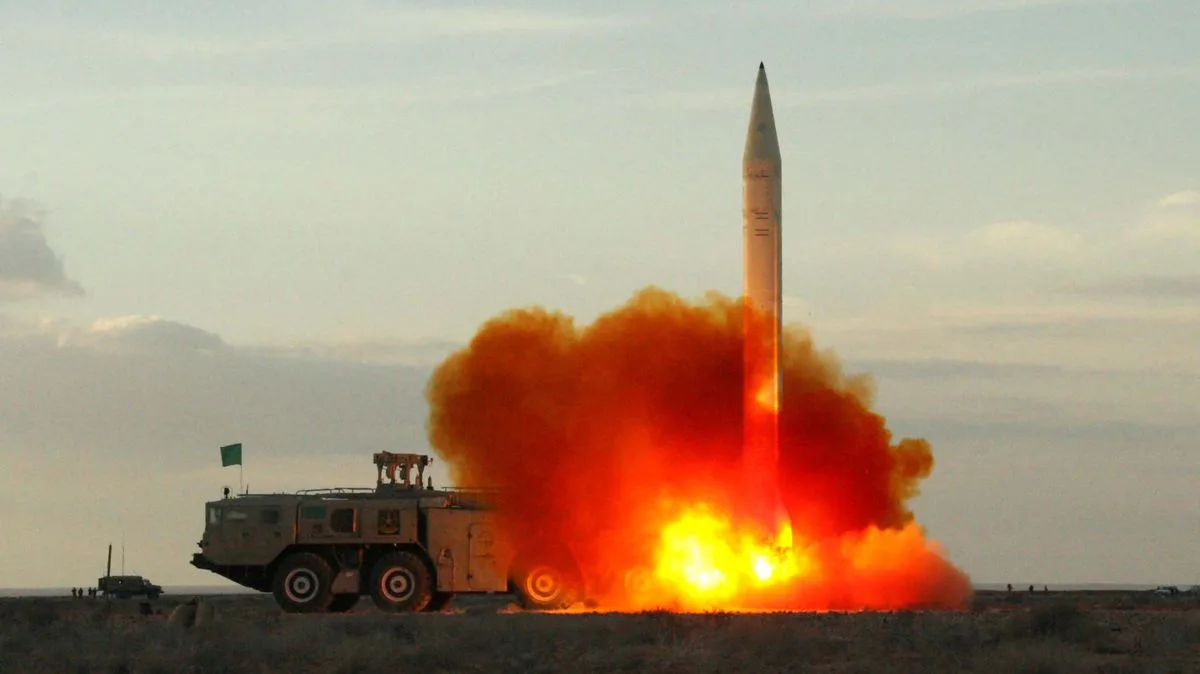
US Nuclear Interceptors 'Don't Work' as Expert Warns of Billions Dead in 72 Minutes
US Nuclear Interceptors 'Don't Work' in Chilling War Scenario

US Nuclear Interceptors 'Don't Work' as Expert Warns of Billions Dead in 72 Minutes

Investigative journalist and Pulitzer Prize finalist Annie Jacobsen has delivered a stark warning about the United States' ability to defend against nuclear attacks, suggesting that American interceptor missiles designed to counter incoming nuclear ICBMs simply "don't work."

Chilling Nuclear War Scenario

In her book Nuclear War: A Scenario, Jacobsen takes readers through a fictional yet terrifyingly plausible sequence of events that unfolds in just 72 minutes. She describes a hypothetical North Korean first strike on the United States that escalates into a full-scale nuclear war, potentially resulting in billions of deaths worldwide.

As global tensions continue to simmer, Jacobsen's analysis of missile defense capabilities becomes particularly relevant. Speaking on the Brad Carr podcast prior to recent international conflicts, she highlighted the alarming challenges facing American missile interception systems.

Interceptor Missile Disparity

When asked whether the United States possesses the capability to shoot down nuclear missiles or even "hack" them, Jacobsen's response was far from reassuring. "Well, we don't. I mean, the short version is we don't," she stated bluntly.

Jacobsen pointed to the stark numerical imbalance between American and Russian defense capabilities. The United States maintains just 44 non-nuclear Ground-Based Interceptors (GBIs) stationed at Fort Greely, Alaska, and Vandenberg Air Force Base, California. In contrast, Russia reportedly possesses 1,670 nuclear warheads on ready-for-launch status.

"Do the math. It's just impossible," Jacobsen emphasized. "What's also impossible is that the statistics on the effectiveness of our interceptor missiles are very poor."

Technical Challenges of Interception

The journalist described the immense technical difficulties involved in shooting down an Intercontinental Ballistic Missile (ICBM), which travels at approximately 14,000 miles per hour several hundred miles above Earth's surface. She characterized the interceptors as lacking sophistication, comparing their approach to using "a bowling ball" in the nose cone that must strike attacking missiles with sheer force.

"It doesn't have explosives," Jacobsen explained. "So, it has to actually impact the warhead, which by the time it's where it can be intercepted, it has lost all of the back end of what we think of as a missile. It's just a nuclear warhead flying through space all those miles up at 14,000 mph. And the interceptor missile, this ball, this kinetic ball, is going to try to hit it at 20,000 mph."

Program on Pause

Jacobsen revealed that the US Missile Defense Agency described the interception challenge as akin to "hitting a bullet with a bullet." She further claimed that the failure rate of these systems is "so extreme" that the program is "now on pause."

Despite maintaining 44 interceptor missiles, Jacobsen alleged that the United States is "not continuing to develop" the technology because it simply "doesn't work" effectively enough to provide reliable defense against nuclear threats.

This sobering assessment comes at a time when global nuclear tensions remain elevated, raising urgent questions about the adequacy of current missile defense strategies and the potential consequences of their limitations in a real-world crisis scenario.




