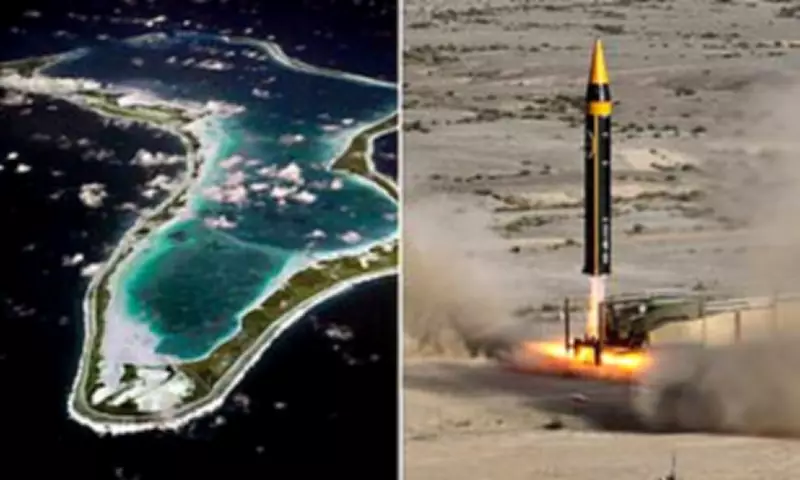
Britain would be compelled to depend on American missile defence systems stationed across Eastern Europe if Iran initiated a rocket assault on the UK, similar to the attempted strike on Diego Garcia this weekend. This stark warning emerges after Tehran fired two ballistic missiles on Friday night towards the joint US-UK base in the Indian Ocean.
Extended Missile Range Puts European Capitals at Risk
The island of Diego Garcia lies 2,360 miles from Iran, significantly beyond the previously estimated 1,240-mile limit of the regime's missile capabilities. This development potentially places Paris, 2,609 miles distant, and even London—2,750 miles away—within Iran's striking range. Strategic analysts fear Tehran could utilise its Simorgh space launch technology to further extend its missile reach. Notably, RAF Akrotiri in Cyprus is merely 1,000 miles from Tehran, highlighting regional vulnerabilities.
Steve Prest, a retired Royal Navy commodore, emphasised the connection between space programmes and ballistic missile development. He stated: 'Ballistic missiles are essentially space rockets. They launch, ascend to great heights, and descend at tremendous velocities. Possessing a space programme inherently provides the foundation for a ballistic missile programme.'

Defence Reliance on Allied Systems
In the event of a ballistic attack, defence experts confirm Britain would have no alternative but to rely on American SM-3 defence systems deployed across Eastern Europe or the Patriot missile systems operated by Germany to intercept incoming rockets. This dependency underscores the critical importance of international military alliances in contemporary security frameworks.
The attempted strike on Diego Garcia coincided with Prime Minister Sir Keir Starmer extending authorisation for the United States to utilise British bases to launch operations in the Strait of Hormuz, aimed at protecting commercial shipping from Iranian aggression. Neither missile fired at Diego Garcia successfully struck its target; one is believed to have been intercepted by a US warship's SM-3 system, while the other malfunctioned during flight.
Political Controversy and Broader Implications
Tory leader Kemi Badenoch accused Sir Keir of concealing details of the attempted attack on Diego Garcia, urging the Prime Minister to 'come clean' regarding the launch specifics. Government sources verified the attack occurred prior to an official statement confirming permission for US military strikes on Iran from the island base to facilitate reopening the Strait of Hormuz.
Concurrently, the United States deployed 'bunker buster' bombs in a reported assault on Iran's Natanz nuclear enrichment facility. These munitions, designed for B-2 stealth bombers, can penetrate targets up to 200 feet underground. The US military asserted that Tehran's capacity to threaten shipping through the Straits of Hormuz has been 'degraded'.
A joint statement from 22 nations, including Britain, France, Germany, Bahrain, and Australia, released by the UAE, demanded Iran reopen the Straits of Hormuz to maritime traffic. Meanwhile, General Sir Richard Barrons, former Commander in Chief of British forces, cautioned that Iran's military power may have been 'serially underestimated', noting previous range estimates of 1,240 miles have been dramatically exceeded.
Economic and Social Ripple Effects
The conflict is triggering widespread economic and social repercussions. Vegetable prices in supermarkets could escalate within weeks as fertiliser and energy costs surge due to the war. National Farmers Union president Tom Bradshaw warned Britain lacks domestic fertiliser production capability, leaving it 'absolutely at the mercy of world markets'. The Middle East is a crucial supplier of fertiliser ingredients, with most transiting the blocked Strait of Hormuz, causing price spikes as spring planting approaches.
Holidaymakers are urgently booking flights and altering destinations to avoid spiralling fares and travel disruptions. Travel agents report heightened interest in European and Caribbean locations as Gulf cities like Dubai face security concerns from Iranian missiles. Industry experts note a 'huge surge in demand' from travellers securing bookings preemptively to circumvent anticipated price increases.

Motorists could confront a 1970s-style 50mph speed limit under emergency plans to conserve fuel amid a global oil supply crunch. Additional measures under consideration include fuel purchase caps, designated petrol stations for emergency services, and restricted diesel sales for essential commercial vehicles. The UK currently holds less than 900,000 tons of petrol in storage, sufficient for approximately 26 days of normal demand, intensifying pressure on Chancellor Rachel Reeves to support motorists, potentially by cancelling a planned 5p fuel duty rise in September.
Sir Keir Starmer has assured Cyprus that the British airbase at RAF Akrotiri will not be utilised by American forces to strike Iran, following discussions with Cypriot President Nikos Christodoulides. This commitment addresses concerns over the base's role in regional conflicts, even as Christodoulides indicated post-war negotiations regarding Britain's 'colonial' military presence on the island.