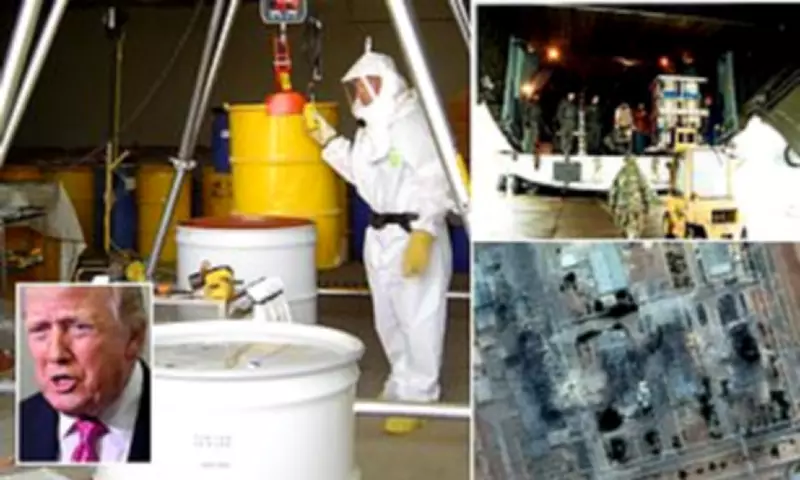
Trump Weighs High-Stakes Military Operation to Seize Iran's Nuclear Material
President Donald Trump is reportedly evaluating a highly complex and potentially explosive military plan to deploy US special operations forces deep inside Iranian territory. The objective would be to capture and remove Iran's stockpile of enriched uranium, a move that could dramatically escalate the ongoing conflict and drag American troops into hostile territory for days or even a full week.
Stealth Mission Targeting Nuclear Sites
According to US officials, the covert operation would target approximately 1,000 pounds of enriched uranium stored at one or two nuclear facilities in Natanz and Isfahan. The primary goal is to completely eliminate Iran's pathway to developing nuclear weapons by removing the radioactive material from their control. The proposal remains under review, with Trump yet to give final approval, but sources indicate he is seriously considering this option despite warnings from advisers about the significant dangers to American forces and the potential for broader regional conflict.
Military experts describe this as one of the most challenging missions the United States could undertake. American forces would likely need to penetrate heavily defended territory, potentially facing Iranian air defenses and drone attacks, before securing the nuclear sites believed to contain the material. Once on the ground, combat troops would establish perimeter security while specialist teams locate, secure, and prepare the uranium for transportation.

Logistical Challenges and Extended Timeline
Retired General Joseph Votel, former commander of US Central Command and US Special Operations Command, emphasized that "this is not a quick in and out kind of deal." The uranium is believed to be stored in multiple hardened locations, including underground facilities at Isfahan and Natanz that have previously been targeted in strikes. The material is likely contained in 40 to 50 specialized cylinders requiring careful handling and shielding during transport.
Richard Nephew, a senior research scholar at Columbia University and former US nuclear negotiator with Iran, explained that these containers would need to be placed into protective casks and moved using multiple trucks before extraction. If no suitable airfield is available, US forces might need to construct a temporary one, further extending what analysts estimate could be a several-day to week-long operation.
Military Buildup Across the Region
The Pentagon has already positioned substantial forces in the Middle East, underscoring how seriously this option is being considered. Several hundred US special operations troops, including Army Rangers and Navy SEALs, have arrived in the region, joining thousands of Marines and Army paratroopers. While these commandos haven't been assigned specific missions yet, they could be deployed across multiple flashpoints: safeguarding the Strait of Hormuz, assisting in potential operations to seize Kharg Island, or participating in missions targeting Iran's nuclear infrastructure.
Approximately 2,500 Marines and 2,500 sailors have recently arrived, along with about 2,000 troops from the Army's 82nd Airborne Division. In total, more than 50,000 US troops are now positioned across the Middle East—about 10,000 more than usual—spread across bases and ships in countries including Saudi Arabia, Bahrain, Iraq, Syria, Jordan, Qatar, the United Arab Emirates, and Kuwait.
Diplomatic Alternatives and Competing Pressures
Behind the scenes, Trump has instructed advisers to pressure Iran to voluntarily surrender the material as part of any negotiated end to the conflict. According to sources familiar with his thinking, the president has made clear that Iran "can't keep" the uranium and has discussed taking it by force if diplomacy fails. During recent remarks, Trump referred to the material as "the nuclear dust," highlighting its centrality to his strategy.
White House press secretary Karoline Leavitt emphasized that no final decision has been made, stating: "It's the job of the Pentagon to make preparations in order to give the commander-in-chief maximum optionality. It does not mean the president has made a decision."

Defense Secretary Pete Hegseth signaled that the US is prepared for multiple scenarios while still hoping for a diplomatic resolution. "The president has kept his eye focused on nuclear capabilities," Hegseth said at a Pentagon briefing. "We have a range of options, up to and including Iran deciding that they will give those up, which of course we would welcome."
Strategic Waterway and Economic Stakes
The potential operation comes as Trump faces competing pressures: avoiding a prolonged war while achieving his stated goal of preventing Iran from developing nuclear weapons. Officials say the president wants the conflict resolved within weeks, not months, and has privately expressed reluctance to commit to a drawn-out ground engagement.
Diplomatic channels involving intermediaries such as Pakistan, Turkey, and Egypt remain active, though no direct Washington-Tehran negotiations have occurred. If Iran agrees to surrender its uranium, US officials say the need for a risky military mission could be avoided entirely, echoing past operations in Kazakhstan and Georgia where nuclear material was removed without combat.
The Strait of Hormuz has become a focal point of the confrontation, with the narrow passage—through which roughly one-fifth of global oil supply typically flows—partially closed by Iran, sending oil prices skyrocketing. Trump has referred to the waterway as the "Strait of Trump" in recent comments and discussed potentially seizing Iran's oil infrastructure, specifically mentioning Kharg Island.
Trump has set an April 6 deadline for Tehran to accept a deal or face strikes on its energy sector, claiming indirect talks via Pakistani intermediaries are "going very well." He stated that a deal "could be soon" while revealing that 20 more oil tankers were set to pass through the Strait of Hormuz as what he called a "sign of respect."
As the situation develops, global markets remain on edge, with Brent crude surging above $116 a barrel amid the uncertainty. The coming weeks will determine whether diplomacy prevails or the United States embarks on one of its most dangerous military operations in recent history.