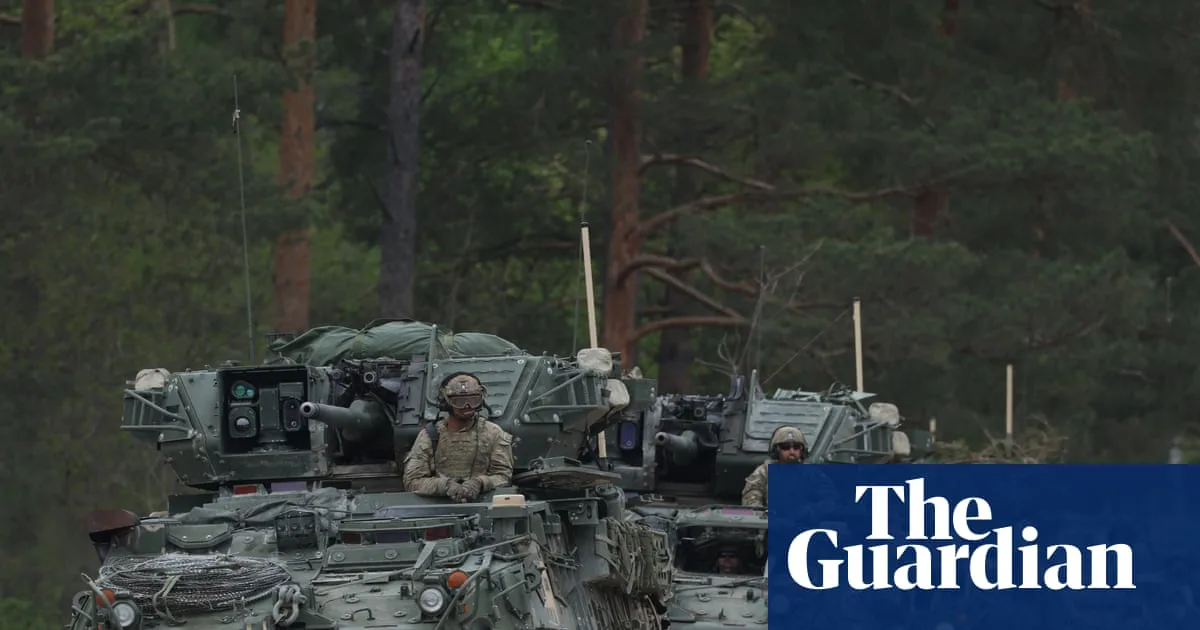
President Donald Trump has announced the surprise deployment of 5,000 additional US troops to Poland, just weeks after vowing to dramatically cut America's military presence in Europe. The decision, posted on Truth Social, was based on his relationship with Poland's newly elected President Karol Nawrocki, a nationalist ally whom Trump publicly endorsed.
Reversal of Pentagon Plans
The announcement appeared to reverse recent Pentagon plans to reduce US troop numbers in Europe by at least 5,000, amid growing complaints from the White House that NATO allies are not doing enough for their own defence or to support the Iran war. As of last week, some 4,000 troops from the Army's 2nd Armoured Brigade Combat Team, 1st Cavalry Division were no longer en route to Poland. The cancelled deployment was part of an effort to comply with Trump's order to reduce the number of troops in Europe, according to reports. A deployment to Germany of personnel trained to fire long-range missiles also was halted.
Democrats and Republicans alike criticised the reductions as sending the wrong signal both to allies and Russian President Vladimir Putin during the war in Ukraine.
Reactions from Officials
Republican Representative Don Bacon of Nebraska said during a congressional hearing that he spoke with Polish officials and they were 'blindsided'. He called the decision 'reprehensible' and said it was 'an embarrassment to our country what we just did to Poland'. Chief Pentagon spokesman Sean Parnell said it was 'a temporary delay' of the deployment of US forces to Poland, which he called a 'model US ally'. He said it was a result of the US reducing the number of brigade combat teams assigned to Europe from four to three and indicated the Pentagon still needed to decide which troops to station where.
NATO chief Mark Rutte welcomed Trump's announcement, saying alliance military commanders were now 'working through all the details'. 'Of course, I welcome the announcement,' the secretary general told reporters ahead of a meeting of NATO foreign ministers in Sweden.
Sweden's Foreign Minister Maria Malmer Stenergard conceded that the messaging from Washington was 'confusing indeed, and not always easy to navigate'. She insisted the priority for Europe was to 'continue to invest in our own defence and our own capabilities'. 'We need the US to stay involved, but it's also natural that as we ramp up, they also reduce a little of their presence in Europe,' she said.
Estonia's top diplomat Margus Tsahkna echoed her message, saying Europe needed to do more while stressing that any US drawdown on the continent must be properly coordinated. 'My message as well to US partners is let's do it in more coordinated ways,' he said. 'That's the reason why we are gathering today here as well, to talk face to face.'
Confusion and Uncertainty
It was not clear whether the brigade would resume its deployment to Poland, if additional troops on top of that rotational deployment could be added, or whether there would still be a drawdown of US troops in Europe, but from a different country. On Friday, US defence officials expressed confusion about Trump's new announcement. 'We just spent the better part of two weeks reacting to the first announcement. We don't know what this means either,' said one official.
US Defence Secretary Pete Hegseth and Defence Under-Secretary Elbridge Colby both spoke with their Polish counterparts this week. Polish Prime Minister Donald Tusk said he was happy to hear 'Washington's declaration that Poland will be treated as it deserves'. As of Tuesday, US General Alexus Grynkewich, commander of both American and NATO forces in Europe, told reporters in Brussels that 'it will be 5,000 troops coming out of Europe'.
Trump's announcement came as Secretary of State Marco Rubio was on his way to Sweden to meet with his NATO counterparts, who have been questioning the Trump administration's policies on reduced US troop levels in Europe. 'There seems to be no process to deliberating policies like troop withdrawals and deployments at the top,' said Ian Kelly, a retired career diplomat who served as US ambassador to Georgia during the Obama and first Trump administrations and now teaches international relations at Northwestern University in Illinois. Mr Kelly said Mr Rubio may have a tough time explaining the US president's wild swings to Europeans who are craving certainty and consistency, even if they might disagree. 'These are not well-thought-out decisions,' Mr Kelly said. 'These are impulsive decisions based on Trump's whims or what his advisers think are Trump's whims.'






