
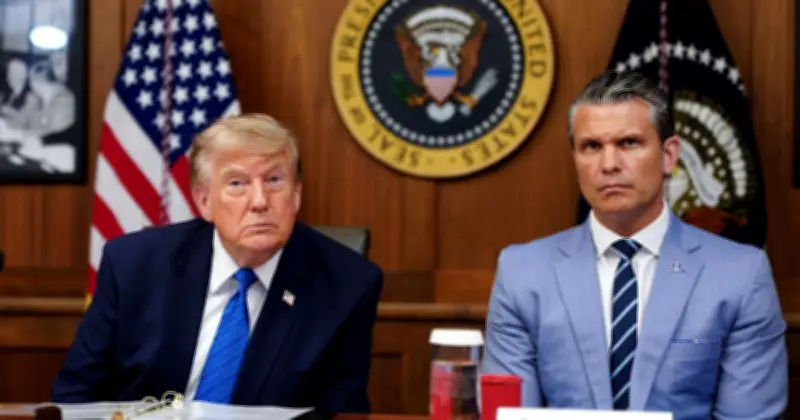
Reports from the United States detail turmoil at the heart of the American administration, with Donald Trump allegedly dressing down Secretary of Defence Pete Hegseth over the country's dwindling missile supplies. The US president is reportedly furious at the low levels of long-range guided missiles and air-defence interceptors, restricting the military's ability to launch operations in Iran.
Missile stocks critically low
Trump claimed this week that he had ordered, before cancelling, "the biggest attack since World War II" to allow another round of peace talks. But according to the Washington Post, there was another reason: America's missile cupboards are looking worryingly bare.
For all the bluster from Trump on Truth Social that "large amounts are being manufactured and shipped to the U.S. as needed," the reality is that it is difficult, even for a country with the manufacturing capabilities of the US, to keep pace with a conflict that has seen more than 1,000 Patriot and Terminal High Altitude Area Defense (THAAD) systems fired as well as more than 850 Tomahawk cruise missiles.
No quick fix
Patriot missiles can take as long as two years to make, meaning that there will be no quick-fix to the United States' woes. A lack of munitions and air defence is evidently a problem for strategic planners overseeing the war in Iran which is dragging on into its sixth month.
It will limit the offensive capabilities on offer to commanders, it will pose a greater risk of loss of American life and it raises the possibility (although still remote) of pilots being tasked with flying bombing sorties due to the inability of launching long-range strikes.
Global ramifications
The ramifications will also be felt beyond the Middle East. Ukraine has relied heavily on western supplies of ATACMs to enable it to launch attacks deep into Russia, targeting supply routes, logistic nodes and oil refineries that would otherwise be out of range. If Washington is forced to husband its own stocks, Kyiv will inevitably feel it.
Whether through Trump's refusal to listen to military advice or the willingness of those around him to filter out unwelcome assessments, the outcome is the same: once again, Vladimir Putin stands to benefit from decisions taken in Washington.
Taiwan and superpower status at risk
The bigger question is what Beijing makes of all this. The Iran war blunder threatens the country's status as the world's pre-eminent superpower. For decades, US military and financial might has been the only thing preventing China from satisfying its most extreme urges on Taiwan. The delicate balance relies on the United States having the capability to defend the island by force if required.
Trump promised to end America's wars, not start new ones. Instead, he has embroiled the United States in a conflict that has consumed scarce munitions without delivering a decisive military or political outcome. In allowing stockpiles of long-range missiles to deplete to such an extent that the country might not be able to pivot to other theatres for as long as it is embroiled in Iran, the US administration has placed Taiwan and its global leader status in jeopardy.
That does not mean an invasion of Taiwan is suddenly around the corner. It does mean that one of America's greatest strategic advantages—its ability to deter crises before they begin—has been weakened.
Trump will blame Hegseth, Hegseth will blame someone else but the fish rots from the head. Donald Trump's enthusiasm for war has got the country stuck in a quicksand it might not be able to remove itself from.




