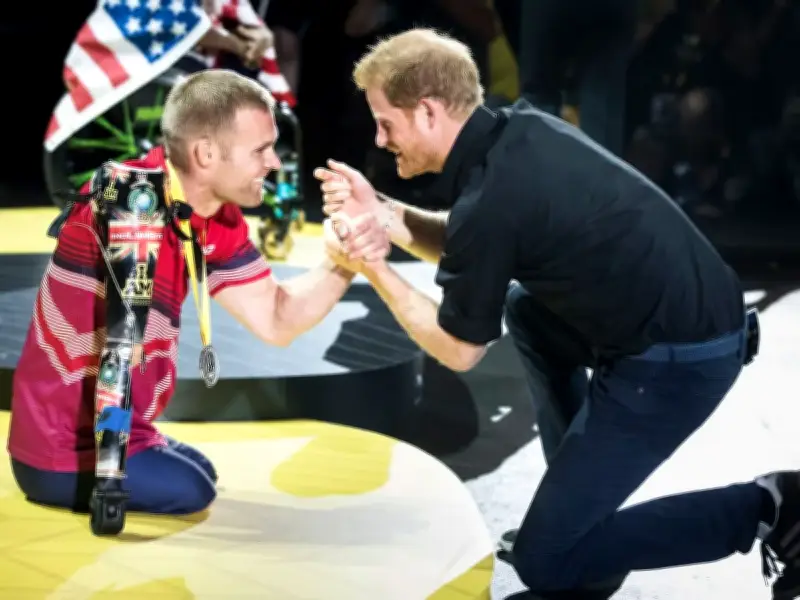
Mark Ormrod MBE, the UK's first triple amputee to survive the battlefield, is calling for a dedicated service to help struggling veterans get the urgent help they need. The former Royal Marines Commando believes support for the estimated one million ex-services personnel coping with physical and mental health issues should be co-ordinated in a central hub.
Dad-of-three Mark, 43, who is Britain's most decorated Invictus Games athlete, was injured in Afghanistan when an IED exploded in the early hours of Christmas Eve, 2007. He was out on a routine foot patrol in the Helmand Province when he took position and knelt on an improvised explosive device, losing both his legs and his right arm above the elbow.
Survival against the odds
Mark was the UK's first triple amputee to survive the Afghanistan conflict. He was classed as dead on the battlefield but medics were alerted when his eyelids started to flutter. Incredibly, he survived. "I shouldn't be here, I should have been dead," he previously said. He was told by doctors that he would never walk again and should prepare himself for the rest of his life in a wheelchair.
However, Mark learnt to walk again with the aid of specialist prosthetic limbs and went on to become one of the biggest champions of the Invictus Games. After leaving the marines, he ran 3,530 miles across America to raise money for military charities in July 2010. In 2012, he was an Olympic torchbearer and later that year hand-cycled 3,000 miles around the UK in a month.
Call for a central hub
Mark, who also featured in the documentary 'Heart of Invictus', said he received help from some "great" charities but also had to search for help himself after his devastating injuries. "There is a lot of support out there but it is often bewildering for a struggling veteran to connect with the right help. That must change because too many of them are suffering," he says.
"There should be a dedicated service with a website that acts as an umbrella for all the veterans' support out there. It needs to be made as accessible and easy as possible for someone to take that first step so there are less barriers to entry, less friction and less reasons not to get the help they need."
Government support and Remembrance
Many veterans experience problems after leaving the service, with studies identifying that 300 to 400 veterans spend some time sleeping rough and up to 4,000 need urgent accommodation support every year. The government is extending its support with a £50 million roll out of its VALOUR scheme designed to give veterans and their families easier access to healthcare, jobs and housing.
Mark, from Plymouth, Devon, who has raised £500,000 for charity through a series of physical challenges, says: "Asking for help is one of the bravest things a veteran, or anyone, can do. It is not a sign of weakness but of strength. It is an incredibly powerful thing to do and the nation should have a more connected and co-ordinated way of coming to their aid when they do ask for help."
Mark has launched his call as the nation comes together to recognise the sacrifices of generations through wars with acts of Remembrance. "It is a source of pride that it is still a hallowed date in the calendar," he says. "We need to ensure it stays that way. We mustn't falter. Every generation should know what those before them went through but continued moving forward. There is a huge message of remembrance but also one of resilience."
Mark, who joined the Royal Marines as a 17-year-old and served in the Iraq War and in Afghanistan, adds: "I lost a couple friends during tours, so that's the thing that always comes to mind the most on Remembrance Day. But it is also a time to step back and reflect on what the generations before me did."