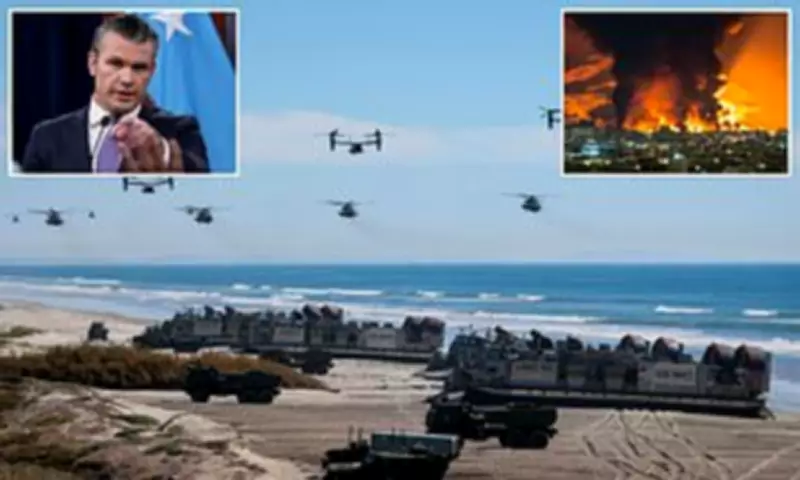
Defence Secretary's Covert Middle East Visit Coincides With Iran Invasion Planning
US Defence Secretary Pete Hegseth has confirmed undertaking a secret, unannounced trip to undisclosed military locations within the Middle East. This revelation comes amidst growing intelligence reports suggesting former President Donald Trump is actively preparing to authorise a comprehensive ground invasion of Iran.
Surprise Inspection of US Central Command Forces
During a Pentagon press briefing held on Tuesday morning, Hegseth disclosed that he visited American service members stationed within the US Central Command operational area over the preceding weekend. The Defence Secretary deliberately refused to identify the specific bases he toured, citing operational security concerns to prevent them from becoming potential targets for Iranian forces.
'The trip was an honor. I had a chance to bear witness, and I witnessed the best of America. I witnessed warriors, a brotherhood of men and women, warriors all,' Hegseth stated emotionally. 'Active duty guard and reserve, united in their love for each other, their shared purpose and their commitment to the mission...I witnessed sheer competency.'

Hegseth emphasised that the visit was completely unexpected for the troops, who had no prior knowledge of his planned inspection. 'It was not rehearsed or scripted. Sometimes we just wandered,' he explained. 'What I witnessed was motivation. It was sheer mission focus. It was the American warrior unleashed.'
Pentagon Prepares for Potential Ground Campaign
This clandestine diplomatic mission occurs against a backdrop of significant military preparations. Multiple reports indicate the Pentagon is actively planning for extended ground operations within Iranian territory, potentially lasting several weeks and involving the deployment of thousands of US Army soldiers and Marine Corps personnel.
Military strategists suggest that both special operations forces and conventional infantry units could be mobilised if the presidential decision is made to escalate the ongoing conflict. When pressed by journalists on Tuesday regarding the potential deployment of American ground troops to Iran, Hegseth remained strategically ambiguous.
'You can't fight and win a war if you tell your adversary what you are willing to do or what you are not willing to do to include boots on the ground,' he asserted cryptically. Hegseth further elaborated: 'Our adversary right now thinks there are 15 different ways we could come at them with boots on the ground. And guess what? There are.'
Strategic Calculations and Regional Escalation
According to intelligence sources, Trump has reportedly signalled a potential willingness to conclude the Iran conflict without necessarily forcing the reopening of the strategically vital Strait of Hormuz. The President previously issued stark threats to bombard Iranian infrastructure targets, including power plants, oil facilities, desalination plants, and Kharg Island, unless the critical waterway was opened immediately.
However, reports from the Wall Street Journal suggest Trump has privately informed advisors he would consider withdrawing from the conflict even if the strait remains blockaded. Such an American exit without securing the strait's reopening would likely cement Tehran's control over this essential global oil transit route, deferring any complex military operation to reopen it to a future date.
The geopolitical situation has intensified following recent American airstrikes targeting an ammunition depot in Isfahan, believed to house portions of Iran's enriched uranium stockpile. Satellite imagery from NASA indicates explosions occurred near Mount Soffeh, a region known to contain military installations. Videos circulating show substantial fireballs and secondary detonations characteristic of ammunition igniting, though Iran has not formally acknowledged the assault.
Simultaneously, regional violence persists into the conflict's fifth week, highlighted by an Iranian drone strike on a massive Kuwaiti oil tanker anchored in Dubai. Trump publicly shared footage of the US strike on Isfahan via his Truth Social platform, displaying 2,000-pound bombs creating dramatic explosions against the night sky, though he provided no accompanying operational details.

Military analysts note that Iran's strategy of disrupting shipping through the Strait of Hormuz has proven relatively economical, relying primarily on drone attacks and explosive-laden suicide boats. Isfahan itself represents a significant strategic location, housing one of three uranium enrichment sites previously targeted by US forces during the twelve-day war between Iran and Israel in June of the preceding year.