
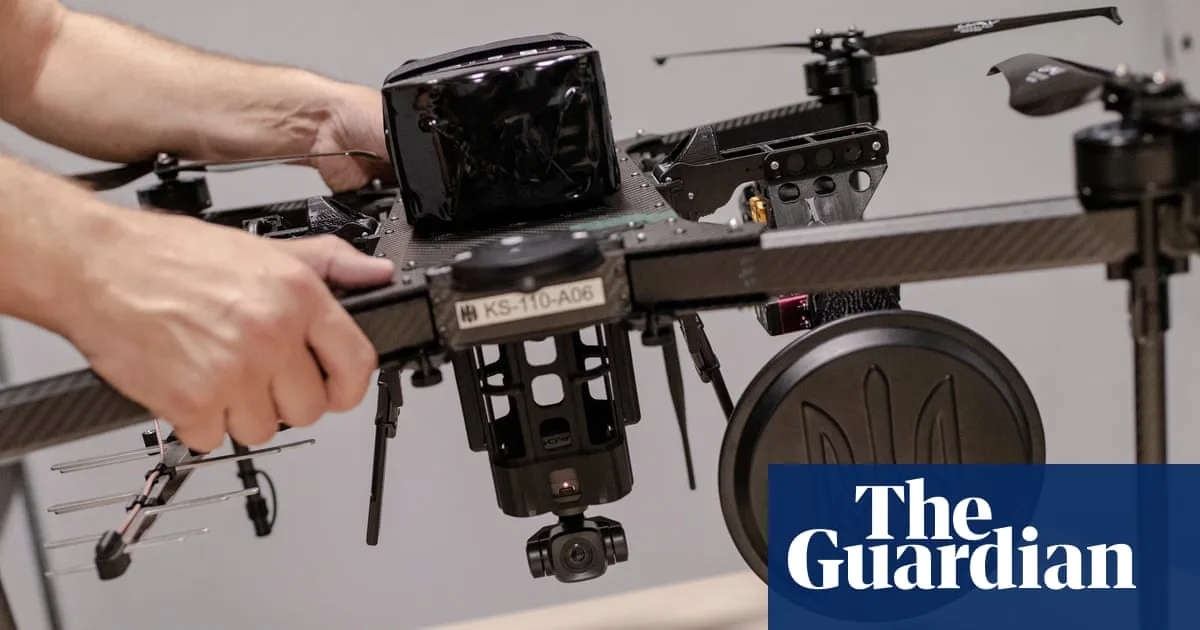
On a June morning, Ukrainian forces launched a fixed-wing drone called the Gogol-M, which flew 200km into Russian airspace before releasing two attack drones from its wings. These smaller drones, operating autonomously, scanned the terrain below, locked onto a target, and detonated on impact. Human operators had only specified the target type and search area, leaving the final decision to the onboard artificial intelligence.
The entire system, comprising the reusable mothership and its two suicidal attack drones, costs just $10,000 (£7,500) and can cover up to 300km, with the attack drones extending 30km further. According to Andrii, a designer at the Ukrainian company Strategy Force Solutions, this dramatically undercuts traditional missile systems, which can cost between $3m and $5m for a comparable strike. He claims that with adequate funding, hundreds or thousands of these drones could be produced monthly.
The innovation is partly a response to battlefield pressures. Operation Spiderweb, in which 117 Ukrainian drones struck Russian airbases on 1 June, relied on terminal guidance software that allowed drones to fly autonomously in the final mile when Russian jamming severed control links. A shortage of US missiles, a lack of trained drone pilots, and the effectiveness of Russian electronic warfare have all accelerated the shift towards greater autonomy. Viktor Sakharchuk of Twist Robotics, which says it produced Ukraine's first autonomously guided combat drones, notes that no technology remains effective for more than three months before countermeasures emerge.
Ukrainian officials openly embrace the trend. Deputy Prime Minister Mykhailo Fedorov, who oversees the country's 'tech war' effort, says Ukraine is training AI models to recognise and prioritise targets, with full autonomy still a work in progress. He confirms that unannounced autonomous drones are being tested, potentially capable of forming swarms, though technical hurdles remain.
Meanwhile, the global race intensifies. The Pentagon's Replicator 1 programme aims to field thousands of autonomous systems by August 2025, and China is reportedly developing the Jiu Tian mothership drone, which can carry up to 100 autonomous drones over a 4,000-mile range. The conflict in Ukraine has thus become a proving ground for inexpensive, scalable autonomous weaponry with far-reaching implications for security worldwide.




