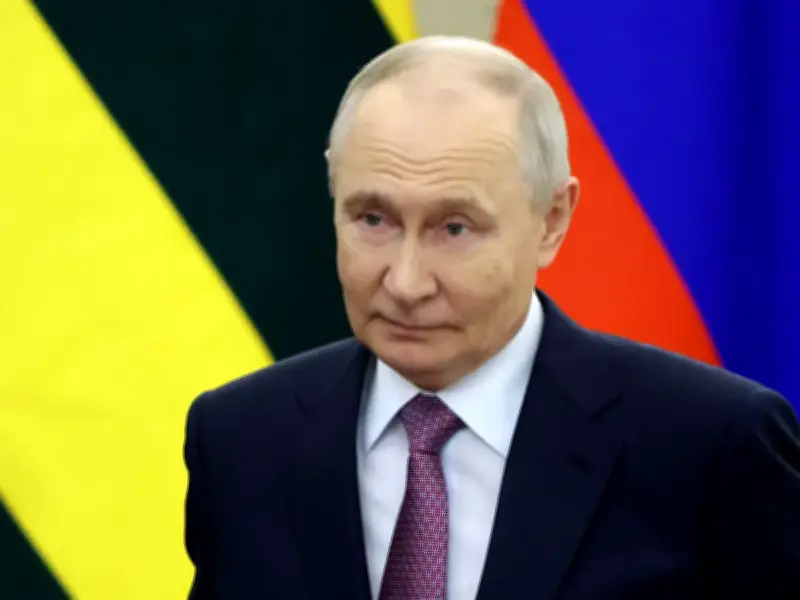
Russian President Vladimir Putin is reportedly reconstructing a top-secret facility designed for a nuclear war. Codenamed Facility 1335, the underground bunker is guarded by machine gun turrets carved into the granite mountainsides of the Urals.
Russia is pouring hundreds of millions of dollars into upgrading tunnels and command centres, according to reports. An investigation by the Dossier Centre, Danwatch and The Sunday Times has revealed the scale of the project, once believed to be abandoned at the end of the Cold War.
Investigation reveals modernised nuclear systems
Dmitrii Sukharev, from the Dossier Centre, told an Australian news outlet that the investigation paints a grim picture of Russia's new nuclear powers. "There are several revelations, including the extent to which Russia's nuclear weapons systems have been modernised," he said. One such example is the complex's ability to survive the bunker-busting bombs used by the US in the Iran war.
It appears that the regime never abandoned its military ambitions post-Cold War. "Since Soviet times, the Kremlin has continued to invest huge sums of money into the modernisation of nuclear weapons," Mr Sukharev said.
Facility 1335 and the Dead Hand strategy
Facility 1335 is the cornerstone of the Kremlin's "Dead Hand" strategy that developed from nuclear tensions in the 1980s. The facility is designed to backup control channels to mobilise missile launchers if communication were lost with the Kremlin's long-wave radio signals.
Australian National University (ANU) emeritus professor of strategic studies Paul Dibb said there is only one target. "It sends a code to Moscow, and if it doesn't hear back, that means the leaders are dead," he said. "So it unloads whatever nuclear missiles were left to wipe out the United States."
Massive construction effort documented
Moscow has transported massive volumes of heavy excavation machinery, rock-drilling equipment, steel, piping and cabling to the secret mountain site, according to procurement records from 2018. The project has used about 20,000 tonnes of steel, millions of litres of fuel and vast quantities of gas, while ventilation systems and specialised air filtration equipment have also been sent underground to protect occupants from contamination.
"We don't fully understand the true capabilities of this system," said Mr Sukharev. "What's clear is that it's designed for the event of a nuclear attack on Russia." He added: "I hope that no one would ever think of using nuclear weapons. In today's world, it makes no sense. There are no winners in a nuclear war."