
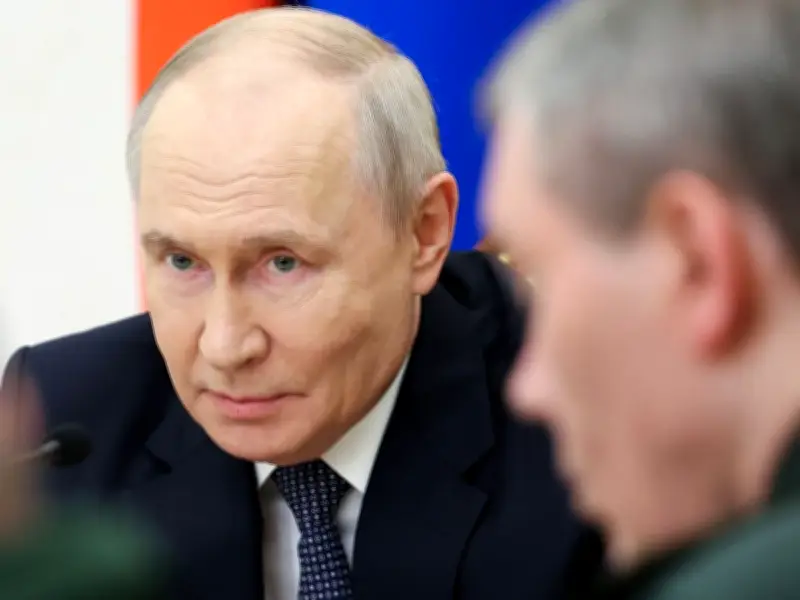
US intelligence officials have warned that Vladimir Putin could send troops to attack a NATO member as early as this autumn in an attempt to test the military alliance's resolve, according to a report from the Wall Street Journal.
Washington has long assumed Russia would never attack a NATO ally while preoccupied with the invasion of Ukraine. But that assumption has shifted due to a shortage of troops, slow frontline progress, and daily Ukrainian attacks inside Russian borders, which have turned the tide of the conflict and pressured Putin in unprecedented ways.
Possible threats and targets
In response, Putin may try to attack or occupy a country on NATO's eastern flank to split resources and fracture the alliance's Article 5 commitments, which require collective defense of any attacked member.
Citing unnamed US officials, the WSJ reports possible threats range from a cyberattack on a NATO country or sending unmarked armed groups to occupy territory, to a limited incursion on the alliance's eastern flank. Countries such as Estonia, Latvia, and Georgia are thought to be at serious risk, while territory in Poland near the Russian exclave of Kaliningrad could also be targeted.
Munitions shortages and warnings
The report also notes Washington faces a shortage of critical munitions, depleted by its war with Iran. Stockpiles of long-range and short-range missile systems, including Patriot and THAAD interceptors, remain critically low.
“The numbers do not lie,” NATO’s Allied Joint Force Command Brunssum said in a post. According to US intelligence assessments, a Russian move could occur anytime between this autumn and 2029.
Echoes from officials
Last month, Russian opposition politician and chess grandmaster Garry Kasparov told Polish media: “I think the chances are growing because Putin needs a winning narrative and Ukraine doesn't offer it.” Lithuanian President Gitanas Nausėda warned: “I cannot deny that we have such information and that it concerns kinetic operations. Not on a large scale, but targeted kinetic operations that are very likely to be directed against critical infrastructure.”
Lithuania's Defense Minister Robert Kaunas said: “We have data that Russia is considering unconventional kinetic attacks on critical infrastructure in the Baltic region. Russia is likely to use Ukrainian production drones to do so.”
The news follows recent probing attacks on NATO-affiliated countries, including Russian drone incursions into Romanian territory and increased Russian military presence near Finland's border. Lieutenant General Christian Freuding, head of Germany's army, told Politico: “All 32 NATO partners agree that Russia might have the capability to invade a NATO partner country in 2029. 2029 is not a German timeline. It’s NATO-agreed intelligence.”




