
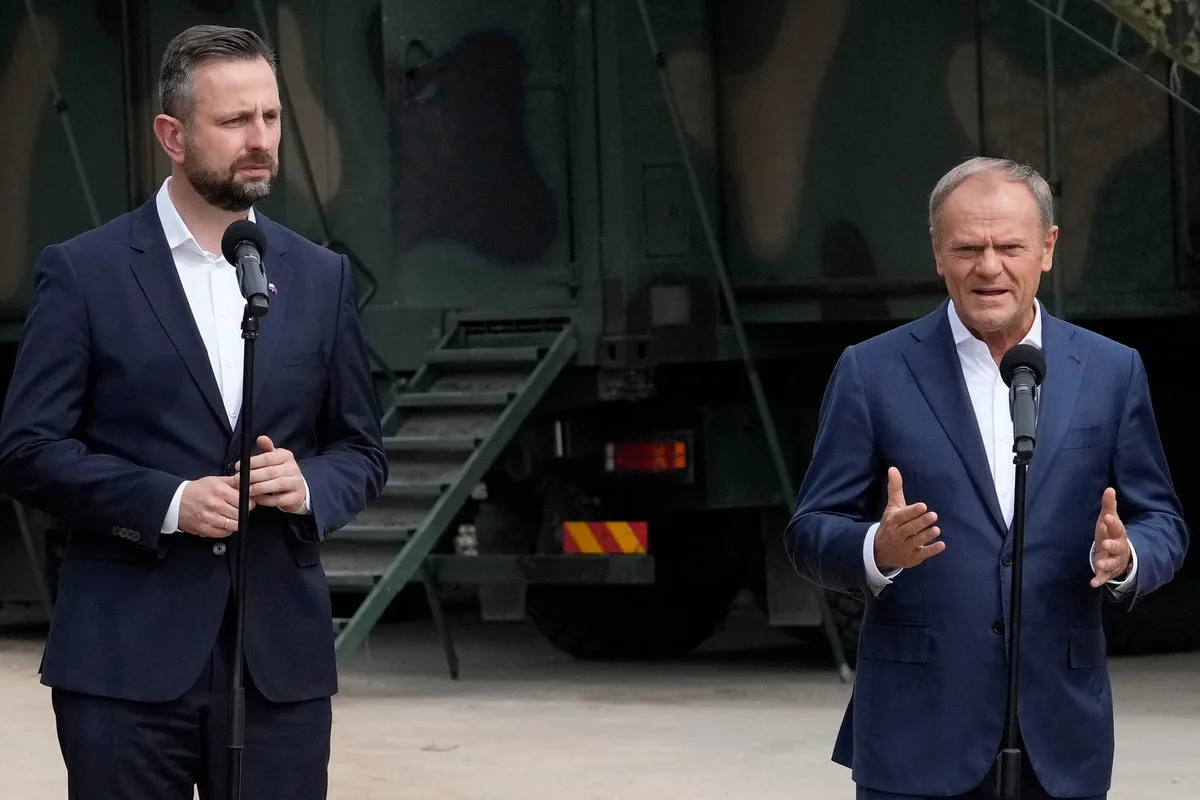
Polish officials on Wednesday welcomed U.S. statements clarifying that the decision not to deploy 4,000 troops to Poland was a temporary measure. The Polish government had reacted with disbelief last week upon learning that the 2nd Armored Brigade Combat Team, 1st Cavalry Division would no longer be deployed as planned to the country bordering Ukraine.
On Tuesday night, chief Pentagon spokesperson Sean Parnell described the move as a “temporary delay” and called Poland a “model U.S. ally.” He attributed the delay to a reduction in the number of brigade combat teams assigned to Europe from four to three, requiring a reassessment of troop placements. Vice President JD Vance also disputed that the U.S. was reducing troop levels, calling it a “standard delay in rotation.”
Polish Prime Minister Donald Tusk said he was happy to hear “Washington’s declaration that Poland will be treated as it deserves.” Defense Minister Władysław Kosiniak-Kamysz, who spoke with Defense Secretary Pete Hegseth on Tuesday night, said the new statements mean that “U.S. presence is maintained.” He added that a rotating model could change into a permanent one, which would be “much better.” Around 10,000 U.S. troops are typically stationed in Poland, mostly on a rotational basis.
Polish officials said they were told they would be involved in discussions about the reorganization of U.S. troops in Europe. The U.S. did not specify how long the delay would last, and Kosiniak-Kamysz said he hoped for clarification in the coming weeks. However, Tusk warned that Europeans should be under no illusion about Washington’s determination to reduce its military presence and the need for Europe to fill the gap.
NATO Secretary-General Mark Rutte said on Wednesday that allies have known for a year that the Trump administration would withdraw some troops from Europe, and it expects Europe and Canada to take greater responsibility for conventional defense. He said the U.S. “will stay involved” but could pivot resources elsewhere. The Trump administration has warned that Europe must look after its own security, including Ukraine’s, in the future.




