Pentagon Explores Anti-Drone Laser Deployment to Secure Residences of Hegseth and Rubio
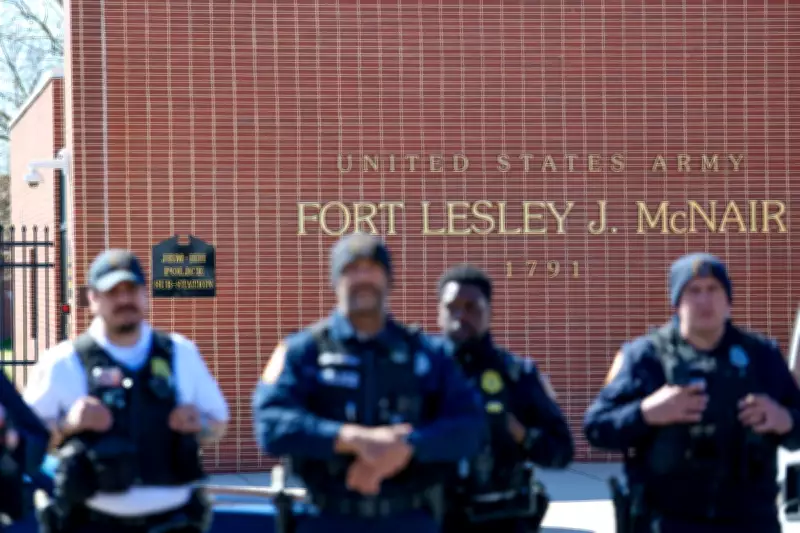
According to a recent report, the Pentagon is actively investigating the possibility of installing advanced anti-drone laser technology at a military installation in Washington D.C. This base, Fort Lesley J. McNair, is notably the residential location for prominent figures Pete Hegseth and Marco Rubio. The consideration emerges amidst escalating tensions and ongoing conflict with Iran, highlighting heightened security concerns for senior government officials.
Sources Reveal Security Discussions and Drone Incidents
Four informed sources, who spoke to The New York Times on condition of anonymity, disclosed that the powerful laser systems are under serious review at Fort Lesley J. McNair in Southwest Washington D.C. This development follows a series of unsettling incidents earlier this month, where multiple "unidentified" drones were observed hovering over the McNair base. These sightings prompted an immediate security review and even led the White House to contemplate relocating Hegseth and Rubio, although neither individual was ultimately moved.
The military is maintaining vigilant surveillance over potential threats to high-ranking government personnel as the war in the Middle East persists. However, The Washington Post reported that the origin of the drones that breached the airspace remains unknown, adding a layer of complexity to the security challenges. Officials noted that multiple drone sightings occurred within a two-week period, catalyzing a White House meeting to formulate an appropriate response strategy.

Airspace Regulation Challenges and Past Incidents
Deploying anti-drone lasers near Fort McNair would introduce significant complications for airspace regulation in and around the capital. The systems have already been a point of contention between the Federal Aviation Administration (FAA) and government authorities. For instance, last month, airspace over El Paso, Texas, was temporarily closed after border officials mistakenly targeted a party balloon with a laser, believing it to be a Mexican cartel drone.
FAA operations in the D.C.-Metro area are under intense scrutiny following a tragic midair collision last year between an Army helicopter and a passenger jet near Ronald Reagan National Airport, which resulted in 67 fatalities. This context underscores the delicate balance between enhancing security and managing air traffic safety.
Heightened Force Protection Levels and Broader Security Concerns
The reported evaluation of anti-drone lasers at McNair coincides with several domestic military bases elevating their force-protection levels to "Charlie." This designation is implemented when commanders possess intelligence suggesting a possible attack. Notably, Joint Base McGuire-Dix-Lakehurst in New Jersey and MacDill Air Force Base in Florida, which houses U.S. Central Command overseeing operations against Iran, were both escalated to Charlie earlier this month.
The only higher alert level than Charlie is "Delta," which indicates an attack is imminent or has already occurred. In a related incident on March 9, a substantial number of "unauthorized drones" were detected flying over Barksdale Air Force Base in Louisiana. This base is home to long-range B-52 bombers capable of carrying nuclear weapons, and the event triggered a lockdown. Barksdale, the second largest airfield in the U.S. Air Force with a fleet of over 40 B-52 bombers and a population of approximately 15,000, exemplifies the widespread security apprehensions.
The Department of Defense has been contacted for confirmation and comment on these reports, but no official statement has been released at this time. The integration of anti-drone laser technology represents a proactive measure to safeguard critical personnel and infrastructure, yet it also raises questions about operational feasibility and regulatory harmony in densely populated urban areas.